
FLARE Magazine Interview: Kim Nelson & Adam Seelig on S—/W—

S—/W—: CanCon True-Crime With an All-Female Cast

“Staging it with women gives women a chance to take back the story that’s about them,” according to Smyth/Williams star Kim Nelson
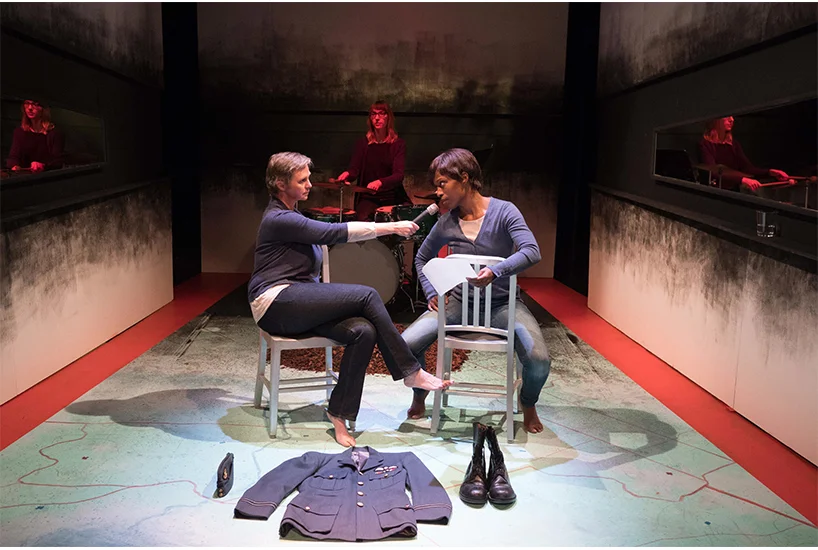
ACTOR DEBORAH DRAKEFORD, DRUMMER LYNETTE GILLIS AND ACTOR KIM NELSON MAKE UP THE ALL-FEMALE CAST OF THIS NEW TRUE-CRIME PLAY, SMYTH/WILLIAMS (PHOTO: YURI DOJC)

ACTOR DEBORAH DRAKEFORD, DRUMMER LYNETTE GILLIS AND ACTOR KIM NELSON MAKE UP THE ALL-FEMALE CAST OF THIS NEW TRUE-CRIME PLAY, SMYTH/WILLIAMS (PHOTO: YURI DOJC)

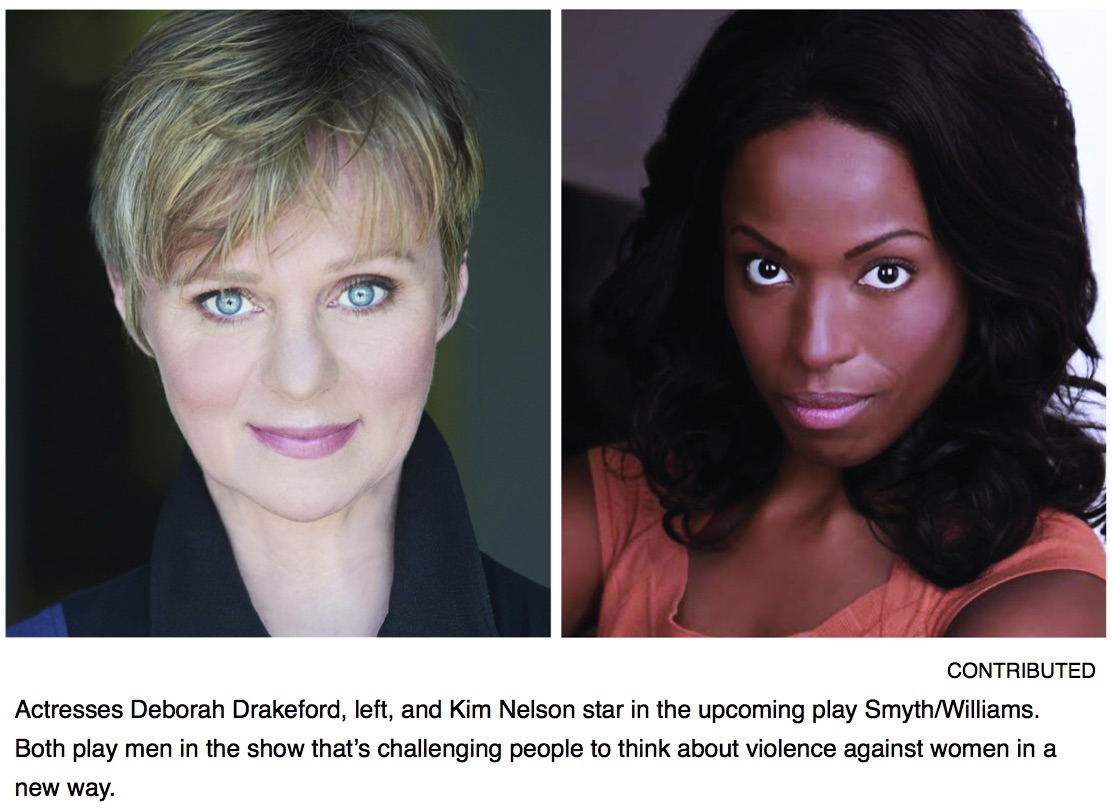
By Erika Graham, March 3, 2017 — A new Canadian true-crime play called Smyth/Williams is staging the real-life police interview that led to the confession of serial killer Russell Williams—with two women, one of whom is a person of colour. In the 2010 interview, former Canadian Forces Colonel Russell Williams admitted to the sexual assault and killings of two women and describes, in haunting detail, how he did it. Canadian actors Kim Nelson and Deborah Drakeford (one of NOW Magazine’s Top 10 Theatre Artists of 2016) alternate reading the eerie transcripts from the perspectives of both OPP Detective Jim Smyth and Williams. According to Nelson, the concept behind the constant switching of characters was originally because it was so difficult for one actor to read all of Williams’ words out loud.

Friends and family members of Williams’ victims have already come forward to try and put an end to the show, saying it is insensitive to sensationalize an event that was so traumatic for them. But, according to the show’s director, Adam Seelig, the purpose of the show is to empathize with the victims and their families and to incite change. FLARE sat down with Nelson and Seelig to discuss what’s it’s been like working on a play that’s rooted in tragedy and controversy, and how an all-female cast has allowed these women “to take back the story that’s about them.”

What was your response when you first heard about the concept for Smyth/Williams?
Kim: There was a little hesitation. It’s a hard subject because of wanting to be cognizant of the families and their pain. But at the same time, it’s important for me to take more active steps in terms of not just sitting back and seeing these injustices being committed and then just forgotten. There’s a really great quote that I had read: “art that ignores violence, abandons the victims.” There are a lot of things this case stirred up that need to be talked about and addressed. For that reason, I thought it was important to be a part of the project and to be able to help.

All the transcripts and video footage from the Russell Williams interview are available online to the public. What is the significance of telling the story through theatre?
Kim: The thing is, YouTube you watch alone in your room, right? Theatre allows us to experience this in a communal way, collectively, to share whatever feelings arise. Hopefully the show will surround us with empathy and a feeling of safety—that we have people who we can experience this with and share this with. Hopefully that safety allows us not only to admit to whatever vulnerabilities it brings up, but also work together towards ways of preventing these things from happening again.

Were there any discoveries you made while working on the project that surprised you?
Kim: I was surprised by how much anxiety it actually brought up in me and how much fear [I had] of my lack of security in the world. I literally found myself sometimes at home terrified that someone would break in. Unfortunately, I have had an experience in my 20s where someone broke into my apartment and went through my underwear drawer [an act Williams confesses to in the transcripts]. So, things like that came up. My feeling of security as a woman walking in the world—the idea that those forces that are supposed to protect me [high-ranking officers like Williams] aren’t always there to protect me. They might be the ones to hurt me. Let’s not hide it. I’m also a black woman, so that makes me more visible. It brought up a lot of anxiety that was really hard to work through but at the same time it made me realize how important it is to speak about it. And to put it out in the open, because dealing with that alone can be mind-numbing sometimes.

Can you pinpoint specific elements of the transcript that brought out those insecurities?
Kim: First of all, the people that you would normally call to protect you—the people who are out there to defend you—are the ones you’re afraid of. Already, that is just like, what? That’s terrifying. Just thinking about that violation of your intimacy, coming into your space and putting on your clothes [Williams confessed to stealing women’s clothes from their homes and performing sexual acts while wearing them]… It’s entering your skin! It’s that taking-on of your experience and your self. That’s a terrifying thing to think about.

What do you think is the significance of an all-female cast?
Kim: Staging it with women gives women a chance to take back the story that’s about them, right? To discuss it and also create a safe space for the audience to be able to maybe view this story in a less directly violent way and give them the space to reflect—just to feel, to feel what this does for us as a society.

How has it been embodying a male character?
Kim: Personally, I haven’t really thought about it as embodying a male character. It’s just been more about the psyche of the person saying what they’re saying. We all have male and female energies, right? So it’s trying to see where these two individuals were as they were saying these words, in a more psychological fashion. One of the things about this is that it’s not really a play, per se. Ninety-nine per cent of what we’re doing is reading from the transcript. We didn’t want to dramatize what happened. We’re not looking to sensationalize it in any way. The real idea is sharing in the experience of what happened so that we can start a conversation. We have to say the words, which is hard enough. Oddly enough, when we first did it, the idea was so that no one should have to read all of Williams’ words, just because there’s just so many emotions that it brings up to have to speak those words. But at the same time, reading Smyth’s words is very hard as well. Thinking of someone that has a clear moral compass ,having to listen to these words and still have to remain very open in order to continue his work, is hard. Just the words: there’s no way to escape the emotions.

Does Smyth know about the play?
Adam: Yes, he does.

Some of the friends and family members involved in actual the case has reached out and said they don’t want the play to be mounted. What’s kept you going?
Adam: This may have been seven years ago and it may be, technically, part of Canadian history but it is something that is still an open wound for so many people. It’s one that is very much a national trauma that we haven’t really had an opportunity to discuss in an empathic forum. This is a major responsibility that we feel to have that compassionate conversation surrounding this material, this subject and specifically this transcript.

Kim: It’s not in spite of the family’s reactions that we’re doing this. On the contrary, we’ve tried to be very empathetic. What they’ve gone through is horrendous. We also have to bear in mind that trauma that happens to one person doesn’t just happen to one person. We saw that it happened to a community, we saw that it happened to a country. It happens within the human fabric. We all feel the repercussions of trauma. We don’t feel it as intensely as the victims or their families, but there is something. When an injustice is done to one person, everyone feels it. We need to start being able to step back and look at our personal responsibility and what we can do to try to heal that trauma, or at least prevent that trauma from happening to someone else. If we can start talking about it, then hopefully we can start working towards that.

What are you hoping audiences take away from Smyth/Williams?
Adam: Bearing witness to a trauma that has taken place. From the Holocaust and Hiroshima, to 9/11 and École Polytechnique, forgetting is very dangerous for our society.
S—/W— Review: Mooney on Theatre

S/W— brings cold, hard facts to Toronto’s Theatre Passe Muraille

In 2010, Russell Williams was arrested for two rape-murders, and other counts of sexual assault, confinement, and breaking and entering. One Little Goat Theatre Company’s Smyth/Williams playing at the Theatre Pass Muraille Backspace is a dramatization of the transcript of Williams’s interrogation by — and subsequent confession to — OPP Detective Jim Smyth.

It is infuriating, nausea-inducing, and exhausting, sitting on the uncomfortable line between a necessary performance and giving an unnecessary platform to a man who doesn’t deserve our attention.

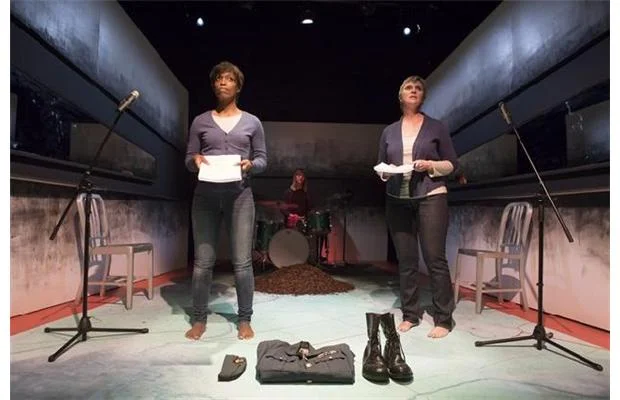
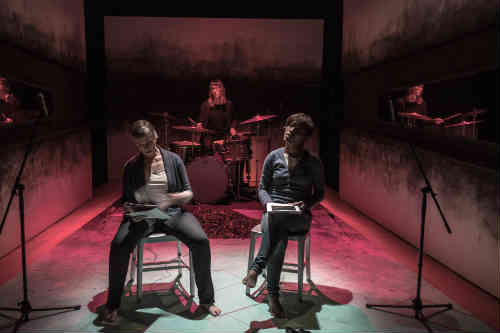
Kim Nelson and Deborah Drakeford read the transcript, switching back and forth between Smyth/Williams as the facts of the case slowly and painfully unfold. They are joined on stage by Lynette Gillis, a drummer, whose thundering percussion illustrates entire censured sections of the text.

This is not a performance you can take lightly. Nelson and Drakeford present their roles with a cool confidence that, combined with the simple set-design of an off-kilter interrogation room by Jackie Chau and an eerie lighting design by Laird Macdonald, fills you with dread.

Everything in this show is inevitable. We already know that Williams was convicted. We can look up the interrogation online. And that’s what makes that dread so much worse. I was sitting in that theatre thinking, it’s hopeless. There’s nothing you can do as you listen to the interrogation unfold. What good is it, now? I wondered, near tears and feeling sick as Drakeford — playing Smyth — presents Nelson with the incontrovertible evidence of Williams’s role in the murders.

My guest loved the fact that women were front and centre, taking the words of a predator and murderer and turning it into a call to action. In fact, that appears to be director Adam Seelig’s goal, to subvert the sexual violence Williams embodies. In the program the company argues the show “raises awareness of, and challenges the toxic culture underpinning sexual violence against women and girls.”

Does it, though? While I think there’s a ton of merit in what I saw, I don’t know if you can subvert the words of predators like this because, sadly, it feels like it gives them what they want: they get the stage and the victims get side-lined.

Smyth/Williams works to disparage the violence. Drakeford and Nelson all but drip contempt as they detail aspects of the case, but who is hearing it?

Is this staging for the women in the audience who already experience the violence? Is it for the men who want to speak out? Is it for the audience that will never see a show like this because it challenges them?

I think One Little Goat handled the material wonderfully but there’s no easy answer to these questions, no guarantees subversion will actually subvert and not reinforce the status-quo. The risk inherent in this particular text makes for an incredible show.

There was a silence in the theatre as the actors left the stage. Maybe everyone was waiting for them to reappear for their bows, but it didn’t feel that way. There were no wayward, awkward claps, no gentle murmuring between couples; just dead silence.

Details


  • Smyth/Williams plays until March 12, 2017 at the Theatre Passe Muraille Backspace (16 Ryerson Ave.)
  • Shows run Wednesday to Saturday at 7:30pm and Sundays at 2:00pm
  • Tickets are $25 general admission, $20 for seniors, students, and arts workers; matinees are $15
  • Tickets can be purchased by phone at 416-504-7529, at the Theatre Passe Muraille Box Office 4 hours before the performance, or online here
  • Contains mature subject matter including graphic discussions of sexual assault and murder.

Photo of Deborah Drakeford, Lynette Gillis, and Kim Nelson by Yuri Dojc

Canadian Press Article & Video on 'S—/W—'

Creative team seeks to 'reflect on endemic misogyny'

Left to right: Kim Nelson, Lynette Gillis, Deborah Drakeford in One Little Goat's S—/W—

Left to right: Kim Nelson, Lynette Gillis, Deborah Drakeford in One Little Goat's S—/W—

By Lauren La Rose, The Canadian Press - TORONTO, March 1, 2017 – The creative team behind a controversial new play based on the police interrogation of convicted sex killer Russell Williams says they’re coming from a place of empathy.

“Smyth/Williams,” which debuts Friday in Toronto, is a reinterpretation of the lengthy, intense 2010 interview between Williams and Ontario Provincial Police Det. Sgt. Jim Smyth, in which the disgraced former military commander confessed to his crimes, including the murders of 37-year-old Cpl. Marie-France Comeau and 27-year-old Jessica Lloyd.

The 90-minute play features an all-female cast, with Kim Nelson and Deborah Drakeford alternating roles during the show.

The actors stand behind microphones at opposite ends of a sparsely decorated set while they read from the interview transcript. A folded military jacket and combat boots sit centre stage as a dividing line.

“We feel so much for these (victims’) families and what they’ve gone through, but we aren’t trying to sensationalize,” says Nelson. “That’s kind of the reason of sticking to the transcript and not bringing a lot of drama and (our) own interpretation to it.

“What we were hoping to do is create an empathic space where this material could be dealt with, and to help us all reflect on the endemic misogyny right now that exists in our culture — the sexualized culture we live in.”

Joining the duo onstage is Lynette Gillis, whose role as a live drummer is to play through the swaths of text redacted from the police transcript, says director Adam Seelig.

“From the very beginning of conceptualizing this production, it was very important that women’s voices be at the centre of it; that women’s voices subvert the male voices that are being represented here and start to control them,” he says.

“Just maybe having women speak it, it’s a more safe space for the audience to hear the words and to be able to more openly reflect on the piece,” adds Nelson, “and on the underlying causes of this misogyny and this violence against women.”

Once a rising star in the Canadian Forces, Williams was sentenced to life in prison in October 2010 after pleading guilty to the murders and 82 fetish break-and-enters and thefts, as well as two sexual assaults.

The production has faced sharp criticism and calls for its cancellation. Kirsten Walkom, a close friend of Lloyd and her family, told The Canadian Press in a January interview: “We need to stop sensationalizing violence against women and we’re not doing ourselves any favours in pretending this is entertainment.” An online petition argues the production forces families and friends to relive the horror of their loss publicly and calls for One Little Goat Theatre Company to reconsider staging the play.

The show’s venue, Theatre Passe Muraille, said in a statement that its role is to “provide a space where artists can freely express their opinions and explore the subject matter that compels them.”

Seelig says the creative team feels “a tremendous amount of responsibility” in telling the story onstage. “We’re doing our very best with it, and really, we do understand that it is difficult material,” he says.

“We’re hoping through the theatre that we can find a way rather than to not talk about it, to talk about it empathically. Rather than, let’s say, the way that the media will present facts dispassionately, to try to present these facts as compassionately as possible.”

For the the video version of this article, click here.
Smyth/Williams runs March 3-12, 2017 at Theatre Passe Muraille Backspace. For more click here.

Metro News on SMYTH / WILLIAMS

Metro News, Jan 25, 2017

Play based on Russell Williams' interrogation advocates for women's rights

Theatre production featuring an all-female cast will hit Toronto stage this March

Serial killer Russell Williams’ police interrogation and subsequent confession is about to hit the stage in Toronto — told by a female cast of two through a feminist lens.

One Little Goat Theatre Company will premiere Smyth/Williams, a play based on the transcripts from the cross-examination of the embattled former military star now serving a life sentence.

The play’s goal is to highlight an issue that’s becoming more urgent in our society: Violence against women and girls.

“This problem is becoming endemic, especially in the military,” said artistic director Adam Seelig, noting a 2015 report from retired Supreme Court justice Marie Deschamps, which showed a woman in the military is five times more likely to be sexually assaulted than a civilian.

But the problem is also prevalent in other structures within society, he said.

“Look at the misogynist rhetoric coming from politics south of our border,” he said, commending last weekend’s Women’s March on Washington and others around the world. “We can’t just let the rights of women be trampled on.”

The play – which uses its female cast to “subvert the male dominance” – is an attempt to use an “extreme case” to convey a message, said Seelig.

The play is set around interviews of Williams conducted by OPP Det. Staff Sgt. Jim Smyth. They detail what happened in two rape-murders for which Williams was eventually convicted.

Actresses Deborah Drakeford and Kim Nelson alternate playing both Smyth and Williams.

Seelig said the unsettling material is intended to make people more aware of the violence.

“It’s a disturbing case, and we hope it communicates directly and strongly with our audience,” he said. “Everyone has to know that it’s our responsibility to end this issue.”

Smyth/Williams runs March 3-12, 2017 at Theatre Passe Muraille Backspace. For more click here.

CBC News on SMYTH / WILLIAMS

CBC News, Jan 23, 2017

Toronto theatre to stage play based on interview of killer Russell Williams

One Little Goat Theatre Company to use an all-female cast for the production

A Toronto-based theatre company is developing a play based on the intense police interrogation in which convicted sex killer Russell Williams confessed his crimes.

One Little Goat Theatre Company plans to premiere Smyth/Williams in March, with an all-female cast that will alternate the roles of the interrogating officer and Williams through the performance.

The company's artistic director, Adam Seelig, says he first got the idea for the play in 2010, when Williams' case and his confession to Ontario Provincial Police Det. Sgt. Jim Smyth was making headlines.

Seelig says he was amazed at the time by Smyth's ingenuity and chilled by Williams' matter-of-fact confessions to heinous crimes — all strong material for a theatrical performance.

But Seelig says he only moved to make the play a reality after noticing what he called a recent urgency around the issue of violence against women, particularly against women in the military.

Williams, once a rising star in the Canadian Forces, was sentenced to life in prison in October 2010 after pleading guilty to the murders of two women — 37-year-old Cpl. Marie-France Comeau and 27-year-old Jessica Lloyd.

The former commander of Canada's largest military airfield also pleaded guilty to 82 fetish break- and-enters and thefts as well as two sexual assaults.

Seelig acknowledges that a play based on Williams' confession to horrifying crimes deals with disturbing material.

But he said current discourse around violence against women, and the recent dialogue around women's rights in the aftermath of the U.S. presidential election, makes the play particularly relevant.

"Now is the time to look at what I will call truly tragic violence," Seelig said. "I would agree with the people who say it is hard, it's heavy, it's difficult, but it is necessary to look at it, to examine it, to raise awareness about it if we're ever going to have any chance of understanding it and curbing it."

The majority of the lines in the play will be taken directly from a transcript of Smyth's interrogation of Williams, Seelig said.

Having the actors in the play alternate roles between Williams and Smyth was also a deliberate decision to ensure a single performer was not over-burdened by playing the sadistic criminal, Seelig said.

"For one person to take on Williams and to say what Williams says is almost too much for a person who feels deeply, and most actors do," he said. "Part of it is to distribute the weight."

Williams came under police suspicion in February 2010 after officers stopped him at a roadside canvass after Lloyd went missing. Officers noticed the distinctive tires on his Nissan Pathfinder, similar to the treads they'd found near Lloyd's Belleville, Ont., home.

The military commander came in for questioning and eventually caved under Smyth's masterful interrogation techniques.

Williams methodically chronicled and catalogued his crimes, shooting videos and still photos of himself in the act and amassing a huge collection of undergarments stolen from women and girls.

The Canadian Forces stripped him of his rank after his conviction and, in a rare move, burned his uniform.

Smyth/Williams runs March 3-12, 2017 at Theatre Passe Muraille Backspace. For more click here.