Hear what the critics and audiences are saying about Music Music Life Death Music: "Seelig manages to impress and surprise once again” —Toronto Star…
Read moreVideo Release: Sneak Preview of MUSIC MUSIC LIFE DEATH MUSIC
See what we've been working on in rehearsals for MUSIC MUSIC LIFE DEATH MUSIC, opening May 25, 2018 in Toronto! Video featuring Richard Harte, Sierra Holder, Theresa Tova and Jennifer Villaverde.
Read more"THE SOUND'S THE THING: ONE LITTLE GOAT'S ADAM SEELIG" IN THE WHOLENOTE MAGAZINE

“I think of poetic theatre as “aural”; it’s about the words, the impact of the sounds.” Music Music Life Death Music creator Adam Seelig speaks to the WholeNote’s Jennifer Parr about the upcoming world premiere.
Read moreMEDIA RELEASE FOR ONE LITTLE GOAT'S "MUSIC MUSIC LIFE DEATH MUSIC"
For Immediate Release: March 28, 2018 • Please include in your listings/announcements
“Toronto’s enterprising One Little Goat Theatre Company” - New York Times
PRESENTS THE WORLD PREMIERE OF
MUSIC MUSIC LIFE DEATH MUSIC
AN ABSURDICAL
WRITTEN, DIRECTED AND COMPOSED BY ADAM SEELIG
STARRING RICHARD HARTE, SIERRA HOLDER, THERESA TOVA AND JENNIFER VILLAVERDE
LIVE BAND LED BY MUSIC DIRECTOR TYLER EMOND
MAY 25 TO JUNE 10, 2018 AT TARRAGON EXTRASPACE
TORONTO – One Little Goat Theatre Company, producer of the acclaimed Ubu Mayor and The Charge of the Expormidable Moose, presents the world premiere of MUSIC MUSIC LIFE DEATH MUSIC: An Absurdical. The show is written, directed and composed by Adam Seelig, and features original, live music and a stellar artistic team of multi-Dora Award nominees and winners, including actors Richard Harte, Theresa Tova, Jennifer Villaverde, and introducing Sierra Holder. MUSIC MUSIC LIFE DEATH MUSIC runs from May 25 to June 10, 2018 at the Tarragon Extraspace (media night May 25).
An exploration of the unexpected dynamics between three generations of family—a grandmother, her daughter, son-in-law, and teenage grandson—MUSIC MUSIC LIFE DEATH MUSIC is a biting comedy with an original, catchy score depicting a family’s attempt to relate to each other, and the society they live in.
“Every family is ludicrous in its own way,” says author Adam Seelig, “and I’m excited to see how this particular family’s idiosyncratic blend of love and contempt, tenacity and fragility, trust and suspicion, joys and frustrations all play out on stage, with music.”
The production features a diverse, all-star cast including Richard Harte (Andrew Lloyd Webber'sThe Boys in the Photograph, One Little Goat's Antigone:Insurgency, Ubu Mayor); Theresa Tova (NOW Magazine Top Theatre Artist of 2017, Tough Jews, The Jazz Singer); Jennifer Villaverde (Soulpepper's Animal Farm, Dora Nominee for YPT's Hana's Suitcase); and introducing Sierra Holder (Sheridan College, Class of 2018).
Writer, director and composer Adam Seelig is the founder and Artistic Director of One Little Goat Theatre Company. He is the author of Every Day in the Morning (slow) (New Star Books, finalist for the 2011 ReLit Award in poetry) and his plays include Ubu Mayor (BookThug 2014), Talking Masks (BookThug 2009), Antigone:Insurgency (2007) and, for children, PLAY: A (Mini) History of Theatre for Kids (Toronto 2016-18).
The production also features live musical performances by renowned Canadian musicians, led by Music Director Tyler Emond on bass (2007 Oscar Peterson Prize), and includes Joshua Skye Engel on guitar (Eat A Peach), Lynette Gillis on drums (Overnight), and Adam Seelig on a vintage Fender Rhodes electric piano.
Performances are at the Tarragon Extraspace, 30 Bridgman Ave, Toronto, Ontario. To purchase tickets please visit www.onelittlegoat.org or call 416-531-1827. Performances run from Tuesday to Saturday at 8pm, and Sunday matinées at 2:30pm. Tickets range from $20 - $35.
FOR MORE INFORMATION OR TO REQUEST INTERVIEWS:
B-Rebel Communications - Ashley Belmer – Ashley@ashleybelmer.com, 514-627-5151 –
Press Photos
ABOUT ONE LITTLE GOAT:
One Little Goat is North America’s only theatre company devoted to contemporary poetic theatre. Founded in New York in 2002, and based in Toronto since 2005, the company is acclaimed for its highly interpretive, provocative approach to international plays. One Little Goat's productions have been staged in Toronto, Philadelphia, Chicago and New York, where the company opened La MaMa's 49th season in 2010 – the final season led by the legendary Ellen Stewart. For more details www.onelittlegoat.org.
AUDITIONS FOR ONE LITTLE GOAT'S "MUSIC MUSIC LIFE DEATH MUSIC"
AUDITION NOTICE – ONE LITTLE GOAT THEATRE COMPANY – TORONTO
Production name: MUSIC MUSIC LIFE DEATH MUSIC: An Absurdical
Deadline to submit: January 15, 2018
Audition date: week of January 22, 2018
Email applications to: OneLittleGoatTC at gmail.com
Contact name: Adam Seelig
Website: http://onelittlegoat.org/about/
“Toronto’s enterprising One Little Goat Theatre Company” (New York Times) is holding auditions for the world premiere of MUSIC MUSIC LIFE DEATH MUSIC: An Absurdical by Artistic Director Adam Seelig (Executive Producer, Derrick Chua; Assistant Producer, Annie MacKay).
Synopsis: DD and JJ’s romantic night at home is interrupted when B (DD’s mother) arrives unannounced, waking up PP (DD and JJ’s teenage son). MUSIC MUSIC LIFE DEATH MUSIC follows the unexpected dynamics between these four characters representing three generations of family.
Dates: performances May 25 - June 10, 2018 at the Tarragon Theatre Extra Space; rehearsals April 30, 2018 onward (precise schedule tbd).
We are seeking actors of the highest calibre with excellent singing abilities for the following roles - actors of all vocal ranges and cultural backgrounds welcome:
- DD: a woman (age 40-50, any vocal range, any ethnicity)
- JJ: a man, DD’s spouse (age 40-50, any vocal range, any ethnicity)
- B: a woman, DD’s mother (age 65-75, any vocal range, any ethnicity)
- PP: a boy, DD and JJ’s son (age 14-15, any vocal range, any ethnicity)
Note regarding the role of PP: only actors aged 16+ will be considered; the role may be played by an adult man or woman who can play a teenage boy.
Please submit résumé and headshot by email to Adam Seelig, Artistic Director, OneLittleGoatTC at gmail.com by 5pm, Monday, January 15, 2018. *Optional: if available, please forward a link to a sample of your singing abilities.
Only Equity (CAEA) members will be considered, except for the role of PP who can be played by a CAEA or non-CAEA actor. Only those selected for an audition will be contacted. Actors will be engaged under a form of Equity policy.
One Little Goat is North America’s only theatre company devoted to contemporary poetic theatre. Acclaimed for its highly interpretive, provocative approach to international plays, One Little Goat consistently features leading Canadian theatre artists. MUSIC MUSIC LIFE DEATH MUSIC is the company’s second play-with-music for mature audiences (the first was UBU MAYOR by Adam Seelig, starring Michael Dufays, Richard Harte and Astrid Van Wieren).
10,000 kids experience One Little Goat's "PLAY: A (Mini) History of Theatre" thanks to Ontario Trillium Foundation
For Immediate Release: Toronto, June 29, 2017
Ontario Trillium Foundation grant enables 10,000 elementary students in Toronto Model Schools for Inner Cities to experience One Little Goat Theatre Company’s PLAY: A (Mini) History of Theatre for Kids

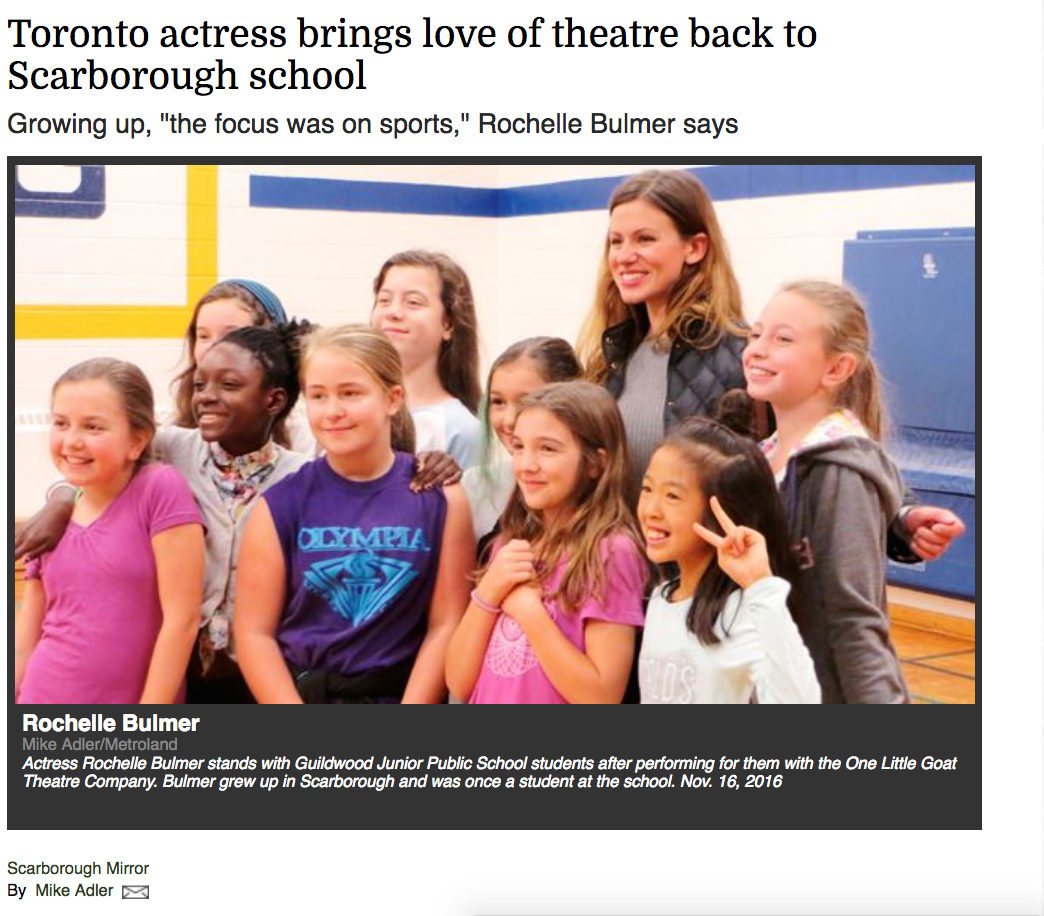
Thanks to a year-long $34,800 Seed grant from the Ontario Trillium Foundation, made in June 2016, “Toronto’s enterprising One Little Goat Theatre Company” (New York Times) has performed the company’s first play for young audiences for 10,000 elementary school students. This completes the company’s tour of 39 of the Toronto District School Board’s Model Schools for Inner Cities, begun last fall and performed at no charge to the schools.
“I am always pleased to see arts programming offered to children in Ontario schools who might not otherwise have the opportunity to engage. Thanks to OTF, thousands of elementary school students in the TDSB’s Model Schools for inner cities can actively participate and learn from One Little Goat Theatre Company’s play – and hopefully many of them will choose to further engage in the arts.” – Peter Milczyn, MPP for Etobicoke-Lakeshore


Written and directed by One Little Goat’s Artistic Director Adam Seelig, PLAY: A (Mini) History of Theatre for Kids makes the case that dramatic play is rooted in childhood games, empowering children as natural-born play-makers. Actors Richard Harte (above right, masked) and “Mavis-the-Sometimes-Cat” (Jessica Salgueiro, above left, alternating with Rochelle Bulmer, below right) are featured in a performance that guides Grades 1-6 audiences through four distinct periods of drama: Early Beginnings: games around the fire; Ancient Greek Tragedy: Antigone by Sophocles; Japanese Noh Theatre: Zeami and 14th-Century Noh; Modern Theatre: Alfred Jarry, Gertrude Stein and Samuel Beckett.

“Sharing with young audiences some of the greatest moments in theatre, from the intensity of Ancient Greek tragedy to the absurdity of 20th-century modernism, is tremendously rewarding,” says Seelig. “All the learning, listening and laughing we do together in these gym performances, made possible by the Ontario Trillium Foundation, will contribute to the kids’ lifelong love of, and participation in, the arts.”
An agency of the Government of Ontario, the Ontario Trillium Foundation is one of Canada’s largest granting foundations. With a budget of over $136 million, OTF awards grants to some 1,000 projects every year to build healthy and vibrant Ontario communities. www.otf.ca
Now in its 11th year, the Model School for Inner Cities program identifies 150 schools throughout Toronto with a large concentration of students living with limited resources, and aims to provide them with the opportunities they need to participate fully and equally in their schools and communities.

One Little Goat, North America’s only company devoted to contemporary poetic theatre, “has done audiences a huge service” (Toronto Star) through its highly interpretive, provocative approach to new and international plays. For over a decade, the company's Canadian and world premieres have garnered praise from the New York Times, Globe and Mail, CBC and others. One Little Goat is a non-profit charity based in Toronto: www.OneLittleGoat.org
One Little Goat gratefully acknowledges the following organizations in addition to the Ontario Trillium Foundation for their support in developing PLAY: the Canada Council for the Arts, Ontario Arts Council, Toronto Arts Council, TD Bank, Irish Cultural Society of Toronto, Embassy of Ireland in Ottawa, and Friends of One Little Goat Theatre Company.
- 30 -
Contact: One Little Goat Theatre Company, 416.915.0201, info@OneLittleGoat.org
S—/W— Review: The Slotkin Letter

l-r Deborah Drakeford, Lynette Gillis, Kim Nelson (photo: Yuri Dojc). At the Theatre Passe Muraille Backspace, Toronto
Adapted and directed by Adam Seelig
From the Ontario Provincial Police Transcripts of the interview of Detective Jim Smyth with Colonel Russell Williams and his connection to crimes (rape, murder, breaking and entering) in the Belleville, Ottawa area.
Set and costumes by Jackie Chau
Lighting by Laird Macdonald
Sound by Tyler Emond
Cast: Deborah Drakeford, Kim Nelson
Drums by Lynette Gillis
Devastating, gripping, compelling theatre acted and directed beautifully. What theatre is for — to inform, instruct and to hold a mirror up to show us who and what we are, good and bad.
The Story. On February 7, 2010, Detective Jim Smyth of the Ontario Provincial Police interviewed Colonel Russell Williams about his involvement in multiple crimes including two rape-murders, two other rapes, breaking and entering that occurred in the Belleville and Ottawa areas. The interview lasted about four and a half hours. Williams’ confession and details about the crimes lasted several more hours. For the purposes of the theatre, Adam Seelig, the director of the piece has adapted the transcripts into a 90 minute verbatim production. The words, including the stammers, unintelligible words and pauses, are all included.
The Production. Jackie Chau’s set is impressive. In front of the back wall is a drum set for Lynette Gillis who will add drum riffs at strategic points in the production. In front of that is a mound of earth perhaps suggesting a grave. The walls of the set are painted in such a way as to create a sense of perspective. A section of mirrored glass is on either wall. There are two utility chairs on either side of the set. The script is on either chair (and I believe on a stand at the back for Lynette Gillis). A pair of military boots are neatly placed downstage along with a military hat and a folded military jacket. There are two standing microphones on either side of the stage.
When the production begins Lynette Gillis sits behind her drums. Deborah Drakeford and Kim Nelson enter and give us the background. Yes, women will be playing the parts of Jim Smyth and Colonel Russell Williams. When the performance begins it becomes clear that both actresses will also be playing both parts at one time or another in the performance. Their body language is clear when each is playing Smyth or Williams.
Drakeford holds up the spiral-bound script indicating the official seal of the Ontario Provincial Police at the top of the page. This confirms the actual verbatim text we are about to hear. When there are components of the text that the police did not want anyone to read or hear that section is blacked out on the page, redacted. Those redacted parts are indicated in the performance by Lynette Gillis who drums during those sections. If the redacted section is short, a musical cue is played. Initially the drumming for a redacted section is rhythmic. One is almost tempted to tap one’s toe to the rhythm. But as the production progresses and redacted parts become longer, the drumming is aggressive, cacophonous, not as rhythmic but very precise in suggesting anger and aggression. It’s as if the drumming is projecting the audiences’ feelings perhaps. That drumming becomes another character; the stuff not said.
While the actresses hold the scripts for the most part, this is not a strictly read performance. The work has been memorized except in a few cases. The interrogation begins with Deborah Drakeford playing Smyth and Kim Nelson playing Williams. There are pleasantries, an offer of coffee and Smyth commenting that he would treat Williams with respect and expected that the treatment would be returned. Nelson sits in the chair, legs spread like a ‘typical guy.’ Her replies are short, unemotional and almost always given without hesitation. There is confidence here, but not arrogance. There is no attitude. Drakeford quietly walks around Williams’ chair asking the questions, full of curiosity, interest. When the information the OPP has that puts Williams at the site of one of the crimes is slowly revealed, Nelson replies without fear but her eyes reveal a bit of concern.
The sections describing heinous crimes are read simultaneously by both actresses in as cool a manner as can be. The words do the talking and communicating without imposing emotion.
Director Adam Seelig has directed this with sensitivity and restraint. The staging captures the meticulous detail in Smyth’s careful interrogation of Williams—slowly pacing behind him when he was questioning Williams. Williams in turn replying as an accomplished military man, meticulous in his planning as well. It’s a cat and mouse game by two accomplished players. Seelig brings all that out while being mindful of the unsettling details of the story.
In the end, both actresses walk upstage; acknowledge their drumming colleague; turn to the audience, put their hands over their hearts and leave to total silence. I can’t recall such total silence at performance as my audience for this one. Not a cough, not a rustle of a program, not a fidget in the seat. Total silence. And there was no applause when the lights came up. Shattering.
Comment. The production started out entitled: Smyth/Williams and close to the first performance the title was changed to S–/W– with the rest of the names of Smyth Williams whited out. Whatever it’s called, it’s a compelling, chilling, unsettling piece of theatre about heinous crimes to women done by a man.
From the statement in the program: “… we urgently feel that, as citizens and artists, it is our responsibility to bear witness to these atrocities, never allowing them to be forgotten, and identifying them as part of a nation-wide epidemic of sexual assaults targeting women and girls. With S–/W—we are confronting the attitudes and norms that enable such violence. “
The intention is noble and important. By using only the words of the interrogation and confession we get some sense of how a decorated and accomplished man such as Russell Williams could do such horrible crimes. We get an equally good idea of the meticulous planning for the interrogation that Detective Smyth used to catch Williams and made him confess.
But the choice of doing this show has been met with angry protest on Facebook, Twitter, and other forms of social media. A woman who was a childhood friend of one of the murdered women was interviewed on CBC radio saying she felt the victims were being exploited by this production and that she didn’t think it was art. She had never actually seen the production but was voicing her negative opinion of it nonetheless.
On opening night some protesters were invited into the theatre lobby (it was cold outside and the house management of Theatre Passe Muraille are kind) to hand out a sheet of explanation for their concerns about the play. This was peaceful too.
The sheet of explanation though well intentioned in respecting the memories of the dead women and those others Williams abused, believes that the play is being disrespectful to Williams’ victims. It is not. I’ve actually seen the play. The play is doing what it intends to do: “…confronting the attitudes and norms that enable violence.”
The sheet chastises One Little Goat for not asking for consent of the victims and their families to use the words from the trial for the play. The words used in the play are in the public domain. I read the details of the case in the newspapers and the information was more harrowing, if it’s to be believed, than in the play.
Obviously this is a very sensitive subject—a play wants to illuminate the harrowing details of a recent sensational case of rape, murder and other crimes, in order to bring attention to the crisis women and girls experience every day. You can’t condemn a play unless you’ve actually seen the play or read what’s included in it.
S–/W—is a shattering, unsettling, vital, important piece of theatre done with respect and sensitivity and it should be seen.
One Little Goat presents:
Opened: March 3, 2017.
Closed: March 12, 2017.
Cast: 3 women
Running Time: 90 minutes
Tickets: 416-504-7529
S—/W— Review: NOW Magazine

Disturbing Smyth/Williams avoids sensationalism
Staging of transcript of interrogation and confession of rapist/murderer Russell Williams – and the protests around it – focus on violence against women
by Jordan Bimm, March 7, 2017

Deborah Drakeford, Lynette Gillis and Kim Nelson steer clear of sensationalism in disturbing verbatim play. (Yuri Dojc)
No one clapped after this piece of disturbing, controversial and powerful verbatim theatre. Even though there had been plenty of talent on display, the audience silently reached a collective decision not to applaud the words of one of Canada’s most heinous rapists and murderers.
The show is an all-female staged reading [staging] of the OPP transcript of the interrogation and eventual confession of Russell Williams, the former Canadian Forces colonel who in 2010 pled guilty to raping and murdering two women, sexually assaulting two others and committing dozens of sexually motivated burglaries and thefts. The 128-page transcript of Detective Jim Smyth’s questioning of Williams was released publicly and is easy to find online.
Director Adam Seelig has boiled down the hours-long conversation to 90 minutes, and cast three women to present the material. Performers Deborah Drakeford and Kim Nelson alternate reading Williams and Smyth, a choice that tamps down the sensationalism and puts women in control of the story – a very different thing than if two men were realistically acting it out. Behind them, live drummer Lynette Gillis provides hard-hitting solos where sections of the transcript are redacted – an effective counterpoint suggesting the violence missing from the cordial interview.
A turning point is reached when Smyth convinces Williams to drop his feigned innocence and confess. That confession includes Williams’s description and characterization of the crimes, and this part will likely be the hardest for people who’ve been affected by sexual assault or violent crimes.
The work’s troubling power was underlined before the show by a group of protesters outside the theatre led by a close friend of one of the victims. They distributed an open letter to audience members citing a lack of consent from the victims and their families and the potential for the show and resulting media coverage to retraumatize the surviving victims and their loved ones.
“We have had no choice or opportunity to have our thoughts, comments or criticisms integrated into the content you are about to see.” The letter points to an online petition calling for the production to cease, which has 2,200 signatures. In the program, One Little Goat addresses “those who have reached out with concerns,” arguing that “there will never be a ‘good’ time to address horrific, traumatic events, yet we cannot afford to wait if our society is to make progress in their wake.”
It’s easy to feel empathy for the protesters, who raise valid concerns about the balance between protecting victims’ rights and pursuing positive change through remembering, confronting and learning from horrible moments in history. Their presence at the theatre added an important dimension to the experience of the show. No matter who is right, this is a deeply thought-provoking, well-crafted work that makes a good-faith attempt to avoid true-crime sensationalism and focus on the problem of violence against women.