JAMES JOYCE’S FINNEGANS WAKE
Episode 019:
Four Judges, Sin City
PAGE 92:6-96:24 OF CHAPTER 4 | 2025-12-4
PODCAST AUDIO
PODCAST TRANSCRIPT
[Music: Instrumental of “The Ballad of Persse O’Reilly” with Adam Seelig on piano and Brandon Bak on drums, from the film series of Finnegans Wake. Music fades out]
Adam Seelig: Welcome to James Joyce’s divine and delirious comedy, Finnegans Wake. In this episode, number 19, we’ll hear Irish-Canadian actor — and my good friend and colleague — Richard Harte performing pages 92 to 96 from Chapter 4 of Joyce’s last novel. I’m Adam Seelig, the director of the reading you’ll soon hear.
I’m happy to let you know that later this month One Little Goat Theatre Company is releasing the complete film of Finnegans Wake Chapter 3 on our website and YouTube channel. Join our email list to be the first to know.
[Music: Adam Seelig plays piano]
Adam Seelig: Finnegans Wake is a production of One Little Goat Theatre Company. For the next five years, One Little Goat will film and record all 17 chapters (roughly 30 Hours) of Joyce’s Finnegans Wake before live audiences in various locations, screening and releasing them along the way, with the aim of completing the entire book in time for its 90th birthday, May 4, 2029. One Little Goat Theatre Company is an official charity in Canada and the United States — if you’d like to support our work, please visit us online at www.OneLittleGoat.org to make a charitable donation. To get in touch, you’ll find our email address on the One Little Goat Theatre Company website and we’d love to hear from you.
[Music fades out]
Adam Seelig: Today’s excerpt features the four old men, among the most amusing characters in all of Finnegans Wake. We’ll also get a first, teasing look at what might be the contents of the famous letter by ALP that promises to exonerate her beleaguered spouse HCE.
The four old men combine—as you’d expect from Finnegans Wake—the high and the low, the sacred and profane. They are at once the four Gospels—Matthew, Mark, Luke and John—and the four drunks of the WWI drinking song that goes something like this:
Glo-ri-ous! Glo-ri-ous!
One keg of beer for the four of us!
Glory be to God that there ain’t no more of us,
The four of us could drink it all alone!
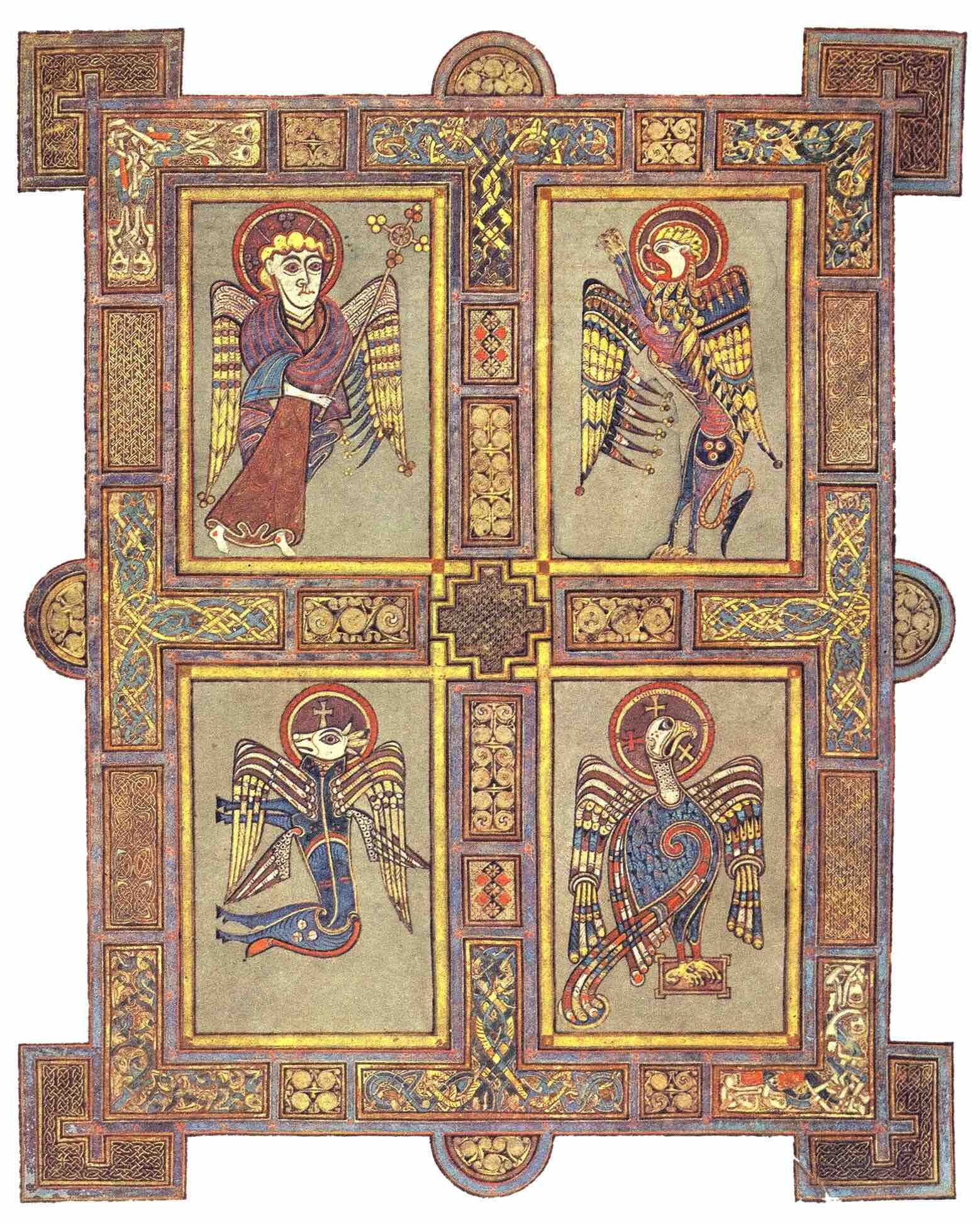
The four Gospels as depicted in The Book of Kells (c.800): Matthew (top l.), Mark (lion, top r.), Luke (eagle, bottom l.), John (ox, bottom r.).
(For those wanting a more polished version of the song, I’ve linked to it in the transcript of this episode posted on One Little Goat’s website.) ‘The four of them,’ as I simply like to call them, are often referred to as “Mamalujo,” an abbreviation for Matthew, Mark, Luke and John. They are, in fact, the first published characters of Finnegans Wake, appearing in Ford Madox Ford’s transatlantic review just over 100 years ago (and for more on that, I’ve linked in the transcript to Peter Chrisp’s terrific blog, from swerve of shore to bend of bay).
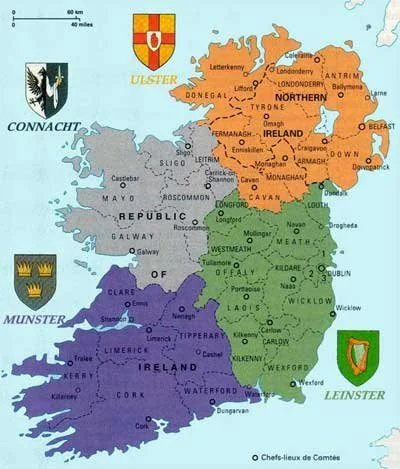
‘The four of them’ are also the four provinces of Ireland, always appearing in the novel in the same order: first is Ulster, with its capital of Belfast; next is Munster, with Cork its capital; third is Leinster and its capital, Dublin; and last is Connacht, with its capital of Galway. In that order, with Ulster north, Munster south, Leinster east and Connacht west, they form the shape of the cross. As John Gordon explains: “The usual Mamalujo order, imposed on the map of Ireland, traces the traditional Catholic sequence of crossing oneself: up, down, left, right. (In the Orthodox churches it is up, down, right, left.)”
Adeline Glasheen contends that Mamalujo also stands for James Joyce’s spouse, daughter and son: Mama (i.e. Nora Joyce), Lucia, Giorgio. Mamalujo.
And ‘the four of them’ are also the four Gaelic authors of the monumental 17th-century chronicle of Irish history known as The Annals of the Four Masters. We met them briefly back in Chapter 1:
[Richard Harte reads] Four things therefore, saith our herodotary Mammon Lujius in his grand old historiorum, wrote near Boriorum, bluest book in baile's annals, f. t. in Dyffinarsky ne'er sall fail til heathersmoke and cloudweed Eire's ile sall pall. And here now they are, the fear of um. (13:1-5)
There’s only one small problem with these four annalists: their memories are fuzzy and often more concerned with romantic reverie than factual accuracy.
In today’s excerpt they take on the role of four judges reaching a verdict on the courtroom proceedings. The four of them put their heads together on the matter, or as the text puts it, “the four justicers laid their wigs together” (92:35), and given the general haziness of these four old men, it will come as no surprise that they default to a verdict of ‘not guilty’ for Pegger Festy / Festy King, whom we encountered in our previous episode (Ep018).

Salvador Dalí, Sinbad the Sailor, 1978. Source: Artsy.
Soon after, they are back in their chambers talking about our protagonists Anna Livia Plurabelle and HCEarwicker, wondering what ALP could possibly see in HCE, whom they deride as “Singabob, the badfather,” (94:33) a mere thingamabob comprised of ‘sin’ and ‘badness’ — a far cry, in other words, from the heroic Sinbad of the Arabian Nights. This then eventually leads to some recollections of past romance, along with plenty of fluid argument, or as the text calls it, “contradrinking” (96:3), and finally concludes today’s excerpt—harmoniously?—with a drunken round of the most famous glass-raising song of them all, Robbie Burns’s “Auld Lang Syne.”
Today’s excerpt also provides a teaser of ALP’s letter that will, she hopes, clear HCE’s much maligned name. “The solid man saved by his sillied woman.” (94:3) We’ll visit this letter in great detail in our next chapter, Chapter 5. In the meantime, Chapter 4 gives us a sneak peak at two letters in the letter or in reaction to the letter, plus a few marks of punctuation. The letters are “A” and “O” separated by an extended ellipsis and a question and exclamation mark, with a final exclamation mark after the “O”. If you want to see it on the page, take a look on One Little Goat’s website, and here, in the spirit of sneak peaks, is Richard Harte reading it in today’s excerpt:
Now tell me, tell me, tell me then!
What was it?
A .......... !
? ..........O! (94:19-22)
From A to O, the letter might contain everything from alpha to omega. If so, the exclamation mark at the end is well warranted!
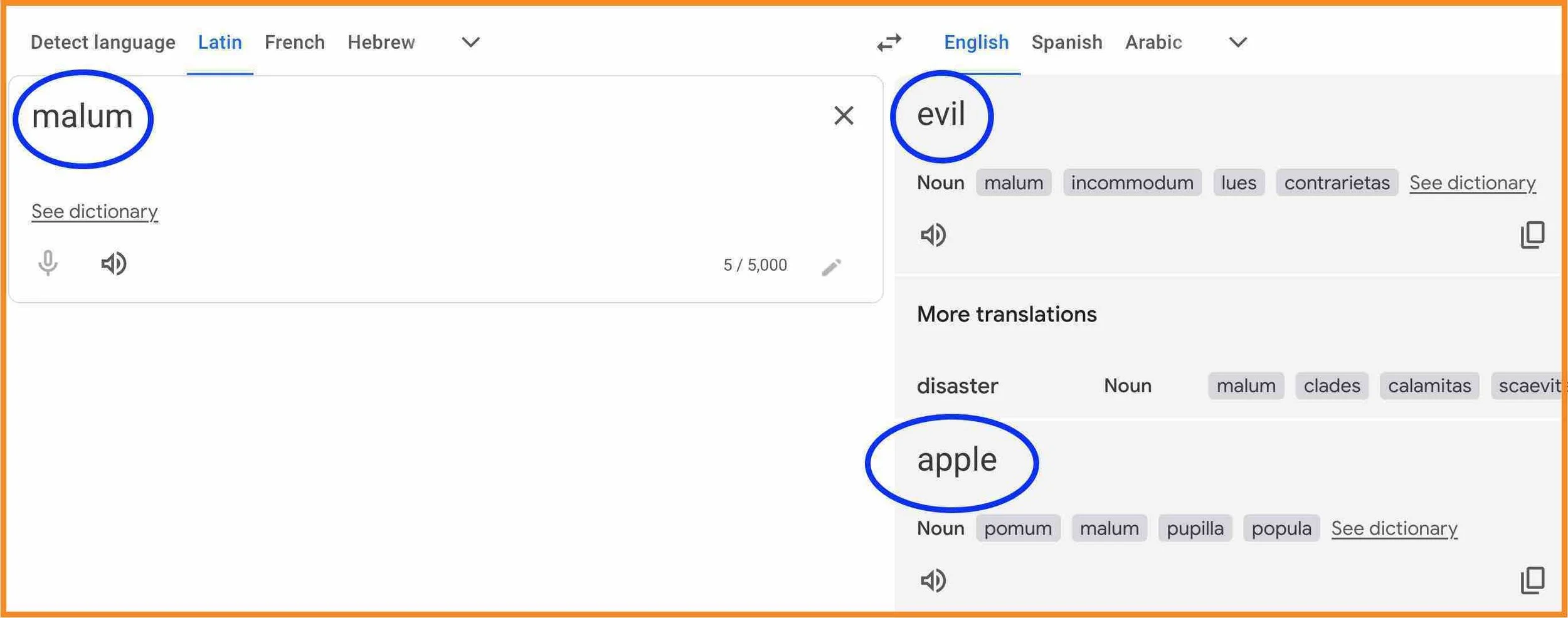
Just prior to the letter, the text reminds us of HCE’s sin, so reminiscent of Adam and Eve’s original sin (Ep018), with the fruit of sexual knowledge here appearing via the Latin word malum meaning both ‘apple’ and ‘evil’. As the text puts it, “ana mala woe is we!” This leads to HCE’s Humpty-Dumpty-like fall, or as the text describes him, “old obster lumpky pumpkin,” adding another appropriately fall fruit to the scene. And then we’re told, “And that was how framm Sin fromm Son, acity arose, finfin funfun, a sitting arrows.” (94:16-19) So we’ve lost Paradise once again, but, like our Biblical forebears, make the most of it: from sin, from sex, children; and from such multiplying, cities and civilization. It all starts with Cupid’s prick, if you will: “a sitting arrows.” Fallen humanity raises a city. What goes down must come up and down again etc. It makes Las Vegas’s nickname redundant — every metropolis is a Sin City.

Here the Wake is recirculating the Catholic concept of felix culpa, referring to the fall of Adam and Eve as fortunate because it gives humanity the opportunity to rise again, much like the phoenix of Dublin’s Phoenix Park that’s central to Finnegans Wake. Joyce has built and based his city on sin, sex, love.
For fun (and Fin) I’d like to offer a contrasting urban model offered by 19th-century Portuguese author José Maria de Eça de Quierós (1845-1900). In de Quierós’s ingenious reimagining of humanity’s origins, titled Adam and Eve in Paradise, it’s not sinful sex but cowering fear that builds our cities. Here’s an excerpt in the new translation by Margaret Jull Costa:
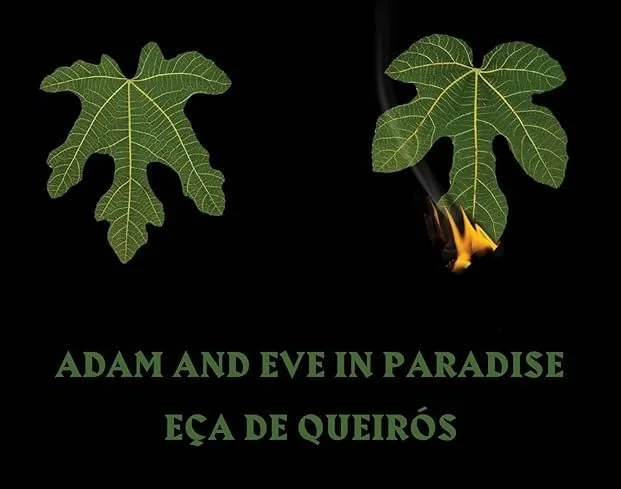
We, his descendants, owe our supremacy to Adam’s cowering terror. It was thanks to those bestial threats that he was obliged to climb up to the highest peaks of Humanity. The Mesopotamian poets of Genesis revealed their understanding of Man’s origins in those subtle verses in which the Serpent, that most dangerous of creatures, leads Adam, out of love for Eve, to eat the fruit of the Tree of Knowledge. If the troglodyte Lion had never roared, Man would not now be working in cities, because Civilization was born out of his desperate attempts to defend himself against both the Unfeeling and the Unthinking. Society is really the work of the wild beasts. (42)
Before we get to Richard’s reading, a quick synopsis of today’s excerpt in sequence… W.P. and Pegger Festy, the two witnesses to take the stand in the courtroom drama of our two previous episodes (Ep017 & Ep018) are presented in contrast, with W.P. appearing to attract all the women. Having reached their noncommittal verdict of ‘not guilty,’ the four justices release Pegger, who, unable to contain his excitement on his way out of court, lets out a massive fart that elicits cries of shame from the gallery. We then get a glimpse of ALP’s letter, as we just discussed, followed by ‘the four of them’ “contradrinking” each other about ALP and HCE.
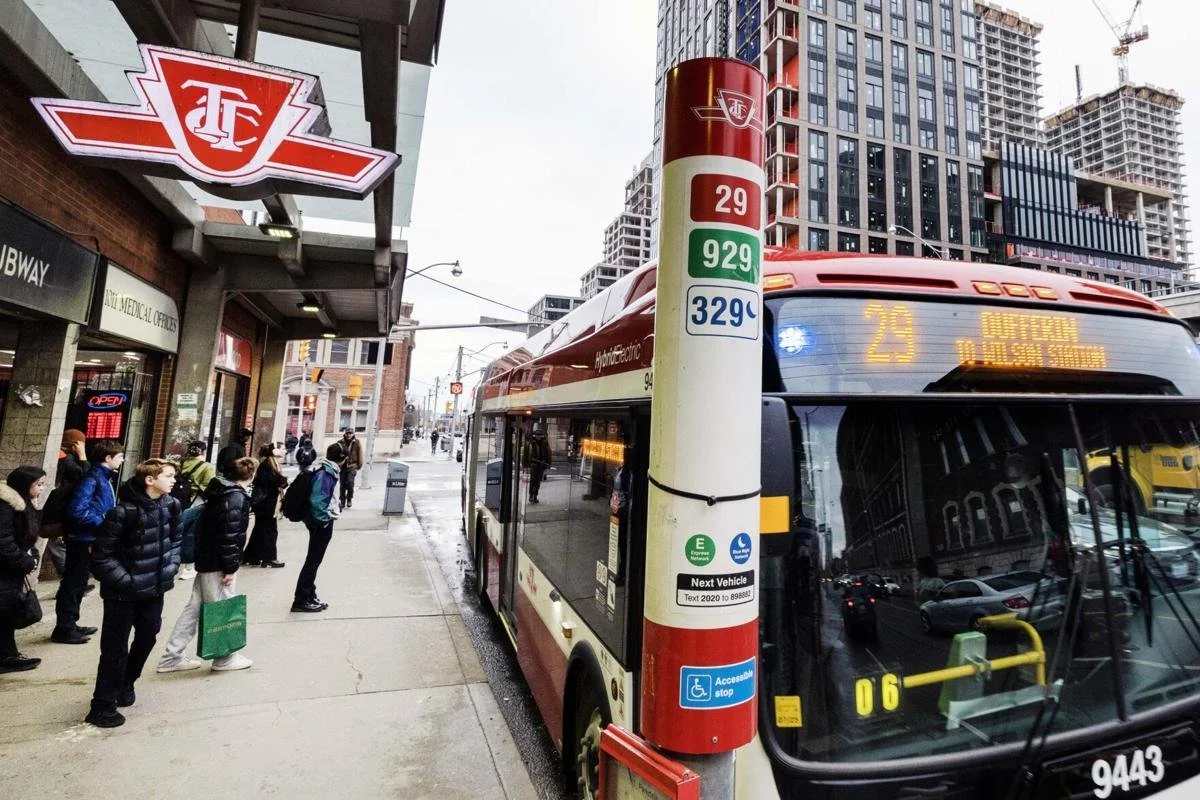
‘Sufferin’ Dufferin,’ Bus 29. Photo: Toronto Star.
And one last note for the Canadian listeners out there: I hope you appreciate the prophetic reference in today’s reading to Toronto’s worst bus route, bus No.29 along Dufferin Street, popularly known as ‘Sufferin’ Dufferin’ (93:30).
Now it’s time for Richard’s performance of James Joyce’s Finnegans Wake, page 92 line 6 to page 96 line 24 of Chapter 4. The performance was filmed and recorded at Type Books on Queen Street West in Toronto on January 22nd, 2024 with a live audience.
[Richard Harte reads Finnegans Wake 92:6-96:24.]
[92] The hilariohoot of Pegger's Windup cumjustled as neatly
with the tristitone of the Wet Pinter's as were they isce et ille
equals of opposites, evolved by a onesame power of nature or of
spirit, iste, as the sole condition and means of its himundher
manifestation and polarised for reunion by the symphysis of
their antipathies. Distinctly different were their duasdestinies.
Whereas the maidies of the bar, (a pairless trentene, a lunarised
score) when the eranthus myrrmyrred: Show'm the Posed:
fluttered and flattered around the willingly pressed, nominating
him for the swiney prize, complimenting him, the captivating
youth, on his having all his senses about him, stincking thyacinths
through his curls (O feen! O deur!) and bringing busses to his
cheeks, their masculine Oirisher Rose (his neece cleur!), and
legando round his nice new neck for him and pizzicagnoling his
woolywags, with their dindy dandy sugar de candy mechree me
postheen flowns courier to belive them of all his untiring young
dames and send treats in their times. Ymen. But it was not un-
observed of those presents, their worships, how, of one among
all, her deputised to defeme him by the Lunar Sisters' Celibacy
Club, a lovelooking leapgirl, all all alonely, Gentia Gemma of the
Makegiddyculling Reeks, he, wan and pale in his unmixed admir-
ation, seemed blindly, mutely, tastelessly, tactlessly, innamorate
with heruponhim in shining aminglement, the shaym of his hisu
shifting into the shimmering of her hers, (youthsy, beautsy, hee's
her chap and shey'll tell memmas when she gays whom) till the
wild wishwish of her sheeshea melted most musically mid the
dark deepdeep of his shayshaun.
And whereas distracted (for was not just this in effect which
had just caused that the effect of that which it had caused to oc-
cur?) the four justicers laid their wigs together, Untius, Mun-
cius, Punchus and Pylax but could do no worse than promulgate
[93] their standing verdict of Nolans Brumans whereoneafter King,
having murdered all the English he knew, picked out his pockets
and left the tribunal scotfree, trailing his Tommeylommey's tunic
in his hurry, thereinunder proudly showing off the blink pitch to
his britgits to prove himself (an't plase yous!) a rael genteel. To
the Switz bobbyguard's curial but courtlike: Commodore valley O
hairy, Arthre jennyrosy?: the firewaterloover returted with such a
vinesmelling fortytudor ages rawdownhams tanyouhide as would
the latten stomach even of a tumass equinous (we were prepared
for the chap's clap cap, the accent, but, took us as, by surprise
and now we're geshing it like gush gash from a burner!) so that all
the twofromthirty advocatesses within echo, pulling up their briefs
at the krigkry: Shun the Punman!: safely and soundly soccered
that fenemine Parish Poser, (how dare he!) umprumptu right-
oway hames, much to his thanks, gratiasagam, to all the wrong
donatrices, biss Drinkbattle's Dingy Dwellings where (for like
your true venuson Esau he was dovetimid as the dears at
Bottome) he shat in (zoo), like the muddy goalbind who he was
(dun), the chassetitties belles conclaiming: You and your gift of
your gaft of your garbage abaht our Farvver! and gaingridando:
Hon! Verg! Nau! Putor! Skam! Schams! Shames!
And so it all ended. Artha kama dharma moksa. Ask Kavya for
the kay. And so everybody heard their plaint and all listened to
their plause. The letter! The litter! And the soother the bitther!
Of eyebrow pencilled, by lipstipple penned. Borrowing a word
and begging the question and stealing tinder and slipping like
soap. From dark Rosa Lane a sigh and a weep, from Lesbia
Looshe the beam in her eye, from lone Coogan Barry his arrow
of song, from Sean Kelly's anagrim a blush at the name, from
I am the Sullivan that trumpeting tramp, from Suffering Duf-
ferin the Sit of her Style, from Kathleen May Vernon her Mebbe
fair efforts, from Fillthepot Curran his scotchlove machree-
ther, from hymn Op. 2 Phil Adolphos the weary O, the leery,
O, from Samyouwill Leaver or Damyouwell Lover thatjolly
old molly bit or that bored saunter by, from Timm Finn again's
weak tribes, loss of strenghth to his sowheel, from the wedding
[94] on the greene, agirlies, the gretnass of joyboys, from Pat Mullen,
Tom Mallon, Dan Meldon, Don Maldon a slickstick picnic made
in Moate by Muldoons. The solid man saved by his sillied woman.
Crackajolking away like a hearse on fire. The elm that whimpers
at the top told the stone that moans when stricken. Wind broke
it. Wave bore it. Reed wrote of it. Syce ran with it. Hand tore
it and wild went war. Hen trieved it and plight pledged peace.
It was folded with cunning, sealed with crime, uptied by a harlot,
undone by a child. It was life but was it fair? It was free but was
it art? The old hunks on the hill read it to perlection. It made
ma make merry and sissy so shy and rubbed some shine off Shem
and put some shame into Shaun. Yet Una and Ita spill famine
with drought and Agrippa, the propastored, spells tripulations
in his threne. Ah, furchte fruchte, timid Danaides! Ena milo melo-
mon, frai is frau and swee is too, swee is two when swoo is free,
ana mala woe is we! A pair of sycopanties with amygdaleine
eyes, one old obster lumpky pumpkin and three meddlars on
their slies. And that was how framm Sin fromm Son, acity arose,
finfin funfun, a sitting arrows. Now tell me, tell me, tell me then!
What was it?
A .......... !
? ..........O!
So there you are now there they were, when all was over
again, the four with them, setting around upin their judges'
chambers, in the muniment room, of their marshalsea, under the
suspices of Lally, around their old traditional tables of the law
like Somany Solans to talk it over rallthesameagain. Well and
druly dry. Suffering law the dring. Accourting to king's evelyns.
So help her goat and kiss the bouc. Festives and highajinks and
jintyaun and her beetyrossy bettydoaty and not to forget now
a'duna o'darnel. The four of them and thank court now there
were no more of them. So pass the push for port sake. Be it soon.
Ah ho! And do you remember, Singabob, the badfather, the
same, the great Howdoyoucallem, and his old nickname, Dirty
Daddy Pantaloons, in his monopoleums, behind the war of the
two roses, with Michael Victory, the sheemen's preester, before
[95] he caught his paper dispillsation from the poke, old Minace and
Minster York? Do I mind? I mind the gush off the mon like Bal-
lybock manure works on a tradewinds day. And the O'Moyly
gracies and the O'Briny rossies chaffing him bluchface and play-
ing him pranks. How do you do, todo, North Mister? Get into
my way! Ah dearome forsailoshe! Gone over the bays! When
ginabawdy meadabawdy! Yerra, why would he heed that old
gasometer with his hooping coppin and his dyinboosycough and
all the birds of the southside after her, Minxy Cunningham, their
dear divorcee darling, jimmies and jonnies to be her jo? Hold
hard. There's three other corners to our isle's cork float. Sure, 'tis
well I can telesmell him H2CE3 that would take a township's
breath away! Gob and I nose him too well as I do meself, heav-
ing up the Kay Wall by the 32 to 11 with his limelooking horse-
bags full of sesameseed, the Whiteside Kaffir, and his sayman's
effluvium and his scentpainted voice, puffing out his thundering
big brown cabbage! Pa! Thawt I'm glad a gull for his pawsdeen
fiunn! Goborro, sez he, Lankyshied! Gobugga ye, sez I! O
breezes! I sniffed that lad long before anyone. It was when I was
in my farfather out at the west and she and myself, the redheaded
girl, firstnighting down Sycomore Lane. Fine feelplay we had
of it mid the kissabetts frisking in the kool kurkle dusk of the
lushiness. My perfume of the pampas, says she (meaning me)
putting out her netherlights, and I'd sooner one precious sip at
your pure mountain dew than enrich my acquaintance with that
big brewer's belch.
And so they went on, the fourbottle men, the analists, ungu-
am and nunguam and lunguam again, their anschluss about her
whosebefore and his whereafters and how she was lost away
away in the fern and how he was founded deap on deep in anear,
and the rustlings and the twitterings and the raspings and the
snappings and the sighings and the paintings and the ukukuings
and the (hist!) the springapartings and the (hast!) the bybyscutt-
lings and all the scandalmunkers and the pure craigs that used to
be (up) that time living and lying and rating and riding round
Nunsbelly Square. And all the buds in the bush. And the laugh-
[96] ing jackass. Harik! Harik! Harik! The rose is white in the darik!
And Sunfella's nose has got rhinoceritis from haunting the roes
in the parik! So all rogues lean to rhyme. And contradrinking
themselves about Lillytrilly law pon hilly and Mrs Niall of the
Nine Corsages and the old markiss their besterfar, and, arrah,
sure there was never a marcus at all at all among the manlies and
dear Sir Armoury, queer Sir Rumoury, and the old house by the
churpelizod, and all the goings on so very wrong long before
when they were going on retreat, in the old gammeldags, the
four of them, in Milton's Park under lovely Father Whisperer
and making her love with his stuffstuff in the languish of flowers
and feeling to find was she mushymushy, and wasn't that very
both of them, the saucicissters, a drahereen o machree!, and (peep!)
meeting waters most improper (peepette!) ballround the garden,
trickle trickle trickle triss, please, miman, may I go flirting?
farmers gone with a groom and how they used her, mused her,
licksed her and cuddled. I differ with ye! Are you sure of your-
self now? You're a liar, excuse me! I will not and you're an-
other! And Lully holding their breach of the peace for them. Pool
loll Lolly! To give and to take! And to forego the pasht! And
all will be forgotten! Ah ho! It was too too bad to be falling
out about her kindness pet and the shape of O O O O O O O O
Ourang's time. Well, all right, Lelly. And shakeahand. And
schenkusmore. For Craig sake. Be it suck.
[End of excerpt]
Adam Seelig: That was Richard Harte reading pages 92 to 96 of Chapter 4 from Finnegans Wake, recorded live at Type Books on Queen Street West in Toronto on January 22nd, 2024.
Join us for Episode 20 in a fortnight when Richard continues Chapter 4 of Finnegans Wake. In the meantime, to be sure you don’t miss the episode, why not follow or subscribe to this podcast?
[Music: Instrumental of “Roll, Jordan, Roll” with Adam Seelig on piano and Brandon Bak on drums, from the film of Finnegans Wake Ch03.]
For more on One Little Goat’s Finnegans Wake project, including transcripts of this podcast and the complete films of Chapters 1 and 2, visit our website at OneLittleGoat.org. And to hear about upcoming performances and screenings, join our mailing list, also on our website.
One Little Goat Theatre Company is a nonprofit, artist-driven, registered charity in the United States and Canada that depends on donations from individuals to make our productions, including this one, possible. If you’re able, please make a tax-deductible donation through our website, www.OneLittleGoat.org
Finnegans Wake is made possible by Friends of One Little Goat Theatre Company and the Emigrant Support Programme of the government of Ireland. Thank you for your support!
And thank you to the artists for this episode: Richard Harte; Sound by William Bembridge; Stage Management by Sandi Becker; Directed by yours truly, Adam Seelig.
A big thanks to Claire Foster and the staff and owners of Type Books, as well as to our wonderful live audience. Thank you to everyone at the Irish Consulate in Toronto. And thank you to Production Consultants Cathy Murphy, Andrew Moodie and Shai Rotbard-Seelig.
Thank you for listening!
[Music fades out]
[End of Ep019]
Mentioned: The four old men, ‘the four of them,’ four Gospels, Mamalujo, four provinces of Ireland, Annals of the Four Masters, four justices, the letter (of ALP to exonerate HCE), “A” and “O” as alpha to omega, cities and civilization founded on Adam and Eve’s fall, city from sin, Latin ‘malum’ as apple and evil, felix culpa, city from fear in Adam and Eve in Paradise by Eça de Quierós, synopsis.
Resources: Transcript for this episode, including the text of Finnegans Wake.
Finnegans Wake (1939) by James Joyce: there are many free copies of FW to read online or download, e.g. finwake.com
James Joyce Digital Archive, “Chicken Guide” to Finnegans Wake provides a ‘plain English’ paraphrase of each chapter by Danis Rose.
Richard Ellmann’s biography of James Joyce. Oxford University Press, 1982.
Edmund Epstein, A Guide through Finnegans Wake. University Press of Florida, 2009.
Adaline Glasheen, Third Census of Finnegans Wake: An Index of the Characters and Their Roles, University of California Press, 1977.
John Gordon’s annotations on his Finnegans Wake blog.
Roland McHugh, Annotations to Finnegans Wake (4th edition). Johns Hopkins University Press, 2016.
Raphael Slepon, fweet.org
William York Tindall, A Reader’s Guide to Finnegans Wake. Syracuse University Press, 1996.
Cited: José Maria de Eça de Quierós. Adam and Eve in Paradise (late 19th century). Trans. Margaret Jull Costa. New Directions, 2025.