JAMES JOYCE’S FINNEGANS WAKE
Episode 023:
IN THE NAME OF ANNAH
PAGE 104:1-108:36 | BEGIN CHAPTER 5 | 2026-06-04
PODCAST AUDIO
PODCAST TRANSCRIPT
[Music: Instrumental of “The Alphabet Song (Variation On)” with Tyler Emond on bass, Jinu Isac on drums, Adam Seelig on piano, from the Finnegans Wake film series. Music fades out]
Adam Seelig: Welcome to James Joyce’s divine and delirious comedy, Finnegans Wake. In this episode, number 23, we’ll hear Irish-Canadian actor — and my good friend and colleague — Richard Harte performing pages 104 to 108 to begin Chapter 5 of Joyce’s last novel. I’m Adam Seelig, the director of the reading you’ll soon hear.
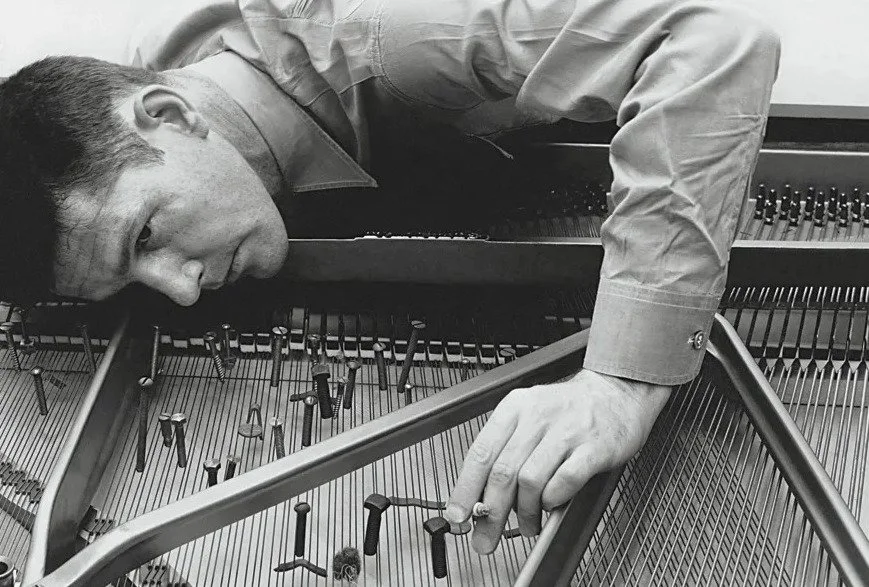
John Cage prepares his piano (photo: Irving Penn, 1947)
For those of you in New York, join me on Thursday, June 11th at Time and Space Limited in Hudson, New York for “Joyce / Cage,” an evening featuring excerpts from One Little Goat’s Finnegans Wake film series paired with Wake-inspired songs by John Cage. The songs will be performed live by soprano Jaclyn Hopping, accompanied by John Cage Trust Executive Director Jeffrey Lependorf, who will also join me in conversation. It promises to be a great night, so come if you can. For information on and tickets to this event, please visit One Little Goat Theatre Company’s website.

And for those of you around Dublin on Tuesday, June 16th, the Bloomsday Film Festival will be screening our complete film of Finnegans Wake Chapter 4 at the James Joyce Centre. For details and links, please visit the Bloomsday Film Festival website or www.OneLittleGoat.org.
[Music: “Breakfast,” instrumental with Tyler Emond on bass, Jinu Isac on drums, Adam Seelig on piano, from the Finnegans Wake film series.]
Adam Seelig: Finnegans Wake is a production of One Little Goat Theatre Company. One Little Goat is filming and recording all 17 chapters (roughly 30 hours) of Joyce’s Finnegans Wake before live audiences in various locations, screening and releasing them along the way, with the aim of completing the entire book for its 90th birthday, May 4, 2029. One Little Goat Theatre Company is an official charity in Canada and the United States. To help us produce this first-of-its-kind filmed reading series — of which we’ve filmed 8 chapters so far, with 9 more to go — please visit OneLittleGoat.org to make a charitable donation. Your donation enables us to bring this production to audiences and helps support the outstanding artists who make it possible. To be the first to hear about our live tapings, events, and screenings, please join our mailing list, also at OneLittleGoat.org.
[Music fades out]
Adam Seelig: Chapter 5 of Finnegans Wake turns to the female protagonist of the novel, Anna Livia Plurabelle, or ALP, focusing on her as river (the River Liffey), as spouse (of HCEarwicker), and as author of a consequential letter that promises to rehabilitate HCE’s much maligned reputation. It’s ‘Anna to the rescue,’ or in the words of the previous chapter, “The solid man saved by his sillied woman.” (94:3)
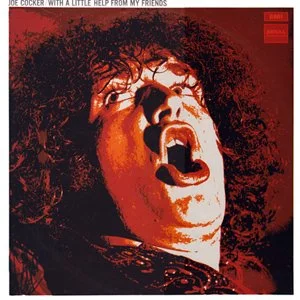
Joe Cocker (1944-2014)
If I had to give this chapter a title — and if the title hadn’t already been taken by Joe Cocker, that ‘roostery’ English blues singer — I’d call it “The Letter.” And if I went a step further to give the chapter subheadings, they would be “The Paper of the Letter,” “The Envelope of the Letter,” “The Message of the Letter,” “The Letters of the Letter,” etc.
This famous letter is found by a Hen named Belinda, and she finds it in a litter, a dump, in dirt, under sod, or to bring back that word we often heard in Chapter 1, in a ‘tip,’ i.e. a trash heap. This littery letter appears to be written by Anna. But even that, as so often happens in the Wake, is open to debate, because there’s a mystery that haunts this chapter, right up to its conclusion, and that is: Who wrote the letter? Was it in fact Anna? And if not her, who?
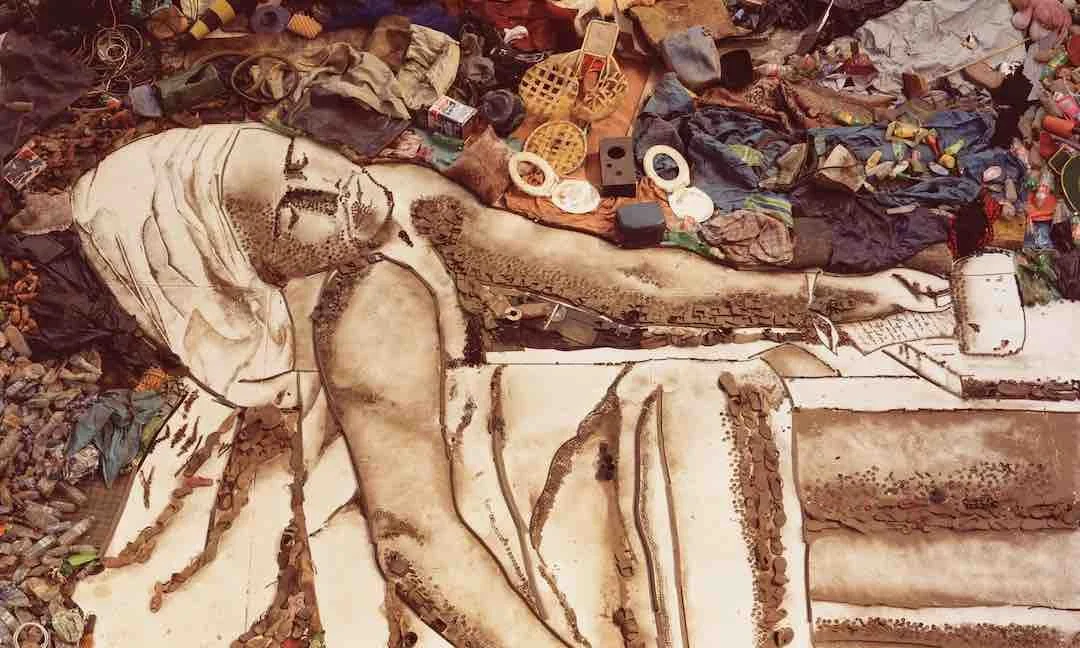
Vik Muniz’s trash/art (New York Times 2010-10-24)
Chapter 5 opens with a glorious and playful invocation of Anna Livia Plurabelle that merges the Quran with the Bible. Every sura in the Quran begins with, “In the name of Allah the all merciful,” and the Lord’s Prayer, one of the Bible’s greatest hits, goes like this: “Our Father which art in heaven, Hallowed be thy name. Thy kingdom come. Thy will be done in earth, as it is in heaven.” (Matthew 6:9-10)) Chapter 5’s opening line combines them: “In the name of Annah the Allmaziful, the Everliving, the Bringer of Plurabilities, haloed be her eve, her singtime sung, her rill be run, unhemmed as it is uneven!” (104:1-3)
The chapter then introduces us to Anna’s famous letter. Although it’s described as “her untitled mamafesta,” the letter in fact has gone by hundreds of different names at many different times. Edmund Epstein counts 312 of them in total, with most referring to the love and marriage of our flawed hero, HCE, and his long-suffering spouse, ALP. One thing that Richard Harte and I regularly look for in the Wake — especially when approaching an epic catalog like this one — is a rising and falling movement in any given phrase, sentence and paragraph because Finnegans Wake itself is, as we’ve seen over several chapters, a sublime and ridiculous evocation of the cyclical rise and fall of humanity.
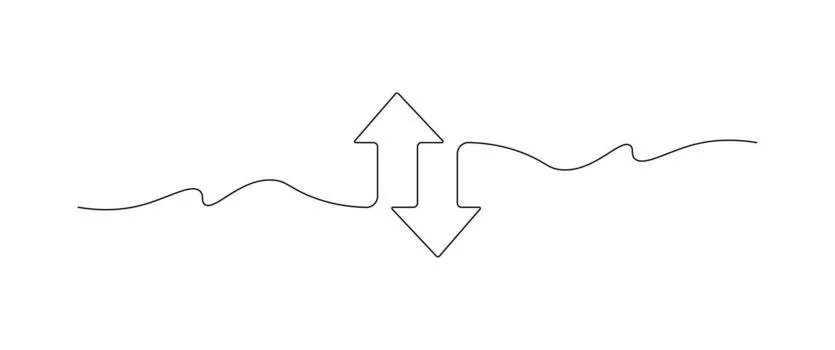
Here, for example, is one of the names for the letter appearing early in the list: “Knickle Down Duddy Gunne and Arishe Sir Cannon,” with the downward motion (“Knickle Down”) followed naturally by the upward (“Arishe Sir Cannon”), in this case suggesting investiture or a knighthood ceremony in which the subject kneels (or ‘knickles’) down in order to receive honour — paradoxically lowering himself to become exalted. The name immediately preceding this one lifts us up: “Anna Stessa’s Rise to Notice” (104:8-9). And these are just two of the 312 inventive names for Anna’s manifesto, of which I’ll point out just a few more…
“From the Rise of the Dudge Pupublick to the Fall of the Potstille” (105:22-23) — another up and down, in this case contrasting the rise of the Dutch Republic with the fall of the Bastille, mixed with a healthy dose of alcoholic terms in light of HCE and ALP’s identity (one of their many identities) as publicans of the Mullingar Inn in Chapelizod; hence “Pupublick,” which also hints at HCE’s sin-tinged stutter, and “Postille,” echoing a “pot still” for distilling whisky.
Several names for the letter call out HCE and ALP’s initials, for example:
— “He Can Explain”, which gives us HCE (105:14), and
— “Allolosha Popofetts”, which yields ALP (106:22-23).
A simple, three-word name, “The Suspended Sentence,” (106:13-14) could refer to the suspended judicial sentence for HCE’s alleged sins, while also applying to Finnegans Wake itself, given that the novel suspends a sentence between the end and the beginning, famously ending mid-sentence and beginning with its continuation — the “r” in the novel’s opening word, “riverrun,” remains uncapitalized for good reason. For more observations on this evocative name for the letter, I will link in the transcript for this episode to a terrific Finnegans Wake blog called, fittingly, “The Suspended Sentence”.
And while you may end up with your own favourite name-for-the-letter in this inventive list, I’ll share mine: “Of the Two Ways of Opening the Mouth” (105:23-24).

Priests perform the opening of the mouth ritual. Extract from the Papyrus of Hunefer Egyptian Book of the Dead (c.1300 BCE).
Not only does this entry reference “The Book of Opening the Mouth” from the Egyptian Book of the Dead, suggesting ancient rituals of death and afterlife, falling and rising, but to my ear it’s a perfect encapsulation of what this entire novel achieves, remarkably, on every single page, and that is an uncanny ability to say two often contradictory things at once; to say it and its opposite; to speak, paradoxically, out of both sides of the mouth. From the very first word of the novel’s very title, Finnegans, I hear at least ‘two ways of opening the mouth,’ with “Finn” suggesting the ‘finality’ of an end, and “egan” suggesting ‘again’; the former a fall, the latter a rise; to ‘end again’? We haven’t even read the full title, let alone the novel, and Finnegans Wake has already shown us “Two Ways of Opening the Mouth”.

The Arms of the City of Dublin. “The motto, which translates, The Obedience of the Citizen is the Felicity of the Town, is parodied in several places in the Wake.” (Danis Rose, James Joyce Digital Archive)
The final name given to ALP’s letter in this multi-page catalog is a breathless, run-on that summarizes her defense of HCE against a conspiring public that has fabricated salacious accusations about HCE vis-à-vis two girls in Dublin’s Phoenix Park and Chapelizod (107:1-7); and in the course of her full-throated defence of her husband, Anna slings some mud of her own, smearing the two girls or young women in this slanderous scenario as “a Pair of Sloppy Sluts” and ends by mentioning their “Raincoats”, a sartorial detail that associates the two allegedly disreputable young women with the two togaed women portrayed in Dublin's traditional Coat of Arms — I’ll post an image of the Dublin Coat of Arms in the podcast transcript because I think you’ll get a kick out of seeing it in this context.
Following our live audience’s deserved applause for Richard’s delivery of this epic, sentence suspended over three pages, the text presents us with a new, professorial character who appears to analyze Anna’s letter as if it were a rare and ancient manuscript, the way a paleographer might.
Where some see mere litter, the hen finds a letter; and where the hen picks (and pecks) out at letter, the paleographer sees a scrap of literature. Like “The Man on the Dump” in Wallace Stevens’s poem, Chapter 5 of Finnegans Wake returns literature to litter while transforming litter into literature. “The proteiform graph itself is a polyhedron of scripture. There was a time when naif alphabetters would have written it down…” (107:8-10) This is how our paleographer’s assessment of the written specimen begins, and after a full paragraph of this polysyllabic (and hilarious) scholarly pretention, a voice from the text, as if heckling our speaker, butts in with the question everyone wants to know: “who […] wrote the durn thing anyhow?” (107:36-108:1) Up until now I assumed it was ALP. This question of who wrote The Letter now becomes the mystery that Chapter 5 attempts to solve.
And that, the text reassures us, will require some forbearance: “remember patience is the great thing” (108:8).

Before we hear the opening pages of Chapter 5, I want acknowledge how lucky we were to film and record this chapter at the Thomas Fisher Rare Book Library at the University of Toronto. Chapter 5 might be the bookiest of chapters in this already bookish book that is Finnegans Wake, so a library, naturally, is a great location; but a library with as deep and broad and (true to its name) rare a collection as the Fisher… well, that is the ideal location. It also doesn’t hurt that the Fisher Library is architecturally stunning. Torontonians will know the Fisher’s exterior as the ‘head of the peacock,’ so to speak, at U of T’s Robarts Library, while others of you may have seen its interior in Star Trek: Discovery (Season 5, Episode 8, “Labyrinths”) where it played the part of the “eternal archive,” an infinite library safeguarding the secrets of the universe. (And I’ll post a link to that Star Trek episode in this episode’s transcript.)
I want to thank Librarians John Shoesmith and David Fernández at the Fisher for opening their doors to One Little Goat for our live taping of this chapter, and for allowing us to pull and display 100 books and manuscripts that relate to the novel in general and this chapter in particular, including a 500-year-old Geneva Bible and Quran; a 1927 copy of transition magazine where the opening pages of Chapter 5 were first published; and two first-editions of Finnegans Wake — the first, a copy in mint condition; the second, a heavily annotated copy annotated by media maven and visionary Marshall McLuhan (1911-80).
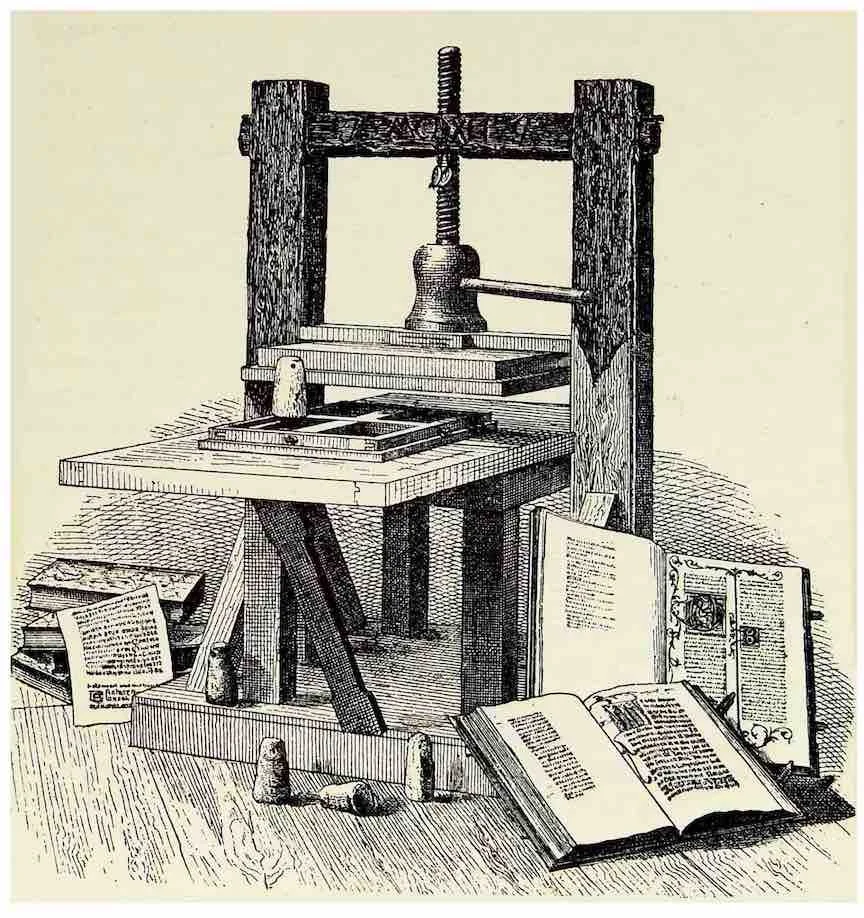
19th-century engraving of Gutenberg's 15th-century printing press. (Image: Public Domain)
Which is another reason our shoot of Chapter 5 at Fisher was bashert, or meant to be: Marshall McLuhan’s archives are housed at Fisher, and McLuhan was a lifelong reader and devotee of Finnegans Wake. His insights into the novel — I can tell you from having looked at some of those annotations in his first edition copy — are absolutely brilliant. For example (as those of you who listened to Episode 2 of this podcast series might recall), McLuhan read Joyce’s text as a verbal fugue, noting that “back” in the opening sentence — “riverrun, past Eve and Adam’s, from swerve of shore to bend of bay, brings us by a commodius vicus of recirculation back to Howth Castle and Environs” — sounds like “Bach” (as in Johann Sebastian), and “bach” is German for “brook,” which is a stream or kind of river; so this ‘river running back’ or ‘backwards’ is also a ‘river running Bach’ or ‘Bachwords.’ A literary fugue.
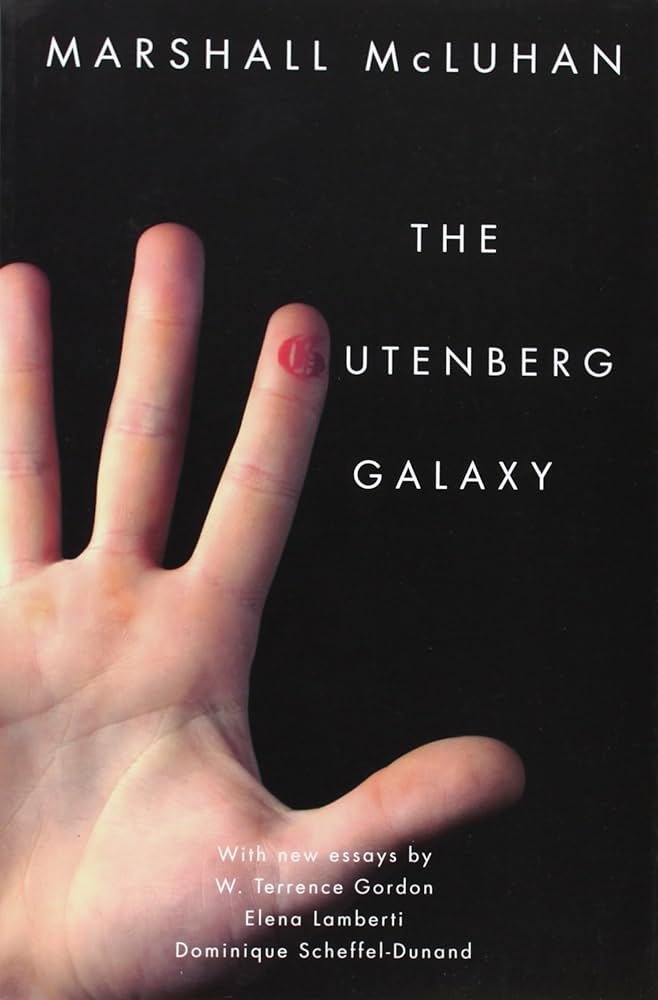

The Gutenberg Galaxy, McLuhan’s book from 1962, examines the effect of the printing press on human thought and experience. McLuhan’s contention is that Johannes Gutenberg’s invention in the 1400s shifted literature from an oral medium to a visual one; from ear to eye; and consequently, from communal to individual. Before the printing press, 99 people wanting to access a text would gather around one person to hear them recite it — because that one person, whether a scholar, rabbi, priest, imam, monk, etc., was the only literate one with access to that scroll. Today, thanks to Gutenberg’s nifty invention, all 99 people can read it on their own. So our experience of texts and literature since the printing press transitioned from oral, audible and communal to visual, silent and solitary. What McLuhan found remarkable in Finnegans Wake, as well as in the unpunctuated writing of Gertrude Stein and other modernists, is literature’s return from eye back to ear, because the Wake not only explores the medium of print, deeply and irreverently, but through its dream language, demands to be heard. In the process, individual readers become communal listeners. And here we are, dear audience, about to hear Richard Harte’s reading/performance of Finnegans Wake.
“Take breath and read it with the ears, as I always wish to be read, and my verse comes all right.” These are the words of the poet — and priest! — Gerard Manley Hopkins (1884-1889), quoted in The Gutenberg Galaxy by McLuhan, who goes on to compare the writing of Hopkins with that of Joyce: “Joyce never tired of explaining how in Finnegans Wake ‘the words the reader sees are not the words that [they] will hear.’ As with Hopkins, the language of Joyce only comes alive when read aloud” (95). It reminds me of another of Joyce’s comments on the Wake: “If anyone doesn’t understand a passage, all [they] need do is read it aloud.” Of course, even then, there’s no guarantee we will “understand” every word, since a certain amount of bewilderment or mystery is fundamental to any dream or dream language, but I can guarantee we’ll have lots of fun along the way — together. That was certainly the case with our live audience at Fisher Library (including, by the way, relatives of Marshall McLuhan), gathered on October 21st, 2024 to hear and see Richard Harte read/perform James Joyce’s Finnegans Wake, Chapter 5. Here are the opening pages of that chapter, from page 104 line 1 to page 108 line 36.
[Richard Harte reads Finnegans Wake 104:1-108:36]
[104] In the name of Annah the Allmaziful, the Everliving, the
Bringer of Plurabilities, haloed be her eve, her singtime sung, her
rill be run, unhemmed as it is uneven!
Her untitled mamafesta memorialising the Mosthighest has
gone by many names at disjointed times. Thus we hear of, The
Augusta Angustissimost for Old Seabeastius' Salvation, Rockabill
Booby in the Wave Trough, Here's to the Relicts of All Decencies,
Anna Stessa's Rise to Notice, Knickle Down Duddy Gunne and
Arishe Sir Cannon, My Golden One and My Selver Wedding,
Amoury Treestam and Icy Siseule, Saith a Sawyer til a Strame, Ik
dik dopedope et tu mihimihi, Buy Birthplate for a Bite, Which of
your Hesterdays Mean Ye to Morra? Hoebegunne the Hebrewer
Hit Waterman the Brayned, Arcs in His Ceiling Flee Chinx on the
Flur, Rebus de Hibernicis, The Crazier Letters, Groans of a Briton-
ess, Peter Peopler Picked a Plot to Pitch his Poppolin, An Apology
for a Big (some such nonoun as Husband or husboat or hose-
bound is probably understood for we have also the plutherple-
thoric My Hoonsbood Hansbaad's a Journey to Porthergill gone
and He Never Has the Hour), Ought We To Visit Him? For Ark
see Zoo, Cleopater's Nedlework Ficturing Aldborougham on the
Sahara with the Coombing of the Cammmels and the Parlourmaids
of Aegypt, Cock in the Pot for Father, Placeat Vestrae, A New
Cure for an Old Clap, Where Portentos they'd Grow Gonder how
I'd Wish I Woose a Geese; Gettle Nettie, Thrust him not, When the
[105] Myrtles of Venice Played to Bloccus's Line, To Plenge Me High
He Waives Chiltern on Friends, Oremunds Queue Visits Amen
Mart, E'en Tho' I Granny a-be He would Fain Me Cuddle, Twenty
of Chambers, Weighty Ten Beds and a Wan Ceteroom, I Led the
Life, Through the Boxer Coxer Rising in the House with the Golden
Stairs, The Following Fork, He's my O'Jerusalem and I'm his
Po, The Best in the West, By the Stream of Zemzem under Zig-
zag Hill, The Man That Made His Mother in the Marlborry
Train, Try Our Taal on a Taub, The Log of Anny to the Base
All, Nopper Tipped a Nappiwenk to his Notylytl Dantsigirls, Prszss
Orel Orel the King of Orlbrdsz, Intimier Minnelisp of an Extor-
reor Monolothe, Drink to Him, My Juckey, and Dhoult Bemine
Thy Winnowing Sheet, I Ask You to Believe I was his Mistress,
He Can Explain, From Victrolia Nuancee to Allbart Noahnsy,
Da's a Daisy so Guimea your Handsel too, What Barbaras Done
to a Barrel Organ Before the Rank, Tank and Bonnbtail, Huskvy
Admortal, What Jumbo made to Jalice and what Anisette to Him,
Ophelia's Culpreints, Hear Hubty Hublin, My Old Dansh, I am
Older northe Rogues among Whisht I Slips and He Calls Me his
Dual of Ayessha, Suppotes a Ventriliquorst Merries a Corpse,
Lapps for Finns This Funnycoon's Week, How the Buckling Shut
at Rush in January, Look to the Lady, From the Rise of the
Dudge Pupublick to the Fall of the Potstille, Of the Two Ways
of Opening the Mouth, I have not Stopped Water Where It Should
Flow and I Know the Twentynine Names of Attraente, The Tortor
of Tory Island Traits Galasia like his Milchcow, From Abbeygate
to Crowalley Through a Lift in the Lude, Smocks for Their Graces
and Me Aunt for Them Clodshoppers, How to Pull a Good Horus-
coup even when Oldsire is Dead to the World, Inn the Gleam of
Waherlow, Fathe He's Sukceded to My Esperations, Thee Steps
Forward, Two Stops Back, My Skin Appeals to Three Senses and
My Curly Lips Demand Columbkisses; Gage Street on a Crany's
Savings, Them Lads made a Trion of Battlewatschers and They
Totties a Doeit of Deers, In My Lord's Bed by One Whore Went
Through It, Mum It is All Over, Cowpoyride by Twelve Acre Ter-
riss in the Unique Estates of Amessican, He Gave me a Thou so I
[106] serve Him with Thee, Of all the Wide Torsos in all the Wild Glen,
O'Donogh, White Donogh, He's Hue to Me Cry, I'm the Stitch
in his Baskside You'd be Nought Without Mom, To Keep the
Huskies off the Hustings and Picture Pets from Lifting Shops, Nor-
sker Torsker Find the Poddle, He Perssed Me Here with the Ardour
of a Tonnoburkes, A Boob Was Weeping This Mower was Reaping,
O'Loughlin, Up from the Pit of my Stomach I Swish you the White
of the Mourning, Inglo-Andeen Medoleys from Tommany Moohr,
The Great Polynesional Entertrainer Exhibits Ballantine Braut-
chers with the Link of Natures, The Mimic of Meg Neg end
the Mackeys, Entered as the Lastest Pigtarial and My Pooridiocal
at Stitchioner's Hall, Siegfield Follies and or a Gentlehomme's Faut
Pas, See the First Book of Jealesies Pessim, The Suspended Sen-
tence, A Pretty Brick Story for Childsize Heroes, As Lo Our Sleep,
I Knew I'd Got it in Me so Thit settles That, Thonderbalt Captain
Smeth and La Belle Sauvage Pocahonteuse, Way for Wet Week
Welikin's Douchka Marianne, The Last of the Fingallians, It Was
Me Egged Him on to the Stork Exchange and Lent my Dutiful
Face to His Customs, Chee Chee Cheels on their China Miction,
Pickedmeup Peters, Lumptytumtumpty had a Big Fall, Pimpimp
Pimpimp, Measly Ventures of Two Lice and the Fall of Fruit,
The Fokes Family Interior, If my Spreadeagles Wasn't so Tight
I'd Loosen my Cursits on that Bunch of Maggiestraps, Allolosha
Popofetts and Howke Cotchme Eye, Seen Aples and Thin Dyed,
i big U to Beleaves from Love and Mother, Fine's Fault was no
Felon, Exat Delvin Renter Life, The Flash that Flies from Vuggy's
Eyes has Set Me Hair On Fire, His is the House that Malt Made,
Divine Views from Back to the Front, Abe to Sare Stood Icyk
Neuter till Brahm Taulked Him Common Sex, A Nibble at Eve
Will That Bowal Relieve, Allfor Guineas, Sounds and Compliments
Libidous, Seven Wives Awake Aweek, Airy Ann and Berber Blut,
Amy Licks Porter While Huffy Chops Eads, Abbrace of Umbellas
or a Tripple of Caines, Buttbutterbust, From the Manorlord Hoved
to the Misses O'Mollies and from the Dames to their Sames, Many-
festoons for the Colleagues on the Green, An Outstanding Back and
an Excellent Halfcentre if Called on, As Tree is Quick and Stone is
[107] White So is My Washing Done by Night, First and Last Only
True Account all about the Honorary Mirsu Earwicker, L.S.D.,
and the Snake (Nuggets!) by a Woman of the World who only can
Tell Naked Truths about a Dear Man and all his Conspirators how
they all Tried to Fall him Putting it all around Lucalizod about
Privates Earwicker and a Pair of Sloppy Sluts plainly Showing all
the Unmentionability falsely Accusing about the Raincoats.
The proteiform graph itself is a polyhedron of scripture.
There was a time when naif alphabetters would have written it
down the tracing of a purely deliquescent recidivist, possibly
ambidextrous, snubnosed probably and presenting a strangely
profound rainbowl in his (or her) occiput. To the hardily curio-
sing entomophilust then it has shown a very sexmosaic of nym-
phosis in which the eternal chimerahunter Oriolopos, now frond
of sugars, then lief of saults, the sensory crowd in his belly
coupled with an eye for the goods trooth bewilderblissed by
their night effluvia with guns like drums and fondlers like forceps
persequestellates his vanessas from flore to flore. Somehows this
sounds like the purest kidooleyoon wherein our madernacerution
of lour lore is rich. All's so herou from us him in a kitchernott
darkness, by hasard and worn rolls arered, we must grope on till
Zerogh hour like pou owl giaours as we are would we salve aught
of moments for our aysore today. Amousin though not but. Closer
inspection of the bordereau would reveal a multiplicity of person-
alities inflicted on the documents or document and some prevision
of virtual crime or crimes might be made by anyone unwary
enough before any suitable occasion for it or them had so far
managed to happen along. In fact, under the closed eyes of the in-
spectors the traits featuring the chiaroscuro coalesce, their con-
trarieties eliminated, in one stable somebody similarly as by the
providential warring of heartshaker with housebreaker and of
dramdrinker against freethinker our social something bowls along
bumpily, experiencing a jolting series of prearranged disappoint-
ments, down the long lane of (it's as semper as oxhousehumper!)
generations, more generations and still more generations.
Say, baroun lousadoor, who in hallhagal wrote the durn thing
[108] anyhow? Erect, beseated, mountback, against a partywall, below
freezigrade, by the use of quill or style, with turbid or pellucid
mind, accompanied or the reverse by mastication, interrupted
by visit of seer to scribe or of scribe to site, atwixt two showers
or atosst of a trike, rained upon or blown around, by a right-
down regular racer from the soil or by a too pained whittlewit
laden with the loot of learning?
Now, patience; and remember patience is the great thing, and
above all things else we must avoid anything like being or be-
coming out of patience. A good plan used by worried business
folk who may not have had many momentums to master Kung's
doctrine of the meang or the propriety codestruces of Carpri-
mustimus is just to think of all the sinking fund of patience pos-
sessed in their conjoint names by both brothers Bruce with whom
are incorporated their Scotch spider and Elberfeld's Calculating
Horses. If after years upon years of delving in ditches dark one
tubthumper more than others, Kinihoun or Kahanan, giardarner
or mear measenmanonger, has got up for the darnall same pur-
pose of reassuring us with all the barbar of the Carrageehouse
that our great ascendant was properly speaking three syllables
less than his own surname (yes, yes, less!), that the ear of Fionn
Earwicker aforetime was the trademark of a broadcaster with
wicker local jargon for an ace's patent (Hear! Calls! Everywhair!)
then as to this radiooscillating epiepistle to which, cotton, silk or
samite, kohol, gall or brickdust, we must ceaselessly return, where-
abouts exactly at present in Siam, Hell or Tophet under that
glorisol which plays touraloup with us in this Aludin's Cove of
our cagacity is that bright soandsuch to slip us the dinkum oil?
Naysayers we know. To conclude purely negatively from the
positive absence of political odia and monetary requests that its
page cannot ever have been a penproduct of a man or woman of
that period or those parts is only one more unlookedfor conclu-
sion leaped at, being tantamount to inferring from the nonpre-
sence of inverted commas (sometimes called quotation marks)
on any page that its author was always constitutionally incapable
of misappropriating the spoken words of others.
[End of excerpt]
Adam Seelig: That was Richard Harte reading the opening pages of Chapter 5 from Finnegans Wake, recorded live at the Fisher Rare Book Library in Toronto on October 21st, 2024.
Join us for Episode 24 in a fortnight for a special interview with Berkeley scholar Nina Beguš on her unusual use of Finnegans Wake to shape Artificial Intelligence. And join us two weeks later for Episode 25 for Richard Harte’s continuation of Chapter 5. In the meantime, to be sure you don’t miss the episode, why not follow or subscribe to this podcast?
[Music: “Closing Credits (Ch05),” instrumental with Tyler Emond on bass, Jinu Isac on drums, Adam Seelig on piano, from the Finnegans Wake film series.]
For more on One Little Goat’s Finnegans Wake project, including transcripts of this podcast and the complete films of Chapters 1, 2 and 3 visit our website at OneLittleGoat.org. And to hear about upcoming performances and screenings, join our mailing list, also on our website. One Little Goat Theatre Company is a nonprofit, artist-driven, registered charity in the United States and Canada that depends on donations from individuals to make our productions, including this one, possible. If you’re able, please make a tax-deductible donation through our website, www.OneLittleGoat.org Finnegans Wake is made possible by Friends of One Little Goat Theatre Company and the Emigrant Support Programme of the government of Ireland. Thank you for your support! And thank you to the artists for this episode: Richard Harte; Sound by William Bembridge; Stage Management by Sandi Becker; Directed by yours truly, Adam Seelig; Music arranged and performed on the piano by me, with Tyler Emond on bass and Jinu Isac on drums, recorded at Ghost Town Studio in Toronto. A big thanks to John Shoesmith, Special Collections Librarian, to David Fernández, Head of Rare Books and Special Collections, and to their colleagues at the Fisher Rare Book Library at the University of Toronto, as well as to our wonderful live audience. Thank you to the team at the Irish Consulate in Toronto. And thank you to Production Consultants Cathy Murphy and Andrew Moodie. Thank you for listening!
[Music fades out]
[End of Ep023]
Mentioned: John Cage, Time & Space Limited, Hudson NY, Bloomsday Film Festival, ALP, Anna Livia Plurabelle, The Letter, letter/litter, who wrote the letter?, Quran and Bible, names of the letter, ALP’s defense of HCE, cyclical falling and rising, “The Suspended Sentence,” “Of the Two Ways of Opening the Mouth,” two women on Dublin Coat of Arms, enter the professor of paleography, letter/litter/literature, patience, Thomas Fisher Rare Book Library at the University of Toronto, Marshall McLuhan, Gutenberg printing press, literature’s shift from ear/aural/communal to eye/visual/individual, Gerard Manley Hopkins, “read it with the ears,” dream language, people gathering to hear text read, synopsis.
Resources: Transcript for this episode, including the text of Finnegans Wake.
Finnegans Wake (1939) by James Joyce: there are many free copies of FW to read online or download, e.g. finwake.com
James Joyce Digital Archive, “Chicken Guide” to Finnegans Wake provides a ‘plain English’ paraphrase of each chapter by Danis Rose.
Richard Ellmann’s biography of James Joyce. Oxford University Press, 1982.
Edmund Epstein, A Guide through Finnegans Wake. University Press of Florida, 2009.
Adaline Glasheen, Third Census of Finnegans Wake: An Index of the Characters and Their Roles, University of California Press, 1977.
John Gordon’s annotations on his Finnegans Wake blog.
Roland McHugh, Annotations to Finnegans Wake (4th edition). Johns Hopkins University Press, 2016.
Raphael Slepon, fweet.org
William York Tindall, A Reader’s Guide to Finnegans Wake. Syracuse University Press, 1996.
Cited: Marshall McLuhan. The Gutenberg Galaxy: The Making of Typographic Man (1962). University of Toronto Press, 2011.