JAMES JOYCE’S FINNEGANS WAKE
SPECIAL: INTERVIEW WITH NINA BEGUŠ ON FINNEGANS WAKE IN AI
2026-06-18
PODCAST TRANSCRIPT
[Music: Instrumental of “The Alphabet Song (Variation On)” with Tyler Emond on bass, Jinu Isac on drums, Adam Seelig on piano, from the Finnegans Wake film series. Music fades out]
Adam Seelig: Welcome to James Joyce’s divine and delirious comedy, Finnegans Wake. This episode, number 24, is a special one because joining us from Berkeley, California will be scholar Nina Beguš, who is using Finnegans Wake to shape an unusual AI named “FinneGAN.” Hi, I’m Adam Seelig, and I’m the director of the Finnegans Wake film series produced by One Little Goat Theatre Company.
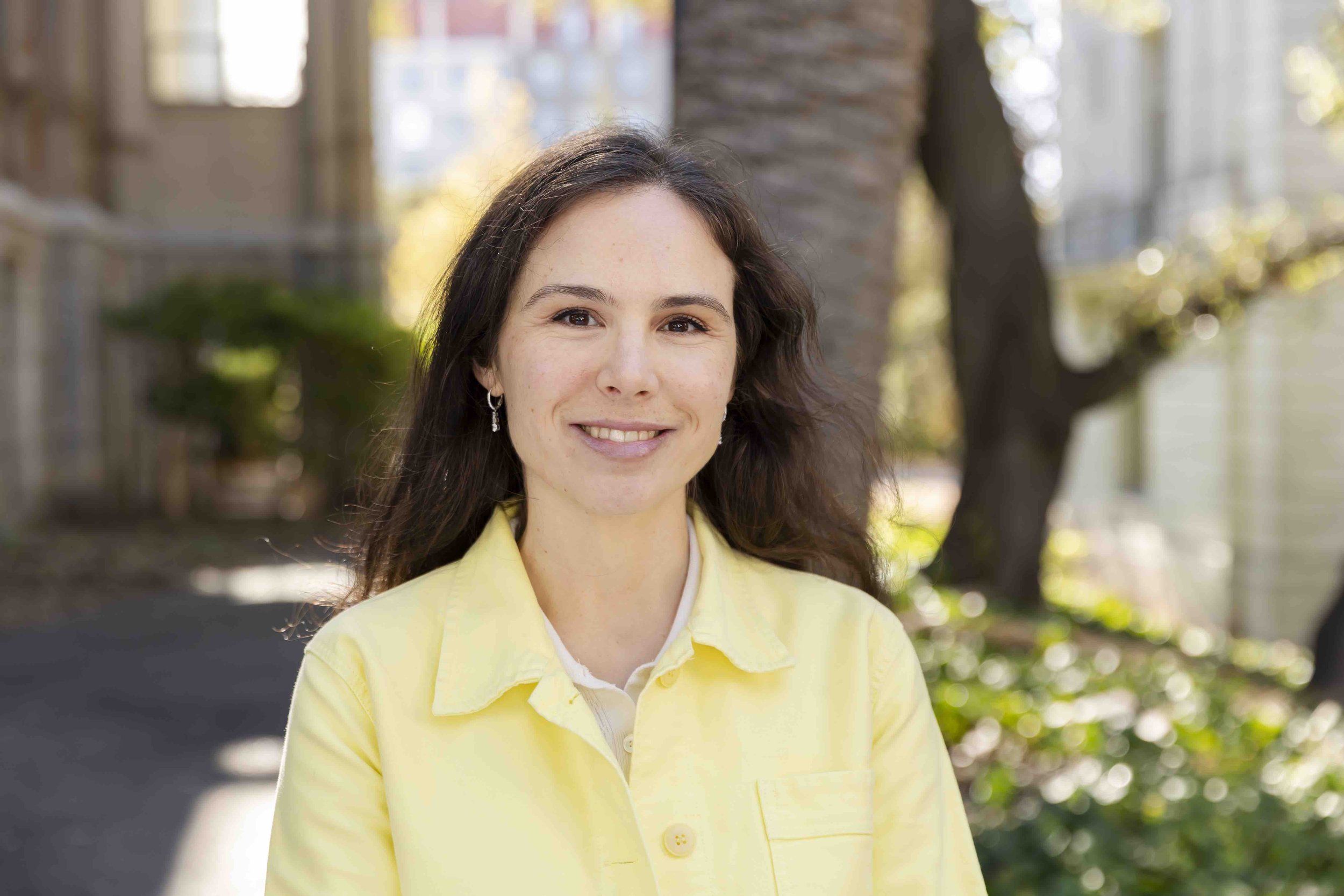
Digital Humanities Scholar Nina Beguš, University of California Berkeley
Thank you to those of you who joined us in Hudson, New York, recently on June 11th at Time and Space Limited for “Joyce / Cage,” an evening featuring excerpts from One Little Goat’s Finnegans Wake film series paired with Wake-inspired songs by John Cage. And thank you to those of you in Dublin who attended our all day screening of Finnegans Wake Chapter 4 at the James Joyce Centre for the Bloomsday Film Festival on Bloomsday, June 16th.
[Music: “Breakfast,” instrumental with Tyler Emond on bass, Jinu Isac on drums, Adam Seelig on piano, from the Finnegans Wake film series.]
Adam Seelig: Finnegans Wake is a production of One Little Goat Theatre Company. One Little Goat is filming and recording all 17 chapters (roughly 30 hours) of Joyce’s Finnegans Wake before live audiences in various locations, screening and releasing them along the way, with the aim of completing the entire book for its 90th birthday, May 4, 2029. One Little Goat Theatre Company is an official charity in Canada and the United States. To help us produce this first-of-its-kind filmed reading series — of which we’ve filmed 8 chapters so far, with 9 more to go — please visit OneLittleGoat.org to make a charitable donation. Your donation enables us to bring this production to audiences and helps support the outstanding artists who make it possible. To be the first to hear about our live tapings, events, and screenings, please join our mailing list, also at OneLittleGoat.org.
[Music fades out]
Adam Seelig: Earlier this year, several people sent me an online article published by Harvard’s Graduate School of Arts and Sciences titled “What Finnegans Wake Teaches Us about AI“ (Paul Massari, February 26, 2026). This was my introduction to the fascinating work of scholar Nina Beguš and the special AI she helped train named FinneGAN. Nina’s research focuses on the oft overlooked innerworkings of Artificial Intelligence, known as “latent spaces,” which she compares to the unusual dream language of Joyce’s last novel. In the process, she’s also coined a term that combines imagination with imitation through a creative process she calls “imagitation.” Brilliant.
Nina is the author most recently of Artificial Humanities: A Fictional Perspective on Language in AI, published by University of Michigan Press, and she joins me right now from her office at the University of California Berkeley. And allow me to just add two quick comments…
(1) as a Stanford University alumnus, and therefore, automatically, a Berkeley rival, I have set aside my anti-Cal prejudices to conduct this interview today with Nina — it took a lot of work for me to do that. And
(2), more seriously, I’m taking a moment to note the recent death of Frederick Wiseman, whose cinematic style is a model and inspiration for the Finnegans Wake film series I’m now directing with One Little Goat Theatre Company. All of Wiseman’s movies are amazing, but if I had to choose a favourite, it would be At Berkeley, his four-hour film of the illustrious university where we now find Nina.
Nina Beguš, welcome, and thank you so much for joining me!
Nina Beguš: Hi, Adam and everyone! I’m so glad to be here.
Adam Seelig: Wow — there is so much for us to discuss. Let’s get into it.
In your AI research I’m seeing a thorough understanding of and appreciation for the arts, and you’re a clear champion for the humanities. To quote you back to yourself, “Humanities are co-cartographers of AI’s interior, bringing literary, philosophical, and architectural tools into spaces that engineering alone cannot fully describe or design.” In the Harvard article, you mentioned wanting to bring your work in Artificial Intelligence and Digital Humanities to a wider audience, including artistic communities. So this might be a case of ‘careful what you wish for’ because, as part of artistic communities myself, I’m eager to know more about your work, particularly your work with Joyce’s last novel and AI, which focuses on latent space. What is latent space?
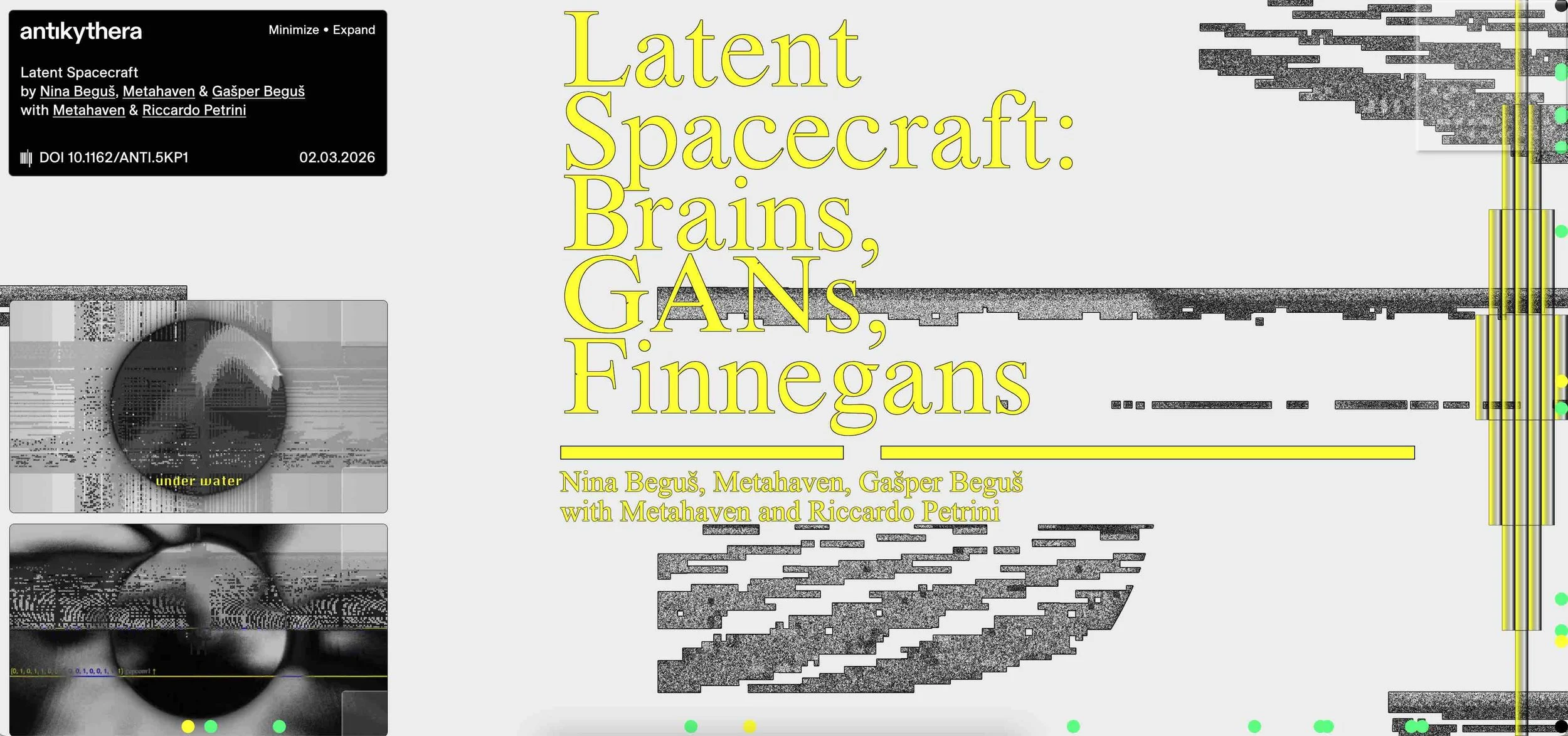
Nina Beguš: Yes, latent spaces — the term is more popular with humanists than with technologists, I must say, first of all. Latent spaces are these hidden layers that are doing all the work behind what any AI model that we have today is doing. So basically, they are these black boxes that we have a really hard time interpreting, because the latent spaces are basically mathematical categories. They are the structures of vectors with hundreds or thousands of dimensions. And in that way, they are invisible to us humans and unimaginable to us humans. But we have techniques that can help us try to visualize them and understand them, although they are radically invisible and inaccessible. And some of these techniques we’re using in this very technical field of interpretability, trying to see what the models are doing inside. And then in this paper that you mentioned, “Latent Spacecraft” (“Latent Spacecraft Brains GANs Finnegans“ 2026) and in our work that we exhibited in the art world, we’ve shown that you could also use humanistic interpretability. You can use humanistic techniques, methods, such as comparison, interpretation, reading, metaphorical, spatial thinking, to navigate these interiors of machine learning models.
Adam Seelig: There were two terms that I didn’t know until I encountered your work. One is this latent space, which you’ve described wonderfully. And maybe I could echo it back to you as a kind of interior of every AI model that we’ve been working with. Is that fair to say, that it’s kind of one layer back from the surface?
Nina Beguš: Yes. Yes. The latency is crucial.
Adam Seelig: And there’s this other term, G.A.N. Could you tell us what that is, please?
Nina Beguš: So we call them GANs. This is just an abbreviation for Generative Adversarial Networks. It’s an architecture of an AI model. It’s very different from what people usually know, which is large language models (LLMs) that are built on transformer architecture. This architecture, it’s called “generative” because these networks are very productive. You give them just a little bit of data and they figure it out on their own. We gave them just eight words of English and they figured out the whole phonology of the English language, for example. So here’s the first difference with large language models: they need a lot — humongous amounts of data. GANs need very little to be able to produce something. “Adversarial” in their name is really about having two neural networks within this architecture — there are two networks that train each other. I often describe them as Higgins, Dr. Higgins and Eliza from Shaw’s Pygmalion, because one network sees the data, knows what the data is. And the other one doesn’t. And I think GANs are actually the only architecture that never sees the data — this generator that needs to produce it, that needs to produce fake data, this generator basically starts from scratch, starts with complete noise. It doesn’t know what the other network is going to offer as data. So it only learns from its feedback. It could be pixels. It could be text. It could be sound. It could be anything. And so it starts with complete noise, and then slowly through feedback and through trying out different options, it gets to more and more structure and eventually to a word in our case, because we gave them words as input data. And this all happens without human intervention.
Adam Seelig: Incredible. So the only part that you have contributed is the vocabulary. And in your case, your vocabulary that you’re describing was under eight words. Now, I believe that your GAN learned to say “start” or something that was somewhat comprehensible or almost comprehensible to us. What was that experiment?
Nina Beguš: So those are the basic GANs. The ones where we just teach them how English language looks like. So we gave them eight words, such as “greasy,” “suit” —very basic, random words. And they would start producing new words. One of the first words, if not the first word, was actually “start.” And it was a combination of the words that they were fed, but it wasn’t in the training data. So this is what we call “imagitation,” because they don’t just imitate, they don’t produce just “greasy greasy greasy,” because they’ve seen “greasy.” But from those few words, they’re able to come up with new words — new words of English or possible words of English.
Adam Seelig: So I have the list of words here from that experiment. The words were: ask, carry, dark, greasy, like, suit, water, & year. And you say here that from that, the model could produce “start” — a plausible word that follows English phonology, but isn’t in our vocabulary. So — and I’m quoting you here — “they don’t produce non-plausible words. They figure out the rules quickly.” One of the many things that is fascinating about the work that you’re doing is that your GANs are behaving like children who are acquiring language. Yes?
Nina Beguš: Yes. They are much closer to how us humans acquire language than, for example, large language models, which obviously learn on text, which is not how any human learns how to speak, and also need an immense amount of data. So the way it works with GANs is they learn from their environment. This is how our children learn too. They have, you know, basic imitation — a child learning from parents, just working with the principles that they are introduced to in their environment. And then they are able to push further into novel combinations. Sometimes kids would come up with a new word that doesn’t really exist. And there’s this aspect of playfulness in this.
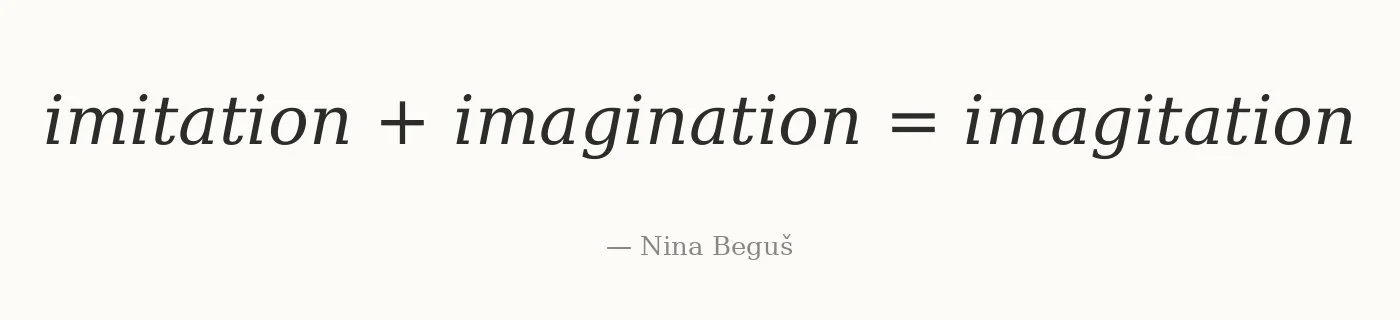
Adam Seelig: I love that, the playfulness is so key. As a parent myself, when my kids were much younger — this is now years ago — my eldest at one point drew a picture of a bunny rabbit and a window, and then he described what was going on. He said, “This bunny is eyes-ing on the window.” There’s no such thing as “eyes-ing” in that sense, as we all know, and maybe it was “looking through” or “looking at” or what have you, but he invented it. The younger one at one point came up with one that we still use to this day, which he invented: “carrot on the cob.” So kids are just amazing with figuring it out, playing with it, making themselves known, and sometimes maybe just pure invention. And that’s what I love about this term that you’ve coined — imitation + imagination = imagitation.
And let’s get to Joyce now, because you are claiming that Joyce — let me paraphrase, and you can tell me if I’m out of line here — was a pioneer in exploring this latent space or this childlike playfulness that bent the rules of conventional syntax?
Nina Beguš: Yes. I mean, as with many things with Joyce, he kind of anticipates what happens in computing decades before anything like that is a possibility. So in the history of computing and Joyce and this conversation that’s been happening, a lot of computing returns to Joyce. So it’s not a coincidence that we did too, because it’s just so interesting how he manages to chart this latency of language. You know, what he was trying to do — he called it “the writing of the night.” He said there are other registers of language. Language is sometimes given in a state which doesn’t really work during the day. It’s not orderly. He called it “wide-awake language.” He said, This is not what I’m going after — not plot and “cut-and-dry grammar.” He said, I want to try to see how the writing of the night looks like. So basically going into this latency of language — what’s happening with language when it’s not completely externalized, because he really tried to express how things are in the night, in different stages: the conscious, unconscious, semi-conscious. He’s talking about that to his editor in his letters when he’s writing Finnegans Wake. That was his pursuit.
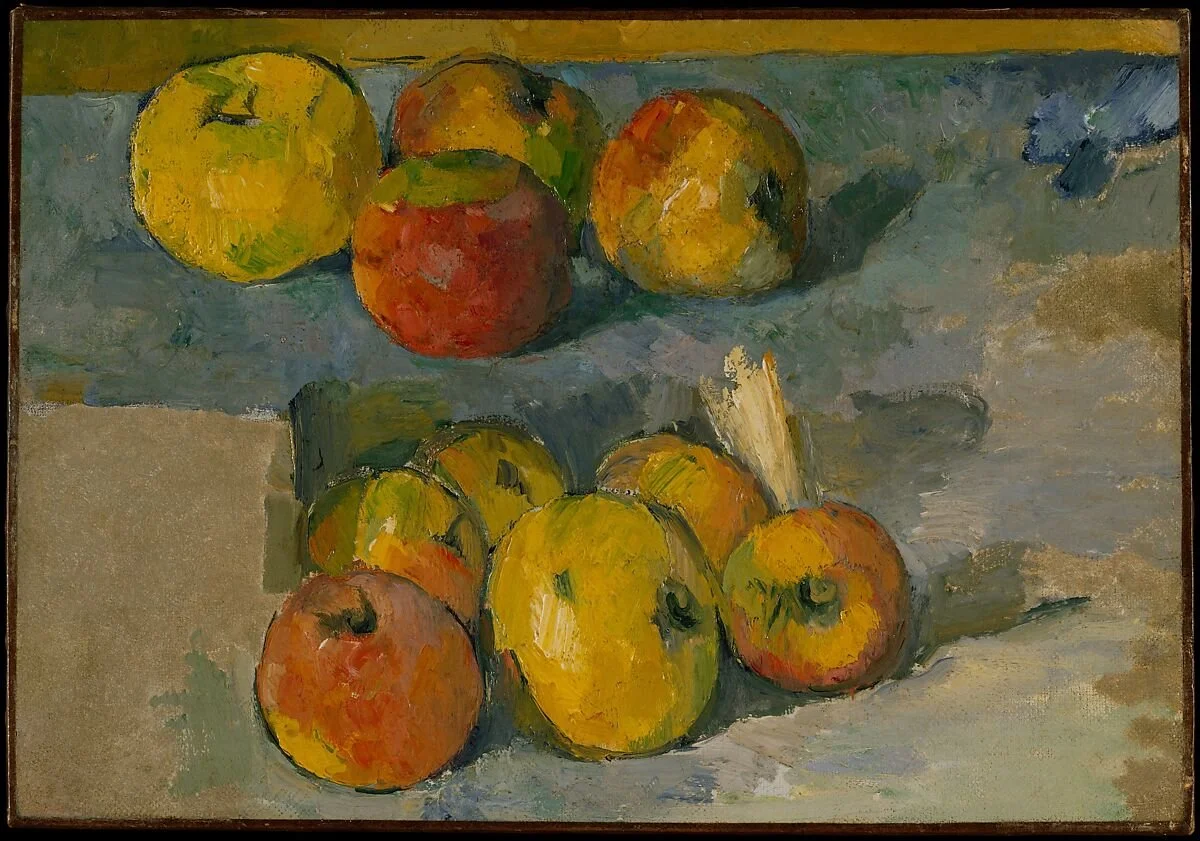
“Apples” (oil on canvas, 1878), Paul Cézanne. Not all red, but not so bad. (Metropolitan Museum of Art)
I think the easiest way to imagine this is for me to ask you: try to imagine a red apple. And as I ask you this, do you see it in your brain? Can you imagine it?
Adam Seelig: I do. It’s also a dangerous question to ask of someone named Adam, but go on.
Nina Beguš: [Laugh] So most people will be able to imagine this, visualize the red apple in a sort of low definition. It’s not completely clear the way your vision can render it if you don’t try, right? And this is how language is as well. You can hear me speak now in clear sentences, but the way language works in my internal layers, in my biological neural networks, in my brain, is more compressed, has this low definition to it. And this is why Joyce is so informative of what we found in our AI models, in GANs. Because when you listen to GANs, you will also hear they have this kind of old-school, gritty sound. It was very important for us to be able to publish these models, for people to just access them and play with them and hear them and see how they work.
Adam Seelig: How is it that the GAN has that kind of voice? What determined the voice of your GAN? In Finnegans Wake, the voice of the narrative often adheres, however lightly, to whoever might be in the scene. If it’s Anna Livia Plurabelle, then that voice might be more flowing and river-like because she is a river. And if it’s Earwicker, then it might take on some of his pub-keeping kinds of sounds and consciousness. And this narrative kind of floats throughout Finnegans Wake and takes on these different — literally hundreds of different voices, languages, and so on, depending on what’s happening in that zone. How did your GAN get its voice? And I should also really highlight the name of your GAN, which is “FinneGAN.”
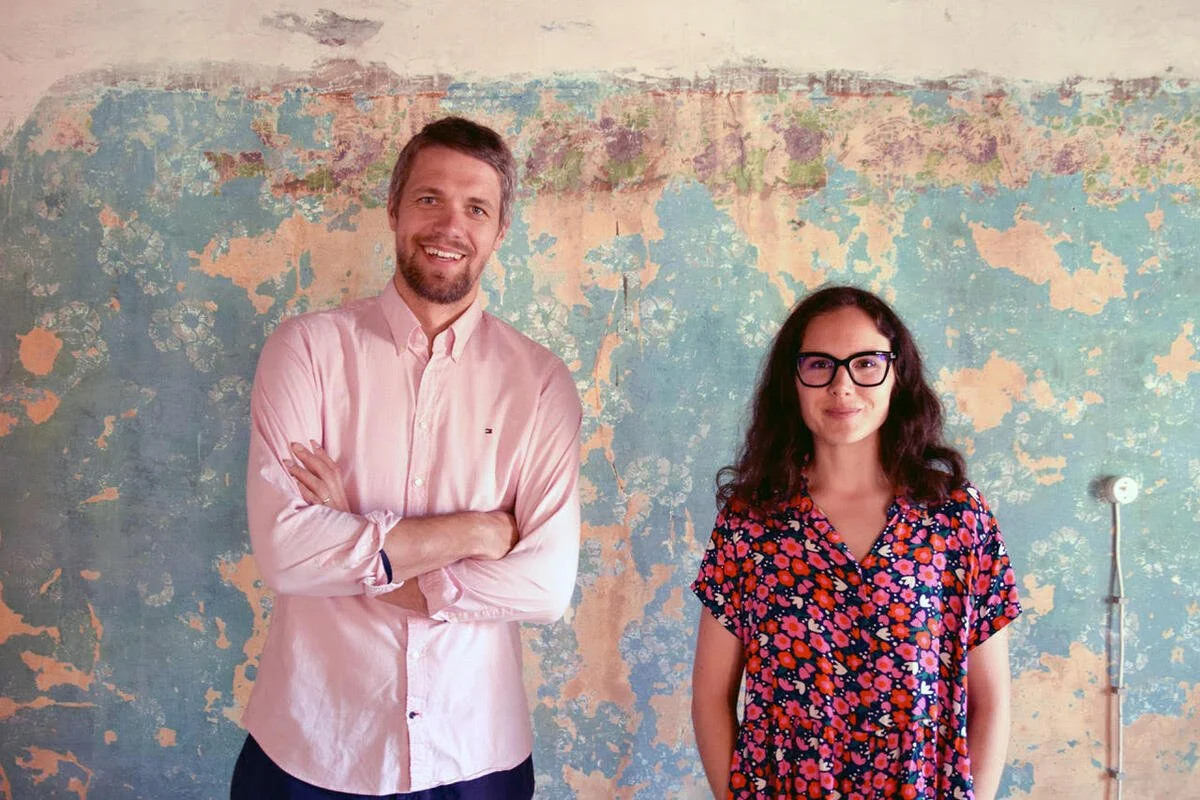
Gašper Beguš and Nina Beguš (Photo: Matevž Granda)
Nina Beguš: Yeah, that’s a different GAN. So we created one that’s just words of English. And then we trained another one from scratch, simply on Finnegans Wake. So this other model, FinneGAN, as we call him, never really saw actual English words, does not know how our English looks like — only knows the world of Finnegans Wake. And what’s interesting about this voice or sound is —so the engineering part, Gašper Beguš, who made these models in his lab here at Berkeley, the engineering part is not very involved. You don’t really know what will come out of it. Gašper also trained these models on whale clicks because he’s studying whale communication. And you can pretty much train them on anything. I mean, GANs were initially, about ten years ago, famous for the deep fakes of cats, right? This is how it all started. Now, do they have a distinct voice? They have this imitative power, of course. But we really wanted to publish them because in general, in mainstream AI, people only interact with large language models that are very polished. They have these glib exteriors, right? Language is very smooth — it’s this world of perfect Newtonian physics where the apple falls beautifully down from the tree.
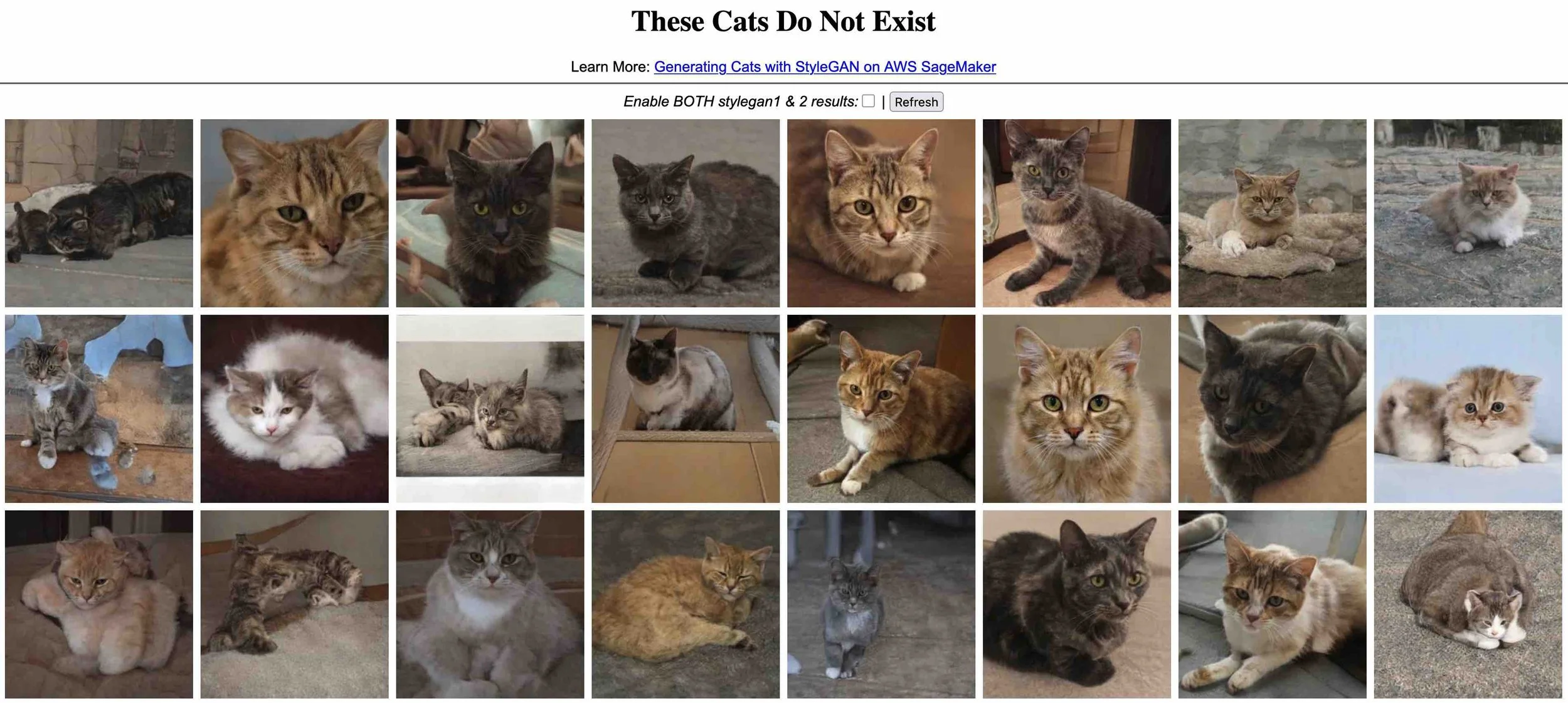
Feline “deep fakes” at www.thesecatsdonotexist.com
Adam Seelig: There’s that apple again, yes.
Nina Beguš: There’s the apple. But with GANs it’s not. It’s like listening to a radio that doesn’t have a clean frequency yet.
Adam Seelig: Very nice. And that’s where Finnegans Wake plays in so nicely into what you’re doing as a literary model for that in-between, night-languagey, children’s language, pre-verbal, post-verbal, can’t-quite-put-your-finger-on-it kind of quality — the dreamlike quality. That was one thing I wanted to ask you about too, is that there’s a lot of focus on children’s acquisition or child acquisition of language and of the childlike play in GANs. And one of the things I wanted to mention in that regard is dreams. I feel like through the dream language of Finnegans Wake, there’s a collapse of the conscious and rational and a kind of unconscious return to that pre-conscious or young, playful kind of zone of speech. And so maybe when we sleep at night, we are going back to a childlike place.
Nina Beguš: I love this comparison. Yes. When we started working on this project — so this was with Gašper Beguš, who built the models, and then with Metahaven, this wonderful artistic collective that helped us think through this, and visualized the models together with Ricardo Petrini. When we started talking about it, we said, isn’t it funny how all these terms — subconscious, deep learning, embedding — they suggest that all cognitive structures have this depth. And it seems like there’s this spatial metaphor about how we think of latency and making the invisible spaces visible, which is really what we’re trying to do here. And this is why we called it Latent Spacecraft, because latent spacecraft is really about navigating. It’s a craft of approaching spaces that are not navigable in a way. And our choice was to navigate them through language, because we know a lot about human language. Linguists have studied it for a long time. Cognitive scientists, right? We know a lot about literature. So this was our way in. It was through language acquisition and through literary experiments such as Finnegans Wake. And I love the dream comparison, because dreams make sense, right, when you’re in them, even though rationally they might not. But there’s this world that is being held together and it’s not in high definition again. It’s about this noisiness that GANs also produced when they try to get to a structure. So when they go from noise to a signal, from noise to a word, they produce a structure that’s clearer and clearer. And this is also how we presented the model — you look at the model and it goes from noise and then into upper and upper and upper layer. And you can see the structure coming together. And at the end, you sort of hear a sentence that you kind of think you know what it might mean, but it’s not completely externalized language yet. It’s like peeking into this dreamlike world where structures are formed in these cloud-like formations, in these soft, condensed formations.
Adam Seelig: I want to point our listeners to — in the transcript of this episode that we’re doing right now — they’re going to find a link to this FinneGAN that you have online. I think there are two GANs there. One is FinneGAN and the other one combines words.
Nina Beguš: Yes.
Adam Seelig: But people who are listening who don’t have patience to go online and find that can just Google “Latent Spacecraft Brains GANs Finnegans.” And I’m on that site right now and looking at this, and as promised, we’re coming back to this. I want to understand what’s going on here. I’m seeing — for those of you who are as old as I am — a kind of foggy TV test-pattern-like image, mostly in black and white, and some interesting patterns that are unfolding. And so this almost Rorschach-like thing that I’m looking at, that has a circle in the middle and then some clouds all around it — it’s very evocative. What happens when I go there?
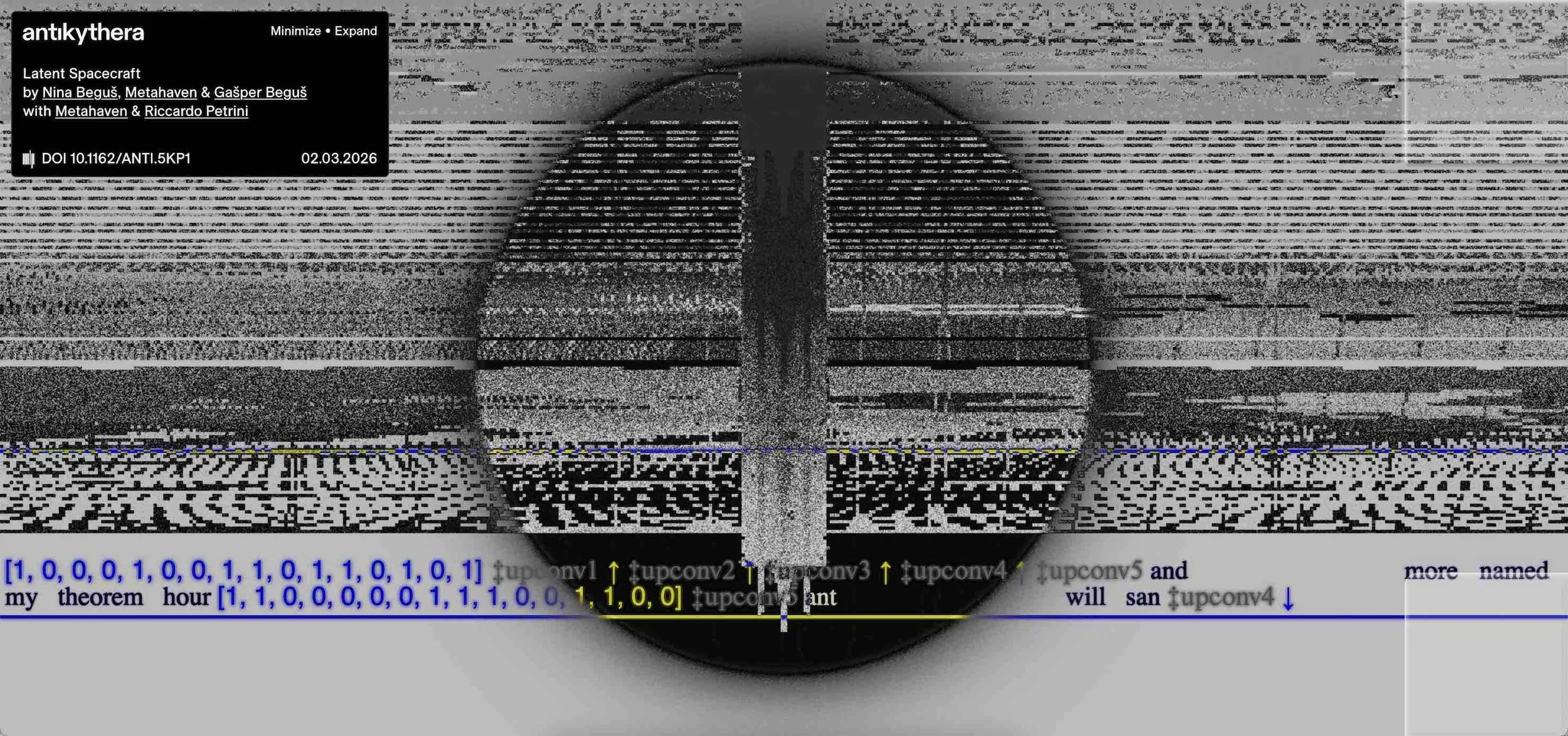
Nina Beguš: Well, basically every time you open this website with the model, the model produces a new sentence from scratch — a sentence that I have never heard or anybody else has ever heard. It’s unique every single time because the model is actually working and producing it for you.
Adam Seelig: Incredible. Do you think that we could — when we’re done with our interview today — do you think that I could borrow some or have some audio of what that sounds like, and we can maybe put some of that into this episode so people can hear a couple of sentences?
Nina Beguš: Absolutely. I think — you might have to explain that they won’t necessarily understand what it is saying. Sometimes the words are close to intelligible, and online we put a transcriptor that’s trying to make sense of what’s being said, but sometimes it’s not very accurate.
Adam Seelig: So those who are reading Finnegans Wake well know that we’re spending a lot of time with the equivalent of your transcriptor, trying to figure out what’s happening here in this latent space of a novel that James Joyce has created. And maybe what we’ll do is I’m going to share a couple — a little bit of Joyce’s background in, let’s say, experimenting or exploring children and their approach to sound, speech, experience, and how important that was to his work, especially in Finnegans Wake. And then maybe you could provide a sentence or two you’ve heard or that have surprised you from your FinneGAN. Would that be an okay approach right now?
Nina Beguš: Oh, absolutely. I often — I mean, I can already do it right now. In the article itself, we put a sentence. Yes. “Right, we inhabit a locked hole, but can we use it?”
Adam Seelig: [recorded after the interview] I’m recording this after the interview and want to thank Nina for providing me with her original audio recordings of FinneGAN to share with you all. Here’s how that phrase sounded when FinneGAN’s voice, so to speak, spoke these words in the first place. And let me just add — and perhaps this is my Finnegans Wake brain accustomed to cyclical themes of falling and rising in the novel — but where Nina’s lab transcription has “right, we inhabit a locked hole,” I swear I can hear FinneGAN saying “rise, we inhabit a locked hole.” Okay, here’s the recording.
FinneGAN: “Right, we inhabit a locked hole, but can we use it?”
Adam Seelig: That was one of the sentences. I love that one.
Nina Beguš: Yeah. So even in the locked hole sentence, you can hear that the model actually says “holee,” it doesn’t say “hole.” But the transcriptor is modern. So it will put some things in there that have not existed in Joyce’s time. It doesn’t have a sense of history.
Adam Seelig: Mm-hmm. So maybe we can let our listeners hear a couple of those, and I’ll find a way to get that audio, and you yourselves can hear a couple of those sentences.
Adam Seelig: [recorded after the interview] And indeed, following the interview, Nina generously sent me some more of FinneGAN’s eccentric phrases, beginning with the second one mentioned in her article, “Latent Spacecraft: Brains, GANs, Finnegans,” which her lab, using Whisper speech recognition software, transcribed as: “Power of Motsunoshi Station Lettuce Wait a ti-i-i-i-i-i-i-i-i-i-i-i-i-i-i-i-i-i-i-i-i-i-i-i-i-i-i-i-i-i-i-i-i.” Here’s how Finnegan said it originally.
FinneGAN: Power of Motsunoshi Station Lettuce Wait a ti-i-i-i-i-i-i-i-i-i-i-i-i-i-i-i-i-i-i-i-i-i-i-i-i-i-i-i-i-i-i-i-i.
Adam Seelig: Have there been any other sentences that have stood out for you? I’ll let you think about that while I share some sentences from Joyce — or even just quickly, a quick background on children in literature and how really they were ignored for so long. And in my mind, at least in English literature, it’s William Wordsworth who really champions children’s experience. And he even in The Prelude talked about the poetic spirit, and claims that everyone is born with the poetic spirit. He calls it “the first poetic spirit of our human life” (Book II, “School-Time (continued),” 275-76). And all are born with it, but only some remember it. Of course, those who remember it are (self-congratulatory, as always, I imagine) the poets. And poets hold on to that. So we all have that. I’m thinking, analogously — it seems like the large language models are the adults who have forgotten that poetic spirit, whereas your GAN is the child that has maintained that poetic spirit.
Nina Beguš: I love that you say that because when we were working with the transcriptor, we said, “Oh, it’s like the adult trying to make sense of what the kid is saying.”
Adam Seelig: Terrific.
Nina Beguš: And sometimes not recognizing it. I mean, I had this experience myself. My oldest child is named Tomaž, and he could not pronounce his name when he was an infant. And so he would always say “mm-bah mm-bah mm-bah,” and we had no idea what that means until many months later. [Laugh] We deciphered it.
Adam Seelig: Yes. And he knew all along and he was making himself known, and it was us who took a little more time to figure it out. But eventually the penny will drop.
In Joyce’s work, he’s already from Dubliners, a young protagonist says — and I’m quoting here — “Every night as I gazed up at the window I said softly to myself the word paralysis. It had always sounded strangely in my ears, like the word gnomon in the Euclid and the word simony in the catechism.”
Then we have Portrait, he goes on to the novel, which famously opens with a kind of children’s story: “Once upon a time and a very good time it was there was a moocow coming down along the road and this moocow that was coming down along the road met a nicens little boy named baby tuckoo...” I mean, this is really getting at these early sounds.
In Ulysses, there’s the chapter “Oxen of the Sun,” where Joyce is exploring the liminal, embryonic, unconscious speech. It opens with these words that I can barely even pronounce — much as your son was unable to pronounce his own name early on and finding some other form of speech. And so it’s kind of early pregnancy of language that he’s exploring there.
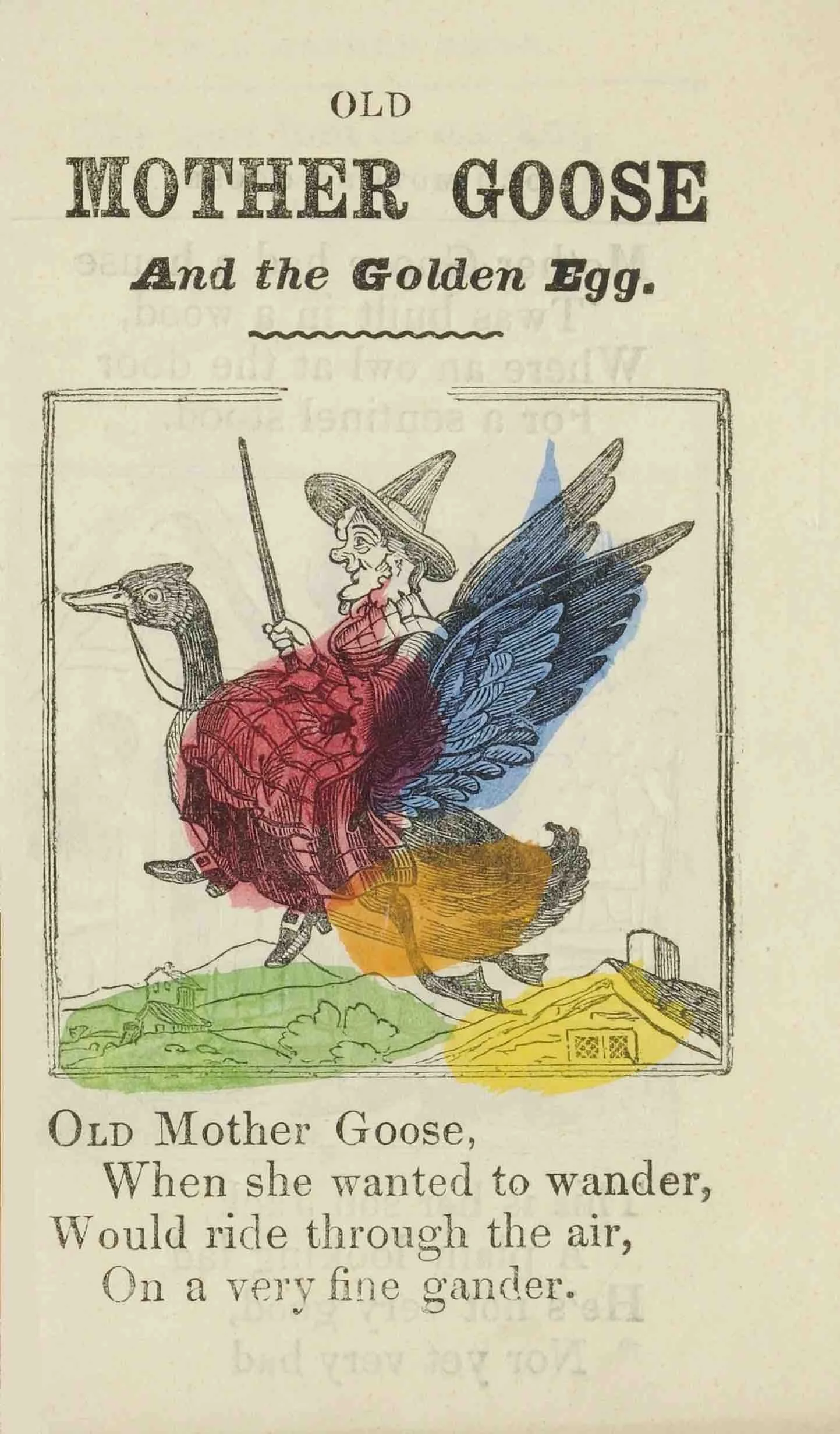
And then I would say when we get to Finnegans Wake — perhaps the greatest influence on the entire novel (and people will argue otherwise for sure) might be Mother Goose. On page one, we already have Humpty Dumpty, and this is from the first page of Finnegans Wake: “The great fall of the offwall entailed at such short notice the pftjschute of Finnegan, erse solid man, that the humptyhillhead of humself prumptly sends an unquiring one well to the west in quest of his tumptytumtoes” (3:18-21). So there we have Humpty Dumpty from the start.

Humpty Dumpty “Cruncheez” spelled à la Joyce.
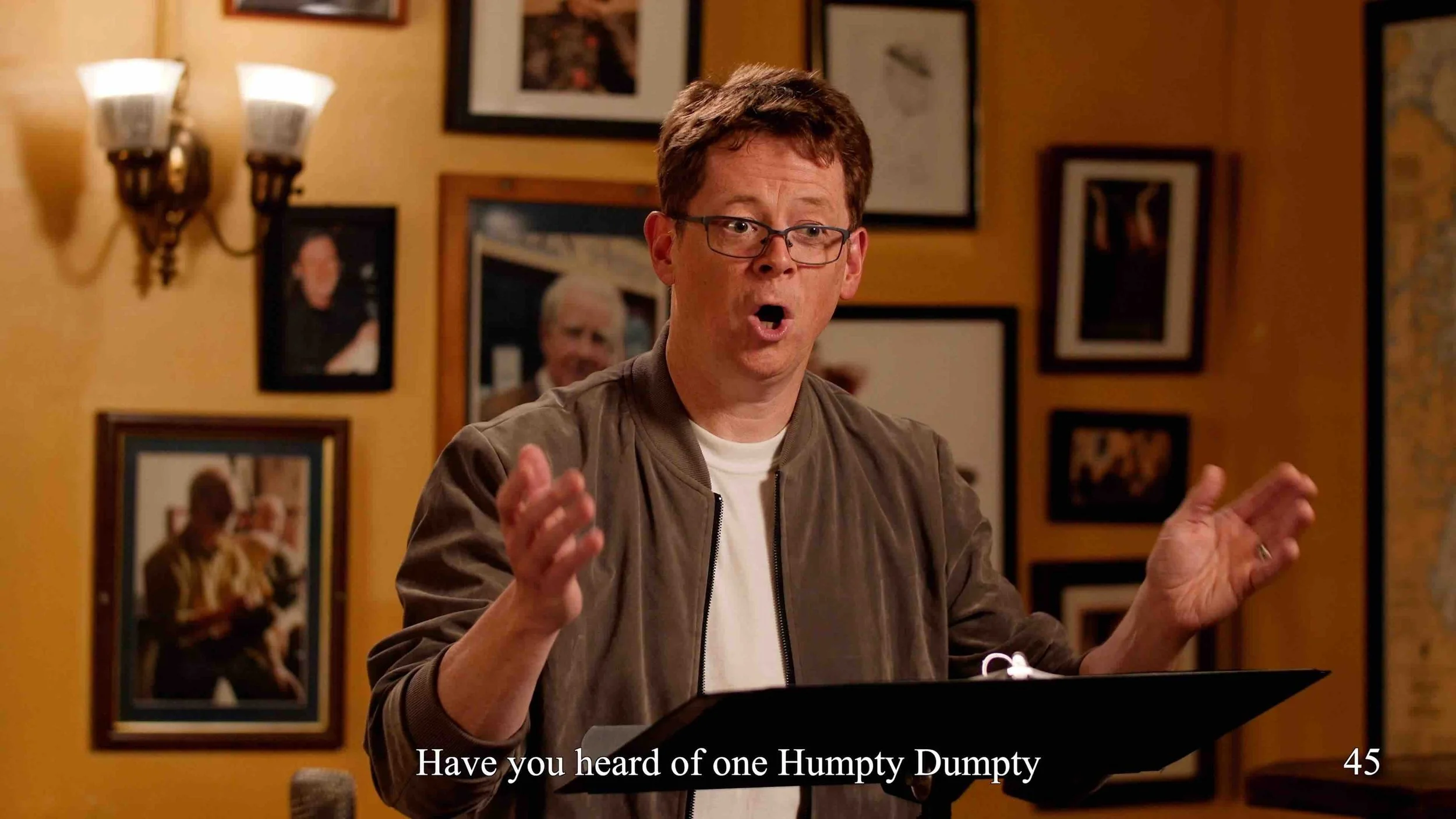
Richard Harte sings the Ballad of Persse O’Reilly (“Have you heard of one Humpty Dumpty…”) in One Little Goat’s film of Finnegans Wake, Chapter 2.
So we know we have someone who is taking “unserious” (I put in quotes) literature for children, and songs and games and so on, and taking them very, very seriously, and mining them and playing with them and stretching them. The first chapter of Book II, which is the chapter I’m rehearsing with Richard Harte now, is all children’s games, children’s dances, children’s songs, children’s rhymes. So the importance of childhood in this work and the playfulness that it brings is so essential.
And so now I want to turn to you one more time and hear maybe some play from your FinneGAN — another sentence or two that it’s played with or invented.
Nina Beguš: Yeah. I mean, approaching this pre-verbal world, I think, is the right identity to it. I’m trying to see what other sentences I’ve written down. Some were actually quite obscene. I’m looking at my folder right now to find them.
Adam Seelig: We want to hear the obscene ones. This is, of course, James Joyce’s world that we’re dealing with.
Adam Seelig: [recorded after the interview] After the interview, Nina successfully dug up the phrase she was thinking of, which her lab transcribed as, “Wanted him quite well for the Olympics. Kolopolitschevskiy rectum.” Here’s how FinneGAN’s original utterance sounded:
FinneGAN: Wanted him quite well for the Olympics. Kolopolitschevskiy rectum.
Adam Seelig: [recorded after the interview] And here’s another FinneGAN expression, transcribed as, “This is a gag out of I’m-a-slaughtering-to-you-with-a-sauce-and-a-stubber-ultra-meat.”
FinneGAN: This is a gag out of I’m-a-slaughtering-to-you-with-a-sauce-and-a-stubber-ultra-meat.
Adam Seelig: [recorded after the interview] And here’s one last phrase from FinneGAN, transcribed by Nina’s lab via speech recognition software as, “Boris’s tower. This round moves completely into my Abu Dhabi city.”
FinneGAN: “Boris’s tower. This round moves completely into my Abu Dhabi city.”
Adam Seelig: You’ve provided some examples of the expression, and we talked about the voice. And this is maybe a little bit strange, but — music and tone. Is that something that is going to play into FinneGAN?
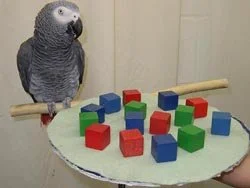
Alex the Parrot (1976-2007)
Nina Beguš: Well, we’re continuing this project with a second iteration, because we started talking about this all also in relation to animals, because there are, you know, machines have acquired human language. But there were some animals that have learned the rudiments of it, like parrots. And they would do imagitation in some sort of way where, you know, this Einstein parrot named Alex, by Irene Pepperberg — he didn’t know the word “apple.” We’re back with apples. But he knew “banana” and “cherry.” So he called the apple “banerry.”
Adam Seelig: Incredible.
Nina Beguš: And this is still so unexplored. And I mentioned already that Gašper works on deciphering whale communication, so we’ve been thinking about sound across humans and machines and also animals — just looking at these underlying principles that maybe work across neural networks, both biological and artificial. But we’ve also been wondering, you know, what’s the original sound? What was the first sound on Earth? Have we always had sound or speech? And I think when you describe now Joyce playing and going back to these childlike operations, approaching the pre-linguistic, pre-verbal word, world — this is really hard to do for an artist. Even if you look at visual artists, for example, right? They become really good in realism and then they go into some other style. And sometimes, you know, at the age of three and four and five, our children create masterpieces. I have a full house of just my kids’ paintings because sometimes they are just so good that you actually have to frame them. And as an artist, you’re kind of trying to go back to that unbounded exploration that you had as a child, that you could afford as a child because you did not know the rules. You did not know limitations, right? This is how it is with language. You’re just exploring it. We’ve all gone through these nursery rhymes and through these tales and stories because this is how you learn how to reason and how to think. So yeah, going all the way back to this — I think it’s more and more important because science has been completely separated from arts. But now, especially with AI, I think it’s becoming more important to have them together. And that hasn’t been always a case that they’ve been separated. I just read Lamarck’s biography and, you know, back in the day scientists would be inspired by a poem during their research process. So I think what we’re really trying to push for here is to have this more interdisciplinary approach to exploring what we see as pure technicality, as this technology.
Adam Seelig: I have a question for you about the GANs. Now you’re working with I imagine several — just for this purpose, let me narrow it down to two. Let me narrow it down to FinneGAN and the other one where you had eight words and then it invented the word — or imagitated the word — “start,” or something that was close to something we recognize and is almost — and even is — intelligible to us. And I’m asking about the difference between the two, because the one where you fed eight words — well, that’s not a lot. But the FinneGAN — did you feed the FinneGAN over 600 pages of text? Because that is obviously drastically more. And how did the limit of one influence that GAN versus the abundance of the other?
Nina Beguš: Yes. So there’s much more data. They are both very small models, but there’s much more data with the FinneGAN. And the way we did it is we use the audio for GANs, not text. So this is a novel that’s meant to be read aloud. I mean, in the paper, I think we put a reading from Sweny’s — where, you know, an actual place in Ireland where people still gather to read Ulysses and other works, because it’s a reference in the novel. So this sound aspect of Joyce is primary, right? Especially with Finnegans Wake.
Adam Seelig: Absolutely. I concur 100% — as someone who’s involved with filming and recording Richard Harte and Pip Dwyer reading all of this material, I couldn’t agree more. Yes, sorry, go on.
Nina Beguš: So the two models — the FinneGAN, because it is trained on four-second audios, I think, then produces sentences. But the concatenation GAN, the one that’s only trained on words, pretty much produces only words, although it has become so good that it started — basically rudimentary syntax — it started to place them one after another. So it would say “water, underwater,” or “Andrei, hi Andrei,” things like that. So it’s already, you know, evolving in that direction where it’s going from just words towards composing them. That’s why we call it the concatenation GAN.
Adam Seelig: And of course, when I say that the FinneGAN is much larger, that’s just a relative term. Of course, compared to any large language model, it is a drop in the bucket. And so that is fundamentally something very different in what you’re doing here from most of the artificial intelligence, AI, that most of us have had exposure to now — even on a daily basis in internet searches and so on.
Nina Beguš: Yeah. I mean, we did train an LLM also on Finnegans Wake — we just didn’t publish it here in this paper, but new papers are coming and it’s already accessible online. We just wanted to see the difference and how good the model is with imagitating words, with creating nonce words — words that could be words, but are not — like “tonard,” “least,” “castank,” right? What Joyce does. And the model is really good at it, turns out.
Adam Seelig: Fantastic. And if you’re ever open one day to training FinneGAN on our audio from our Finnegans Wake film series, we would be very open to that.
Nina Beguš: Wonderful.
Adam Seelig: I am wondering about that: is the audio that you shared or brought or trained, what have you, for your FinneGAN — is that audio read by a human or is it read out loud by a machine?
Nina Beguš: It’s read out loud by a machine. We didn’t want to get into a copyright issue. We were considering — I know there’s beautiful audio readings by, you know, Irish actors — we were considering using that. I’m sure it would have a different tone to it if we had.
Adam Seelig: Well if you ever wanted to do that, I know a couple of Irish actors who have been reading Finnegans Wake a lot. [Laugh] So talk to me and we’re very happy to share. And I think it’s just an extraordinary project that you’ve got going on here — that you have drawn this comparison between a kind of machine learning, a sort of infancy of machine learning, and the importance of infancy and pre-verbal / post-verbal / dream-verbal world of Finnegans Wake. It’s really, I think, an inspired connection that you’ve made. And this term that you’ve created is one that I anticipate I’ll be using in future, which is imagitation, this imitation plus imagination that is so actively a part of the GANs and, of course, so actively a part of the Finnegans Wake world.
Nina, thank you very much for joining us here, telling us about what you’re working on, telling us about your FinneGAN. And I look forward to future conversations in person and maybe in this format again in future.
Nina Beguš: Yes, that would be wonderful. Thanks so much for having me. It was a pleasure.
[End of interview]
Adam Seelig: That was my interview with Berkeley scholar Nina Beguš. Together with her colleagues Gašper Beguš, Metahaven and Riccardo Petrini, Nina is the author of “Latent Spacecraft: Brains, GANs, Finnegans,” to which you’ll find a link in the transcript for this podcast on One Little Goat Theatre Company’s website, www.OneLittleGoat.org. Join us in a fortnight for Episode 25 when Richard Harte continues Chapter 5 of Finnegans Wake. In the meantime, to be sure you don’t miss the episode, why not follow or subscribe to this podcast?
[Music: “Closing Credits (Ch05),” instrumental with Tyler Emond on bass, Jinu Isac on drums, Adam Seelig on piano, from the Finnegans Wake film series.]
For more on One Little Goat’s Finnegans Wake project, including transcripts of this podcast and the complete films of Chapters 1, 2 and 3 visit our website at OneLittleGoat.org. And to hear about upcoming performances and screenings, join our mailing list, also on our website.
One Little Goat Theatre Company is a nonprofit, artist-driven, registered charity in the United States and Canada that depends on donations from individuals to make our productions, including this one, possible. If you’re able, please make a tax-deductible donation through our website, www.OneLittleGoat.org Finnegans Wake is made possible by Friends of One Little Goat Theatre Company and the Emigrant Support Programme of the government of Ireland. Thank you for your support! Music for this episode was arranged and performed on the piano by yours truly, Adam Seelig, with Tyler Emond on bass and Jinu Isac on drums, recorded at Ghost Town Studio in Toronto. A big thank you once again to special guest Nina Beguš. Thank you as ever to the team at the Irish Consulate in Toronto. And thank you to Production Consultants Cathy Murphy and Andrew Moodie. Thank you for listening!
[Music fades out]
[End of Ep024]
Mentioned: Nina Beguš, Artificial Intelligence (AI), Digital Humanities, Stanford vs Cal (Berkeley), Frederick Wiseman, “At Berkeley” (film), FinneGAN, “imagitation,” latent spaces, GANs (Generative Adversarial Networks), large language models (LLMs), “What Finnegans Wake Teaches Us about AI,” “Latent Spacecraft Brains GANs Finnegans,” humanistic interpretability, eight-word experiment, whale communication, nonce words, child language acquisition and invention, children and language in Joyce (Dubliners, A Portrait of the Artist as a Young Man, Ulysses “Oxen of the Sun”, Finnegans Wake), Mother Goose, Humpty Dumpty, “the writing of the night,” dream language, pre-verbal language, Metahaven, Ricardo Petrini, Gašper Beguš, University of California Berkeley, Whisper speech recognition, deep fakes (of cats), “We inhabit a locked hole but can we use it?”, William Wordsworth’s “poetic spirit” in children, Shaw’s Pygmalion, Irene Pepperberg’s Alex the parrot, Richard Harte, Pip Dwyer, Sweny’s Pharmacy Dublin, interdisciplinary science and arts.
Resources: Transcript for this episode, including the text of Finnegans Wake.
Cited: “What Finnegans Wake Teaches Us about AI,” Paul Massari, Harvard Graduate School of Arts and Sciences, 2026-02-26.
“Latent Spacecraft Brains GANs Finnegans,” Nina Beguš, Gašper Beguš, Metahaven, Ricardo Petrini; Antikythera, https://latentspacecraft.antikythera.org/, 2026-03-02.