JAMES JOYCE’S FINNEGANS WAKE
Episode 027: THE (DIRTY) BOOK OF KELLS
PAGE 119:10-123:10 | CHAPTER 5 | 2026-07-30
PODCAST TRANSCRIPT
[Music: Instrumental of “The Alphabet Song (Variation On)” with Tyler Emond on bass, Jinu Isac on drums, Adam Seelig on piano, from the Finnegans Wake film series. Music fades out]
Adam Seelig: Welcome to James Joyce’s divine and delirious comedy, Finnegans Wake. In this episode, number 27, we’ll hear Irish-Canadian actor — and my good friend and colleague — Richard Harte performing pages 119 to 123 from Chapter 5 of Joyce’s last novel. I’m Adam Seelig, the director of the reading you’ll soon hear.
Will you be in Toronto on Tuesday, August 11th? If so, join us at the Winchester Street Theatre for a very special live taping of Book II Chapter 1 of Finnegans Wake. For more details and to reserve a seat, please visit One Little Goat Theatre Company’s website at www.OneLittleGoat.org
[Music: “Breakfast,” instrumental with Tyler Emond on bass, Jinu Isac on drums, Adam Seelig on piano, from the Finnegans Wake film series.]
Adam Seelig: Finnegans Wake is a production of One Little Goat Theatre Company. One Little Goat is filming and recording all 17 chapters (roughly 30 hours) of Joyce’s Finnegans Wake before live audiences in various locations, screening and releasing them along the way, with the aim of completing the entire book for its 90th birthday, May 4, 2029. One Little Goat Theatre Company is an official charity in Canada and the United States. To help us produce this first-of-its-kind filmed reading series — of which we’ve filmed 8 chapters so far, with 9 more to go — please visit OneLittleGoat.org to make a charitable donation. Your donation enables us to bring this production to audiences and helps support the outstanding artists who make it possible. To be the first to hear about our live tapings, events, and screenings, please join our mailing list, also at OneLittleGoat.org. [Music fades out]
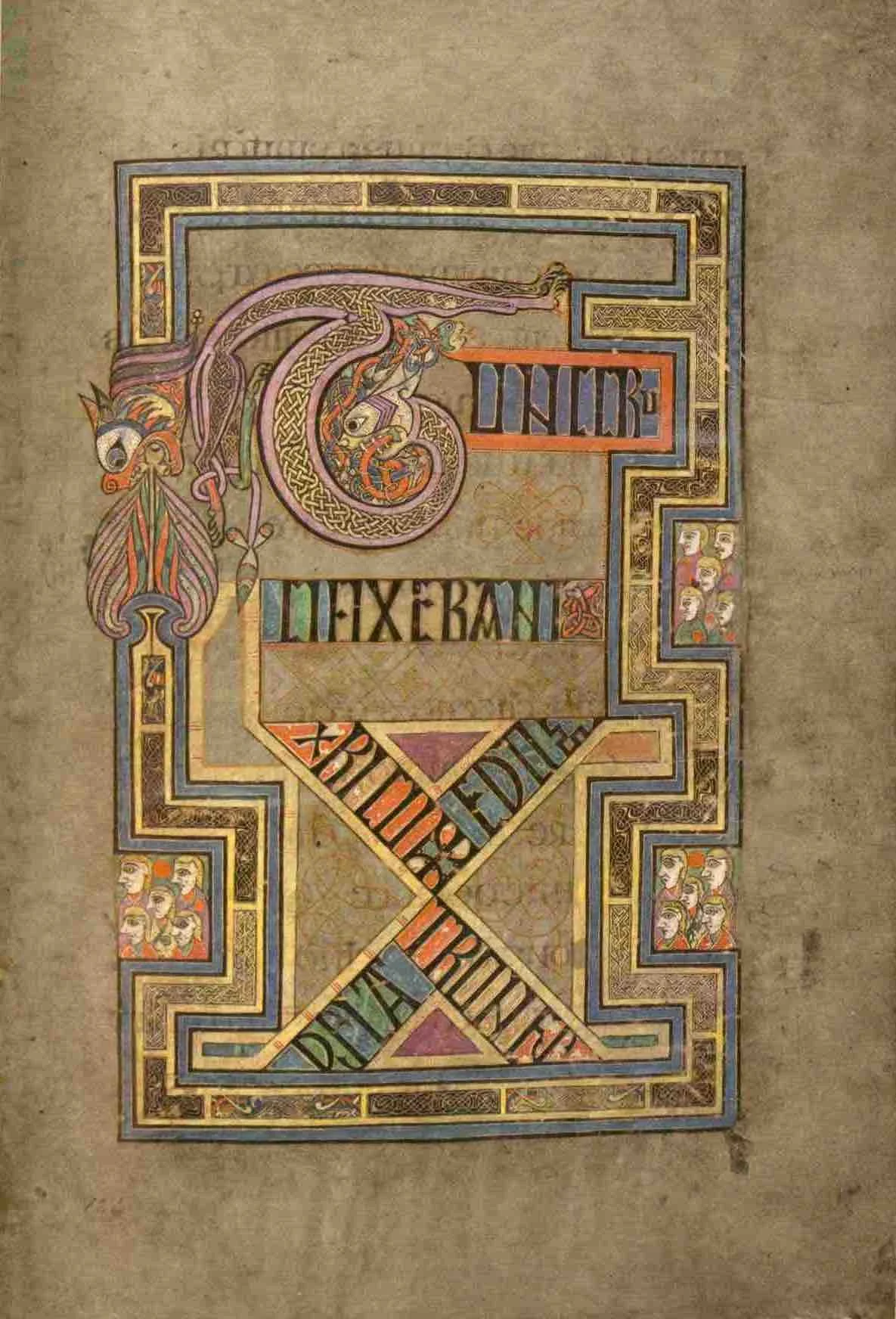
Tunc page from Book of Kells. “Tunc crucifixant cum eo duo latrones” (“Then they crucified two thieves with him,” Matthew 27:38.)
Adam Seelig: The Book of Kells is, with all due respect to the works of James Joyce, Ireland’s greatest literary treasure. An illuminated Celtic manuscript of the Gospels that dates back over 1,000 years, the Book of Kells was found, after being stolen and stripped of its gold-crusted case, in a pile of dirt. This medieval theft and discovery is recounted in the medieval Irish chronicle known as the Annals of Ulster, which describes the Book of Kells found “under a sod”, much like the Ardagh Chalice mentioned earlier in Chapter 5 of Finnegans Wake (Ep025). Of course this is all highly reminiscent of The Letter at the heart of this chapter, found by Belinda the Hen in a heap of litter.
A hundred years ago, Sir Edward Sullivan published his scholarly paean to the magnificent Book of Kells (1914). Sullivan’s publication, which included photographic plates of the illuminated medieval manuscript, became one of James Joyce’s favourite books. As Joyce wrote to his friend Arthur Power, “In all the places I have been to, Rome, Zurich, Trieste, I have taken it about with me, and have pored over its workmanship for hours. It is the most purely Irish thing we have, and some of the big initial letters which swing right across a page have the essential quality of a chapter of Ulysses.” Never short on ambition, Joyce wanted Finnegans Wake to be his Book of Kells: stylistically singular and instantly recognizable by any page. As he wrote to Power, “Indeed, you can compare much of my work to the intricate illuminations [of the Book of Kells]. I would like it to be possible to pick up any page of my book and know at once what book it is.” (Ellmann 545)
In today’s excerpt, our littery letter, this incomplete missive discovered on a dirty tea-stained scrap of paper, this (if you’ll allow me a little Yiddish) this bisl of an epistle will receive the Book of Kells treatment à la Edward Sullivan. Here is Sir Edward’s full-throated appreciation for Ireland’s glorious manuscript:
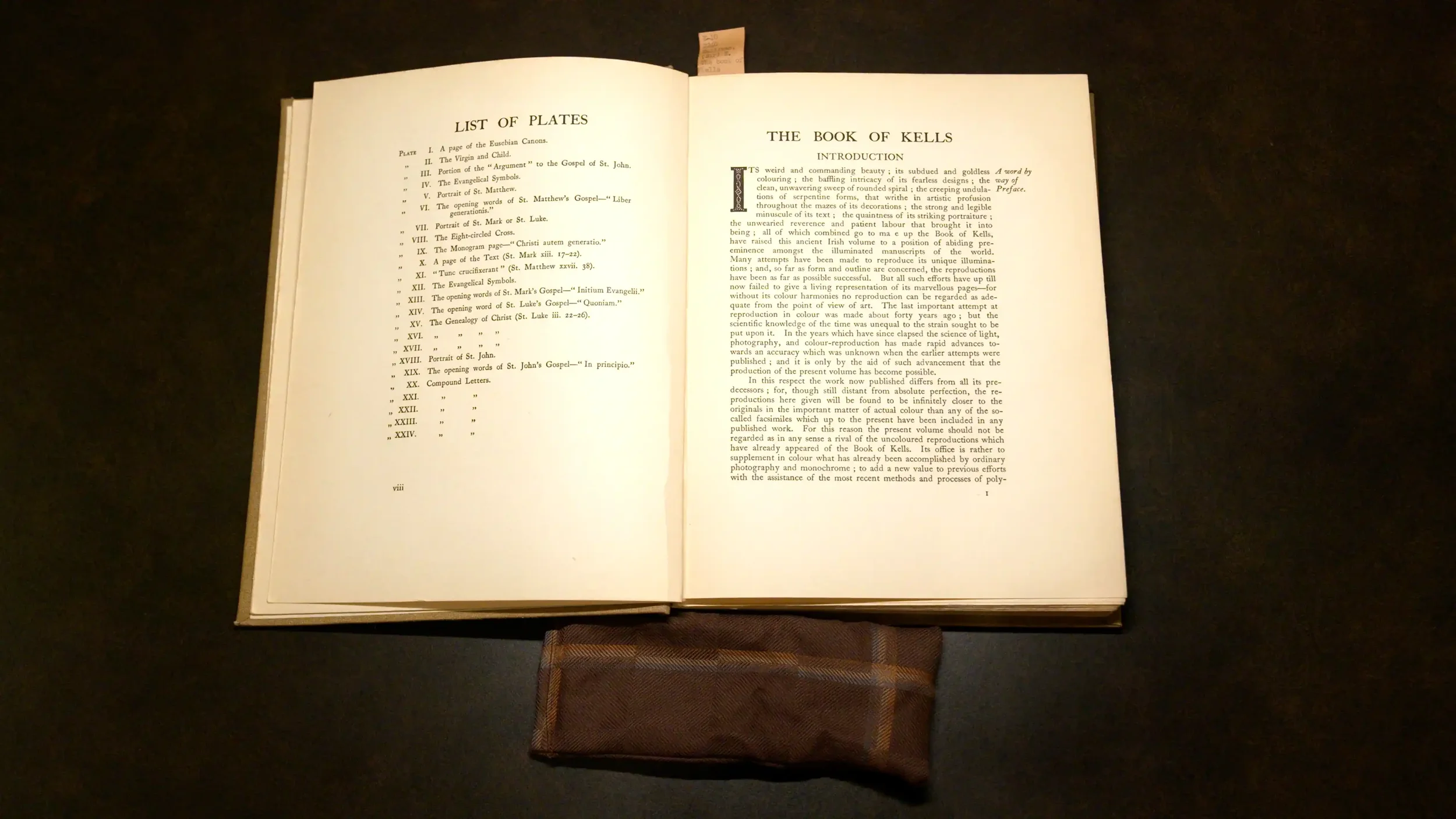
Sir Edward Sullivan’s intro to Book of Kells (Fisher Library, University of Toronto)
Its weird and commanding beauty; its subdued and godless colouring; the baffling intricacy of its fearless designs; the clean, unwavering sweep of rounded spiral; the creeping undulations of serpentine forms that writhe in artistic profusion through the mazes of its decorations; the strong and legible minuscule of its text; the quaintness of its striking portraiture; the unwearied reverence and patient labour that brought it into being; all of which combined go to make up the Book of Kells, have raised this ancient Irish volume to a position of abiding preeminence among the illuminated manuscripts of the world.
This is the wondrous tone that the Wake will adopt, and of course parody, in today’s excerpt, which scrutinizes practically every letter in The Letter with tremendous enthusiasm. As the Sullivanesque analysis will urge us at one point, “look at this”! (120:9) It will also introduce all kinds of symbols and sigla to represent our protagonists, HCE and ALP, and their children and environment. So lively is this description of the various letters and sigla of The Letter that I think of today’s excerpt as a ‘dance of letters’.
Some of my favourite moments include ALP represented as a triangle or delta, a most fitting symbol for our riverrunning female protagonist; the letter “W” described scatologically as a seated tuches “floprightdown” (120:32); and the confusion of the letters “P” and “K,” resulting in “thence your pristopher polombos, hence our Kat Kresbyterians” (120:2) instead of Christopher Columbus and Pat Presbyterians.
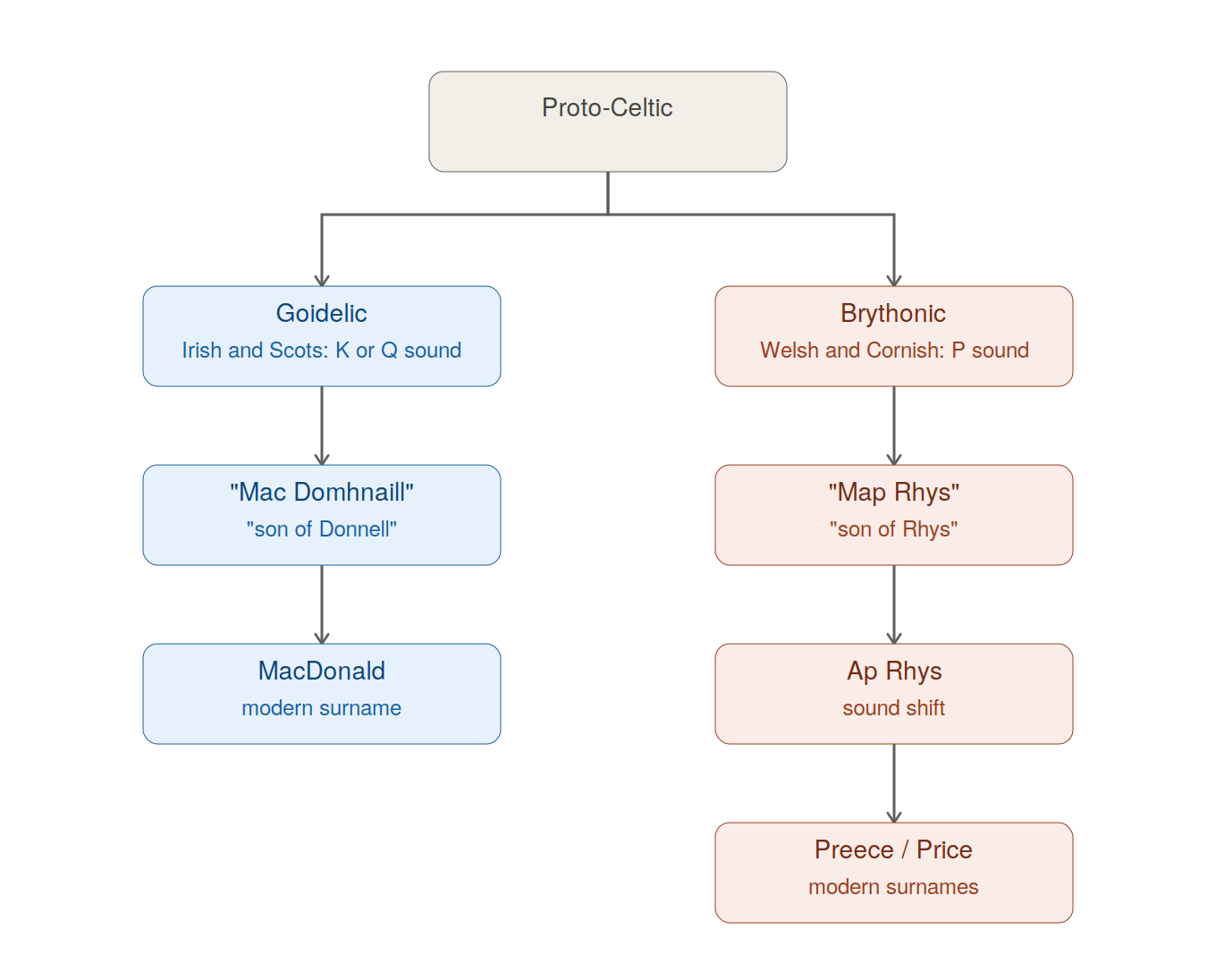
P/K (or P/Q) split in Celtic language
This swap of letters “P” and “K” might at first appear simply playful—or perhaps I should say clayful—but as is always the case with the Wake, it points to so much more: in this case, the P/K split, also known as the P/Q split, in the history of the Celtic language. The Wake plays with this P/K motif throughout the novel, so I’ll take a moment to describe it. Roughly three thousand years ago, Celtic language pronunciations went in two directions: the Irish and Scots inclined toward “K” or “Q” or “hard C” enunciations, while the Welsh and Cornish took to “P” as their plosive of preference. This elocutionary difference can still be found today in, for example, traditional Celtic names. Where the Irish use “Mac” with a “hard C” to mean “son of” in a traditional surname like MacDonald or McDonnell (i.e. son of Donnell), the Welsh used “Map” with a “P” to signify “son of,” such that Map Rhys (i.e. son of Rhys), which evolved into “Ap Rhys,” which in turn evolved into today’s “Preece” and “Price.” (For those wanting to dive deeper into these linguistics, I’ll link in the podcast transcript to Brendan O Hehir’s book A Gaelic Lexicon for Finnegans Wake.)
And throughout this dance of letters we’ll hear some turns of phrase that match Sir Edward’s verbal felicity, my favourite in today’s excerpt being: “here keen again and begin again to make soundsense and sensesound kin again” (121:15).
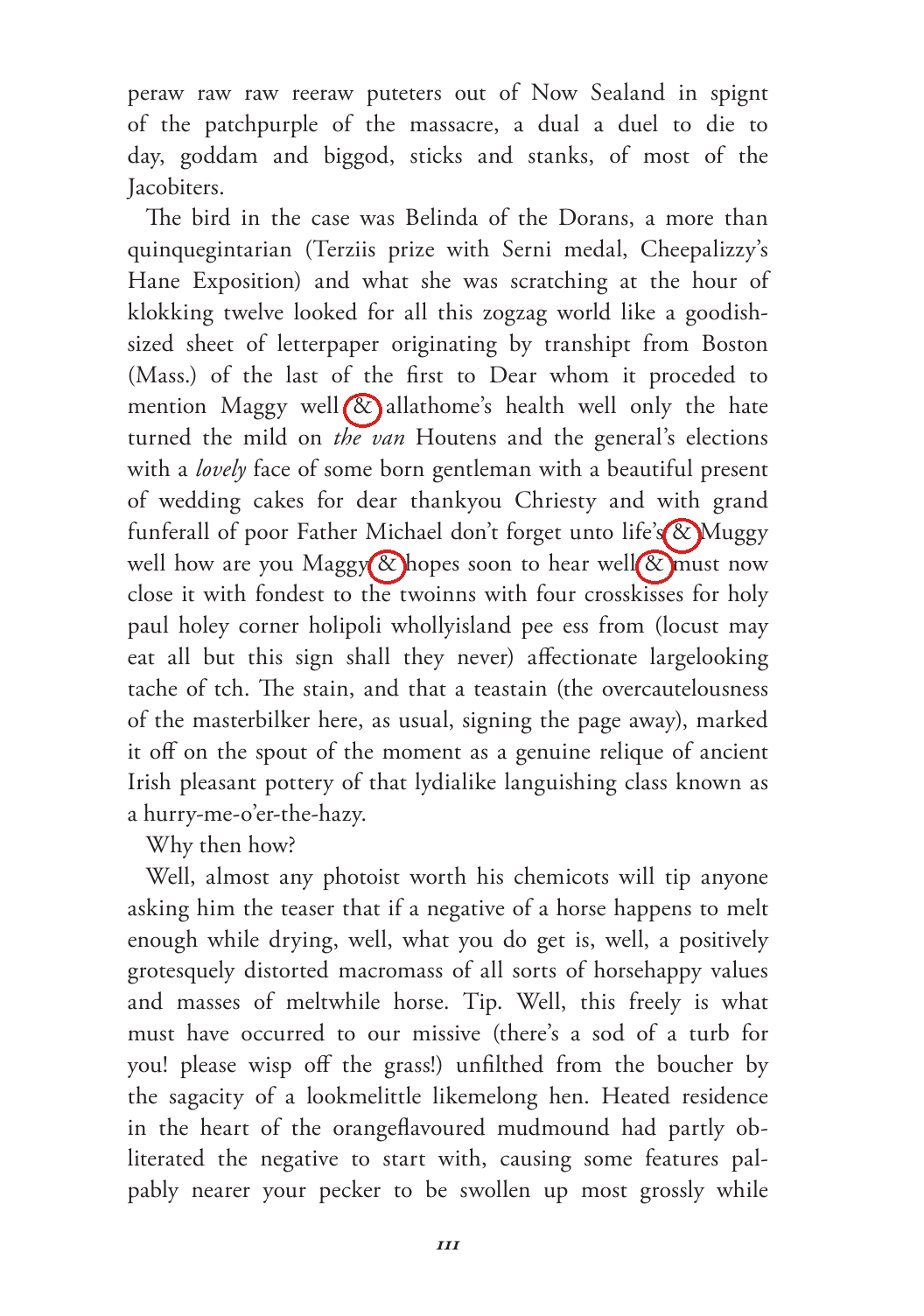
The Wake’s analysis of The Letter goes on to describe “four shortened ampersands” (121:36-122:1), correlating to the four ampersands that indeed appear in The Letter back on page 111 (Ep025), and these four marks will transform briefly, surreally into a heated card game between ‘the four of them,’ those recurring old men we’ve encountered in previous chapters representing the four compass points of Ireland, with Belfast in the north, Cork in the south, Dublin east and Galway west.
We then return to The Letter, now compared explicitly to the Book of Kells, with specific reference to the Tunc page of the illuminated Celtic manuscript, of which I’ll post an image in the podcast transcript because some of the descriptions of The Letter could also apply to the Tunc page; look, for example, for the “three squads of candidates […] in their three ballotboxes” (122:26) on the Tunc page.
But “the tenebrous Tunc page of the Book of Kells” (122:22-23) also points to something darker lurking in The Letter, reminding us of the mystery that haunts Chapter 5 right up to its very end, i.e. who in fact wrote The Letter; who is behind it?
The Tunc page is named for the first and most prominent word on that particular manuscript page, which reads, in Latin, “Tunc crucifixant cum eo duo latrones”, “Then they crucified two thieves with him”, from Matthew 27:38, which some will recognize from the King James Bible — “Then were there two thieves crucified with [Jesus], one on the right hand, and another on the left.” — and others will know from St. Augustine’s “Do not despair; one of the thieves was saved. Do not presume; one of the thieves was damned.” — an elegant formulation so admired by Samuel Beckett that it figures in a little play he wrote called Waiting for Godot. (No doubt Beckett in writing Godot was also thinking of his hero Joyce’s allusions to the Tunc page in the Wake.)
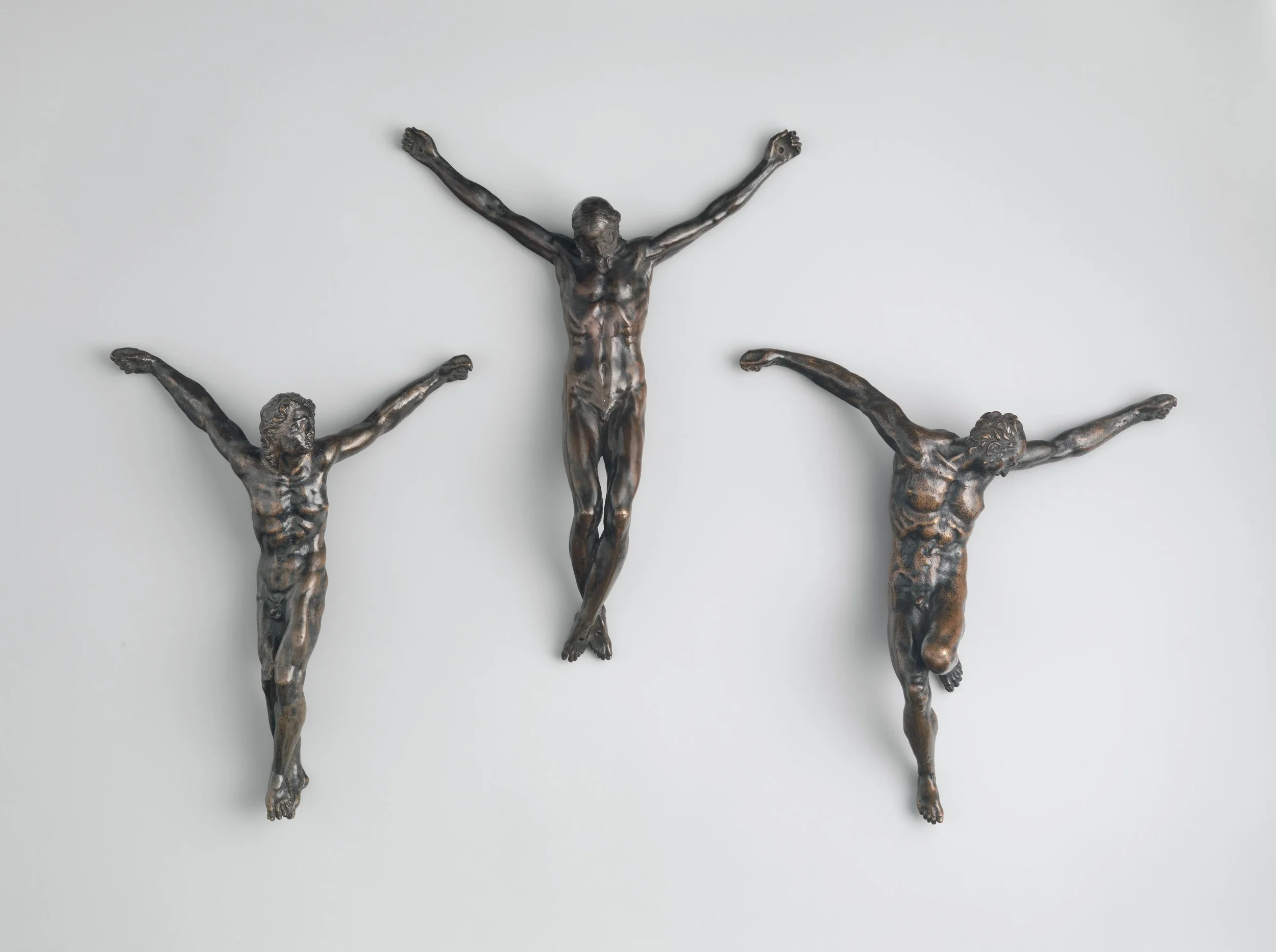
“Christ and the Two Thieves Crucified” (bronze, multiple artists, 1570) (Metropolitan Museum of Art)
Two thieves: one saved, one damned. So something sinister is at play in The Letter, and what ostensibly sounded like a full-throated, sunny appraisal of the tea-stained epistle turns out to contain plenty of shade. Keep an ear out, for example, for some of these words and phrases when you hear Richard reading today’s excerpt:
— “this, for instance, utterly unexpected sinistrogyric return to one peculiar sore point in the past” (120:27-28);
— “one of them as wrongheaded as his Claudian brother” (120:36-121:1);
— “skelterfugue” suggesting subterfuge (121:28);
— “the third person is the person darkly spoken of” (122:31);
— “imperfectible moral blindness” (122:35-36).

Negativity and suspicions have been creeping in all along, to the point where today’s excerpt will leave us hanging with doubts. Could it be that “a big thick dhee” (i.e. a man!) is behind The Letter (123:1-2)? (“a big thick dhee” brings to mind that Monty Python character in the Life of Brian known as Biggus Dickus.) Could it be that The Letter was written not by Anna Livia Plurabelle, a woman, but by, as the final four words of today’s excerpt suggest, “a meandering male fist?” (123:10)
Now it’s time for Richard’s performance of James Joyce’s Finnegans Wake, page 119 line 10 to page 123 line 10 of Chapter 5. The performance was filmed and recorded at the Thomas Fisher Rare Book Library, University of Toronto on October 21st, 2024 with a live audience. And since today’s excerpt is so alphabetically lively, taking great pleasure in the very letters of The Letter, the brief opening music you’ll hear, which I wrote for piano trio with Tyler Emond on bass and Jinu Isac on drums, offers a variation on the “ABC Song”.
[Music: “The Alphabet Song (Variation On),” instrumental with Tyler Emond on bass, Jinu Isac on drums, Adam Seelig on piano, from the Finnegans Wake film series.]
[Richard Harte reads Finnegans Wake 119:10-123:10]
[119] For, with that farmfrow's foul flair for that flayfell foxfetor,
(the calamite's columitas calling for calamitous calamitance) who
that scrutinising marvels at those indignant whiplooplashes; those
so prudently bolted or blocked rounds; the touching reminiscence
of an incompletet trail or dropped final; a round thousand whirli-
gig glorioles, prefaced by (alas!) now illegible airy plumeflights,
all tiberiously ambiembellishing the initials majuscule of Ear-
wicker: the meant to be baffling chrismon trilithon sign [E], finally
called after some his hes hecitency Hec, which, moved contra-
watchwise, represents his title in sigla as the smaller Δ, fontly
called following a certain change of state of grace of nature alp
or delta, when single, stands for or tautologically stands beside
the consort: (though for that matter, since we have heard from
Cathay cyrcles how the hen is not mirely a tick or two after the
first fifth fourth of the second eighth twelfth — siangchang
hongkong sansheneul — but yirely the other and thirtieth of the
ninth from the twentieth, our own vulgar 432 and 1132 irre-
spectively, why not take the former for a village inn, the latter
for an upsidown bridge, a multiplication marking for crossroads
ahead, which you like pothook for the family gibbet, their old
fourwheedler for the bucker's field, a tea anyway for a tryst
someday, and his onesidemissing for an allblind alley leading to
an Irish plot in the Champ de Mors, not?) the steady monologuy
of the interiors; the pardonable confusion for which some blame
the cudgel and more blame the soot but unthanks to which
the pees with their caps awry are quite as often as not taken
for kews with their tails in their or are quite as often as not
[120] taken for pews with their tails in their mouths, thence your
pristopher polombos, hence our Kat Kresbyterians; the curt
witty wotty dashes never quite just right at the trim trite
truth letter; the sudden spluttered petulance of some capItalIsed
mIddle; a word as cunningly hidden in its maze of confused
drapery as a fieldmouse in a nest of coloured ribbons: that ab-
surdly bullsfooted bee declaring with an even plainer dummp-
show than does the mute commoner with us how hard a thing it
is to mpe mporn a gentlerman: and look at this prepronominal
funferal, engraved and retouched and edgewiped and pudden-
padded, very like a whale's egg farced with pemmican, as were it
sentenced to be nuzzled over a full trillion times for ever and a
night till his noddle sink or swim by that ideal reader suffering
from an ideal insomnia: all those red raddled obeli cayennepep-
percast over the text, calling unnecessary attention to errors,
omissions, repetitions and misalignments: that (probably local or
personal) variant maggers for the more generally accepted ma-
jesty which is but a trifle and yet may quietly amuse: those super-
ciliouslooking crisscrossed Greek ees awkwardlike perched there
and here out of date like sick owls hawked back to Athens: and
the geegees too, jesuistically formed at first but afterwards genu-
flected aggrily toewards the occident: the Ostrogothic kako-
graphy affected for certain phrases of Etruscan stabletalk and, in
short, the learning betrayed at almost every line's end: the head-
strength (at least eleven men of thirtytwo palfrycraft) revealed
by a constant labour to make a ghimel pass through the eye of an
iota: this, for instance, utterly unexpected sinistrogyric return to
one peculiar sore point in the past; those throne open doubleyous
(of an early muddy terranean origin whether man chooses to
damn them agglutinatively loo — too — blue — face — ache or
illvoodawpeehole or, kants koorts, topplefouls) seated with such
floprightdown determination and reminding uus ineluctably of
nature at her naturalest while that fretful fidget eff, the hornful
digamma of your bornabarbar, rarely heard now save when falling
from the unfashionable lipsus of some hetarosexual (used always
in two boldfaced print types — one of them as wrongheaded as
[121] his Claudian brother, is it worth while interrupting to say? —
throughout the papyrus as the revise mark) stalks all over the
page, broods [F] sensationseeking an idea, amid the verbiage,
gaunt, stands dejectedly in the diapered window margin, with
its basque of bayleaves all aflutter about its forksfrogs, paces
with a frown, jerking to and fro, flinging phrases here, there, or
returns inhibited, with some half-halted suggestion, [F], dragging
its shoestring; the curious warning sign before our protoparent's
ipsissima verba (a very pure nondescript, by the way, sometimes
a palmtailed otter, more often the arbutus fruitflowerleaf of the
cainapple) which paleographers call a leak in the thatch or the
aranman ingperwhis through the hole of his hat, indicating that the
words which follow may be taken in any order desired, hole of
Aran man the hat through the whispering his ho (here keen
again and begin again to make soundsense and sensesound kin
again); those haughtypitched disdotted aiches easily of the rariest
inasdroll as most of the jaywalking eyes we do plough into halve,
unconnected, principial, medial or final, always jims in the jam,
sahib, as pipless as threadworms: the innocent exhibitionism of
those frank yet capricious underlinings: that strange exotic serpen-
tine, since so properly banished from our scripture, about as freak-
wing a wetterhand now as to see a rightheaded ladywhite don a
corkhorse, which, in its invincible insolence ever longer more and
of more morosity, seems to uncoil spirally and swell lacertinelazily
before our eyes under pressure of the writer's hand; the ungainly
musicianlessness so painted in sculpting selfsounder ah ha as
blackartful as a podatus and dumbfounder oh ho oaproariose as
ten canons in skelterfugue: the studious omission of year number
and era name from the date, the one and only time when our
copyist seems at least to have grasped the beauty of restraint; the
lubricitous conjugation of the last with the first: the gipsy mat-
ing of a grand stylish gravedigging with secondbest buns (an in-
terpolation: these munchables occur only in the Bootherbrowth
family of MSS., Bb — Cod IV, Pap II, Brek XI, Lun III, Dinn
XVII, Sup XXX, Fullup M D C X C: the scholiast has hungrily
misheard a deadman's toller as a muffinbell): the four shortened
[122] ampersands under which we can glypse at and feel for ourselves
across all those rushyears the warm soft short pants of the quick-
scribbler: the vocative lapse from which it begins and the accu-
sative hole in which it ends itself; the aphasia of that heroic agony
of recalling a once loved number leading slip by slipper to a
general amnesia of misnomering one's own: next those ars, rrrr!
those ars all bellical, the highpriest's hieroglyph of kettletom and
oddsbones, wrasted redhandedly from our hallowed rubric prayer
for truce with booty, O'Remus pro Romulo, and rudely from the
fane's pinnacle tossed down by porter to within an aim's ace of
their quatrain of rubyjets among Those Who arse without the
Temple nor since Roe's Distillery burn'd have quaff'd Night's
firefill'd Cup But jig jog jug as Day the Dicebox Throws, whang,
loyal six I lead, out wi'yer heart's bluid, blast ye, and there she's
for you, sir, whang her, the fine ooman, rouge to her lobster
locks, the rossy, whang, God and O'Mara has it with his ruddy
old Villain Rufus, wait, whang, God and you're another he
hasn't for there's my spoil five of spuds's trumps, whang, whack
on his pigsking's Kisser for him, K.M. O'Mara where are you?;
then (coming over to the left aisle corner down) the cruciform
postscript from which three basia or shorter and smaller oscula
have been overcarefully scraped away, plainly inspiring the tene-
brous Tunc page of the Book of Kells (and then it need not be
lost sight of that there are exactly three squads of candidates for
the crucian rose awaiting their turn in the marginal panels of
Columkiller, chugged in their three ballotboxes, then set apart for
such hanging committees, where two was enough for anyone,
starting with old Matthew himself, as he with great distinction
said then just as since then people speaking have fallen into the
custom, when speaking to a person, of saying two is company
when the third person is the person darkly spoken of, and then
that last labiolingual basium might be read as a suavium if who-
ever the embracer then was wrote with a tongue in his (or per-
haps her) cheek as the case may have been then) and the fatal
droopadwindle slope of the blamed scrawl, a sure sign of imper-
fectible moral blindness; the toomuchness, the fartoomanyness
[123] of all those fourlegged ems: and why spell dear god with a big
thick dhee (why, O why, O why?): the cut and dry aks and wise
form of the semifinal; and, eighteenthly or twentyfourthly, but
at least, thank Maurice, lastly when all is zed and done, the pene-
lopean patience of its last paraphe, a colophon of no fewer than
seven hundred and thirtytwo strokes tailed by a leaping lasso —
who thus at all this marvelling but will press on hotly to see the
vaulting feminine libido of those interbranching ogham sex up-
andinsweeps sternly controlled and easily repersuaded by the
uniform matteroffactness of a meandering male fist?
[End of excerpt]
Adam Seelig: That was Richard Harte reading pages 119 to 123 from Chapter 5 of Finnegans Wake, recorded live at the Fisher Rare Book Library in Toronto on October 21st, 2024. Join us for Episode 28 in a fortnight for the conclusion of Chapter 5. In the meantime, to be sure you don’t miss the episode, why not follow or subscribe to this podcast?
[Music: “Closing Credits (Ch05),” instrumental with Tyler Emond on bass, Jinu Isac on drums, Adam Seelig on piano, from the Finnegans Wake film series.]
For more on One Little Goat’s Finnegans Wake project, including transcripts of this podcast and the complete films of Chapters 1, 2 and 3 visit our website at OneLittleGoat.org. And to hear about upcoming performances and screenings, join our mailing list, also on our website. One Little Goat Theatre Company is a nonprofit, artist-driven, registered charity in the United States and Canada that depends on donations from individuals to make our productions, including this one, possible. If you’re able, please make a tax-deductible donation through our website, www.OneLittleGoat.org. Finnegans Wake is made possible by Friends of One Little Goat Theatre Company and the Emigrant Support Programme of the government of Ireland. Thank you for your support! And thank you to the artists for this episode: Richard Harte; Sound by William Bembridge; Stage Management by Sandi Becker; Directed by yours truly, Adam Seelig; Music arranged and performed on the piano by me, with Tyler Emond on bass and Jinu Isac on drums, recorded at Ghost Town Studio in Toronto. A big thanks to John Shoesmith, Special Collections Librarian, to David Fernández, Head of Rare Books and Special Collections, and to their colleagues at the Fisher Rare Book Library at the University of Toronto, as well as to our wonderful live audience. Thank you to the team at the Irish Consulate in Toronto. And thank you to Production Consultants Cathy Murphy and Andrew Moodie. Thank you for listening!
[Music fades out] [End of Ep027]
Mentioned: Book of Kells, literary Celtic treasure, found in dirt, Sir Edward Sullivan, Joyce admiring Book of Kells, dance of the letters, the letters of The Letter, symbols and sigla, P/K or P/Q split in Celtic language (Welsh/Irish), ‘the four of them,’ the Tunc page in Book of Kells, Jesus and two thieves, St. Augustine, Samuel Beckett, Waiting for Godot, Monty Python, suspicions about who wrote the letter, written by woman or man?, synopsis.
Resources: Transcript for this episode, including the text of Finnegans Wake.
Finnegans Wake (1939) by James Joyce: there are many free copies of FW to read online or download, e.g. finwake.com
James Joyce Digital Archive, “Chicken Guide” to Finnegans Wake provides a ‘plain English’ paraphrase of each chapter by Danis Rose.
Richard Ellmann’s biography of James Joyce. Oxford University Press, 1982.
Edmund Epstein, A Guide through Finnegans Wake. University Press of Florida, 2009.
Adaline Glasheen, Third Census of Finnegans Wake: An Index of the Characters and Their Roles, University of California Press, 1977.
John Gordon’s annotations on his Finnegans Wake blog.
Roland McHugh, Annotations to Finnegans Wake (4th edition). Johns Hopkins University Press, 2016.
Raphael Slepon, fweet.org
William York Tindall, A Reader’s Guide to Finnegans Wake. Syracuse University Press, 1996.
Cited: Sir Edward Sullivan. The Book of Kells. London, The Studio, 1914.
Brendan O Hehir. A Gaelic Lexicon for Finnegans Wake. Berkeley, University of California Press, 1967.