JAMES JOYCE’S FINNEGANS WAKE
Episode 025:
Letter from boston, thunderword #5
PAGE 109:1-114:20 | CHAPTER 5 | 2026-07-02
PODCAST TRANSCRIPT
[Music: Instrumental of “The Alphabet Song (Variation On)” with Tyler Emond on bass, Jinu Isac on drums, Adam Seelig on piano, from the Finnegans Wake film series. Music fades out]
Adam Seelig: Welcome to James Joyce’s divine and delirious comedy, Finnegans Wake. In this episode, number 25, we’ll hear Irish-Canadian actor — and my good friend and colleague — Richard Harte performing pages 109 to 114 from Chapter 5 of Joyce’s last novel. I’m Adam Seelig, the director of the reading you’ll soon hear. This episode is releasing on July the 2nd of 2026, so I’d like to wish all the Canadian listeners out there a Happy belated Canada Day; and to the Americans, a Happy early Fourth of July.
[Music: “Breakfast,” instrumental with Tyler Emond on bass, Jinu Isac on drums, Adam Seelig on piano, from the Finnegans Wake film series.]
Adam Seelig: Finnegans Wake is a production of One Little Goat Theatre Company. One Little Goat is filming and recording all 17 chapters (roughly 30 hours) of Joyce’s Finnegans Wake before live audiences in various locations, screening and releasing them along the way, with the aim of completing the entire book for its 90th birthday, May 4, 2029. One Little Goat Theatre Company is an official charity in Canada and the United States. To help us produce this first-of-its-kind filmed reading series — of which we’ve filmed 8 chapters so far, with 9 more to go — please visit OneLittleGoat.org to make a charitable donation. Your donation enables us to bring this production to audiences and helps support the outstanding artists who make it possible. To be the first to hear about our live tapings, events, and screenings, please join our mailing list, also at OneLittleGoat.org. [Music fades out]
Adam Seelig: Boston, Massachusetts is the birthplace of the Irish American folk song that gives Finnegans Wake its title. It’s also the origin of the letter at the heart of Chapter 5 and of today’s excerpt — the letter written by ALP that will, she hopes, clear the name of her publicly maligned spouse, HCE. But was it in fact written by ALP? This mystery will continue to haunt Chapter 5 right up to the chapter’s very last line.
Today’s excerpt begins by focusing on The Envelope of The Letter, asking us if anyone has ever “looked sufficiently longly at a quite everydaylooking stamped addressed envelope?” Well if you haven’t, you’re about to, because, as the text tells us, an envelope is to a letter what underwear is to the naked body. It’s far more suggestive than you may have thought.
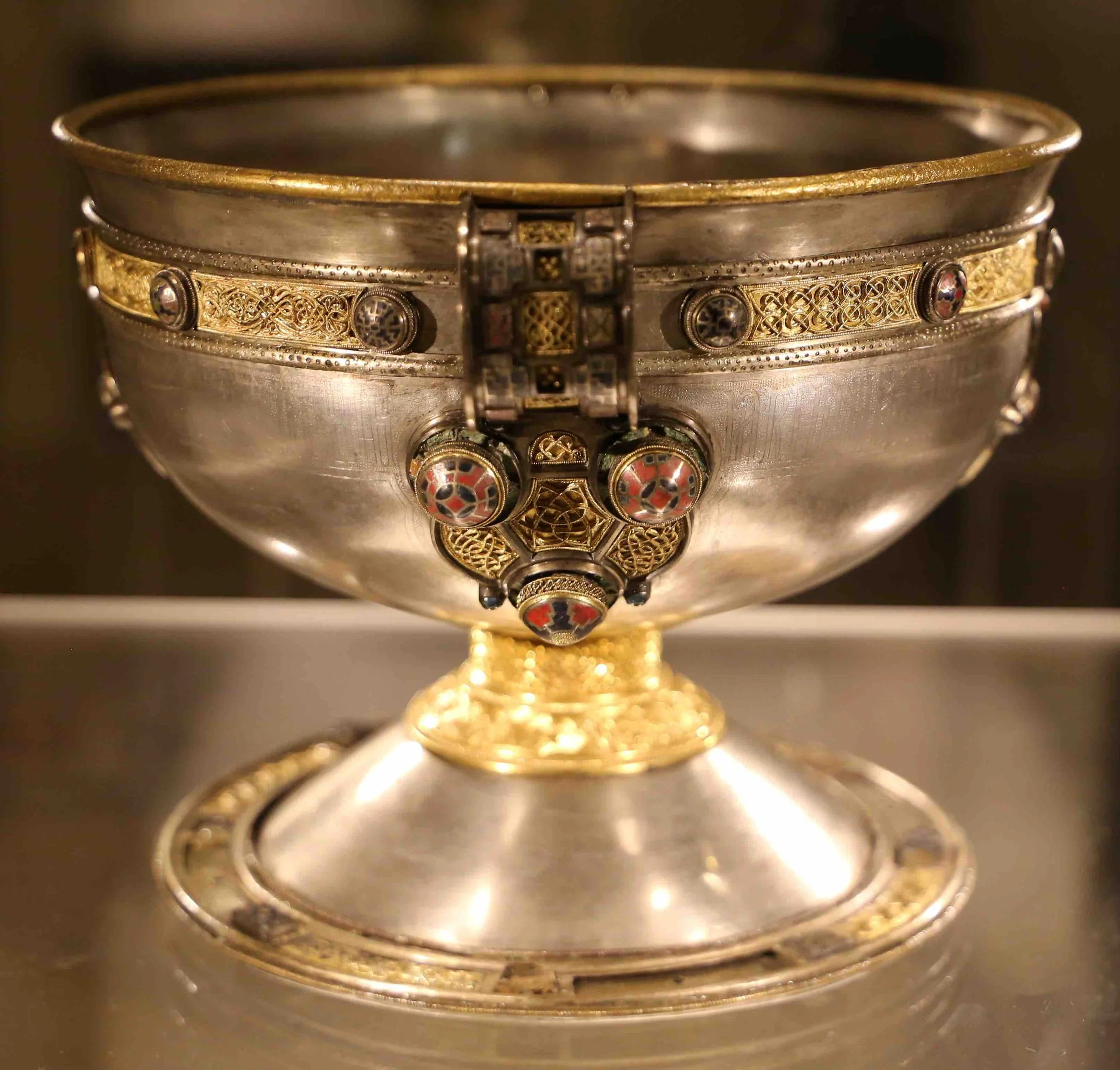
Ardagh Chalice, 8th Century CE (National Museum of Ireland)
We then return to our trusted hen, Belinda, who has pecked and picked out The Letter from a dump of litter; a littery letter that might even hold up as literature. Remember (and if you don’t, Finnegans Wake now reminds us), some of Ireland’s greatest treasures were discovered in even muckier contexts, like the Ardagh Chalice, the 1,100-year-old gold-silver-bronze-brass-and-pewter cup discovered accidentally in 1868 by two boys, Jim Quin and Paddy Flanagan, who were simply digging in the dirt for potatoes. So too the Book of Kells, Ireland’s extraordinary literary treasure, was discovered a thousand years ago hidden under — you guessed it — a pile of dirt. The Book of Kells will come up later in this chapter in more detail, and I’ve posted in the transcript for this podcast episode an image of the Ardagh Chalice; the real thing is on display at the National Museum of Ireland.
Now, on page 111, we get to hear The Letter itself. Like most letters, it was mailed from somewhere; in this case, “Boston (Mass.)”. Like most letters, it is dated; in this case, “the last of the first,” or the last day of the first month, i.e. the 31st of January. And like most letters, it begins with the word “Dear”. But who is the addressee? Here’s where the dream language of the Wake, true to form, becomes playfully elusive: “Dear whom it proceded to mention”. Based on these first words, the addressee appears to be nameless. But the very next word is the name “Maggy”. “Dear whom it proceded to mention Maggy”. So is the letter written to “Maggy”? Well, the very next words give us: “Dear whom it proceded to mention Maggy well & allathome's health well…” etc.
If The Letter had any commas, we could have determined to whom it’s addressed. But as it flows punctuationlessly, we can only guess at where its first comma might have gone. Was ALP’s intention — if indeed ALP wrote the letter — was her intention?:
“Dear whom it proceded to mention [COMMA,] Maggy well & allathome's health well…” etc.
Or was the intention?:
“Dear whom it proceded to mention Maggy [COMMA,] well & allathome's health well…” etc.
Without that vital comma, the Wake, always open to possibilities, ever rich in ambiguity, keeps its options open. Here’s a quick preview of Richard Harte setting up and reading The Letter in today’s excerpt:
…a goodish-sized sheet of letterpaper originating by transhipt from Boston (Mass.) of the last of the first to Dear whom it proceded to mention Maggy well & allathome's health well only the hate turned the mild on the van Houtens and the general's elections with a lovely face of some born gentleman with a beautiful present of wedding cakes for dear thankyou Chriesty and with grand funferall of poor Father Michael… (111:8-15)
I’ll save the rest so you can hear it all in context, but what you can probably already gather from this sample is that The Letter — perhaps reflecting the pile of litter in which Belinda the Hen found it — is a jumble of epistolary tropes, including news from home with reports on the weather, people’s health, current events, a wedding, a funeral (or in the language of the Wake, a “funferall”, echoing Tim Finnegan’s funeral in the Irish American folk song, “Lots of fun at Finnegan’s Wake”). For me, The Letter is an auditory equivalent of the cubist paintings and collages of Picasso and Braque, especially those that include scattered snippets of newspaper text (I’ll post some of these images in the podcast transcript). Picasso and Braque’s cubist works never give us a whole, autonomous story from Le Journal, but they certainly convey the experience of taking in the newspaper in bits and pieces. Similarly, The Letter of the Wake may not give us a whole, autonomous story from Boston, but it certainly conveys, through collage, the personal experience of writing and receiving news from Irish America. Collage, cubism, bricolage, composite — there are numerous ways to describe the style of The Letter, but perhaps pastiche comes closest, because Joyce felt it fitting once in his own personal correspondence (which, perhaps disappointingly, includes proper punctuation) to describe himself as a ‘cut-and-paste’ author: “I am quite content to go down to posterity as a scissors and paste man for that seems to me a harsh but not unjust description.” (Ellmann 626)

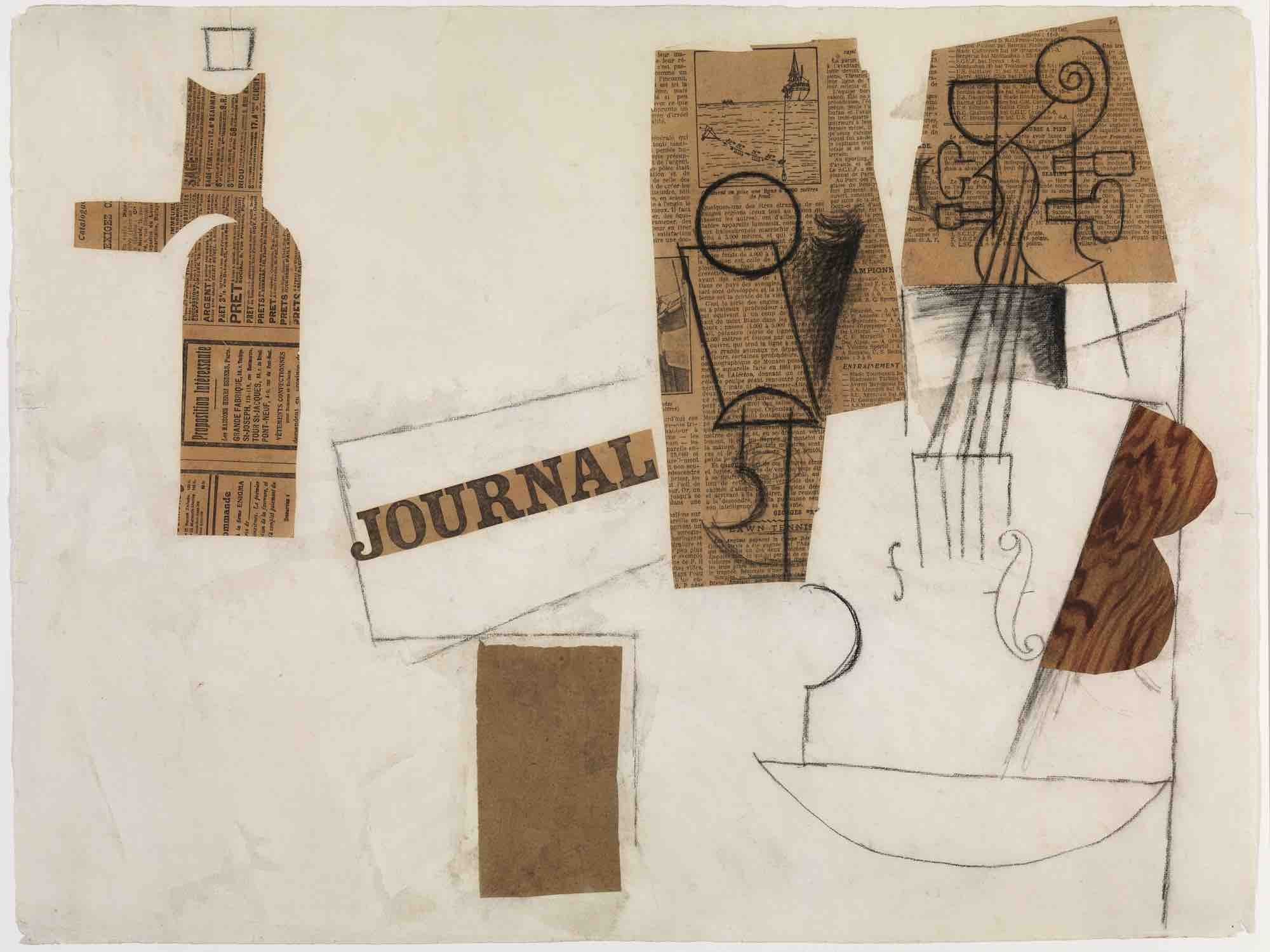
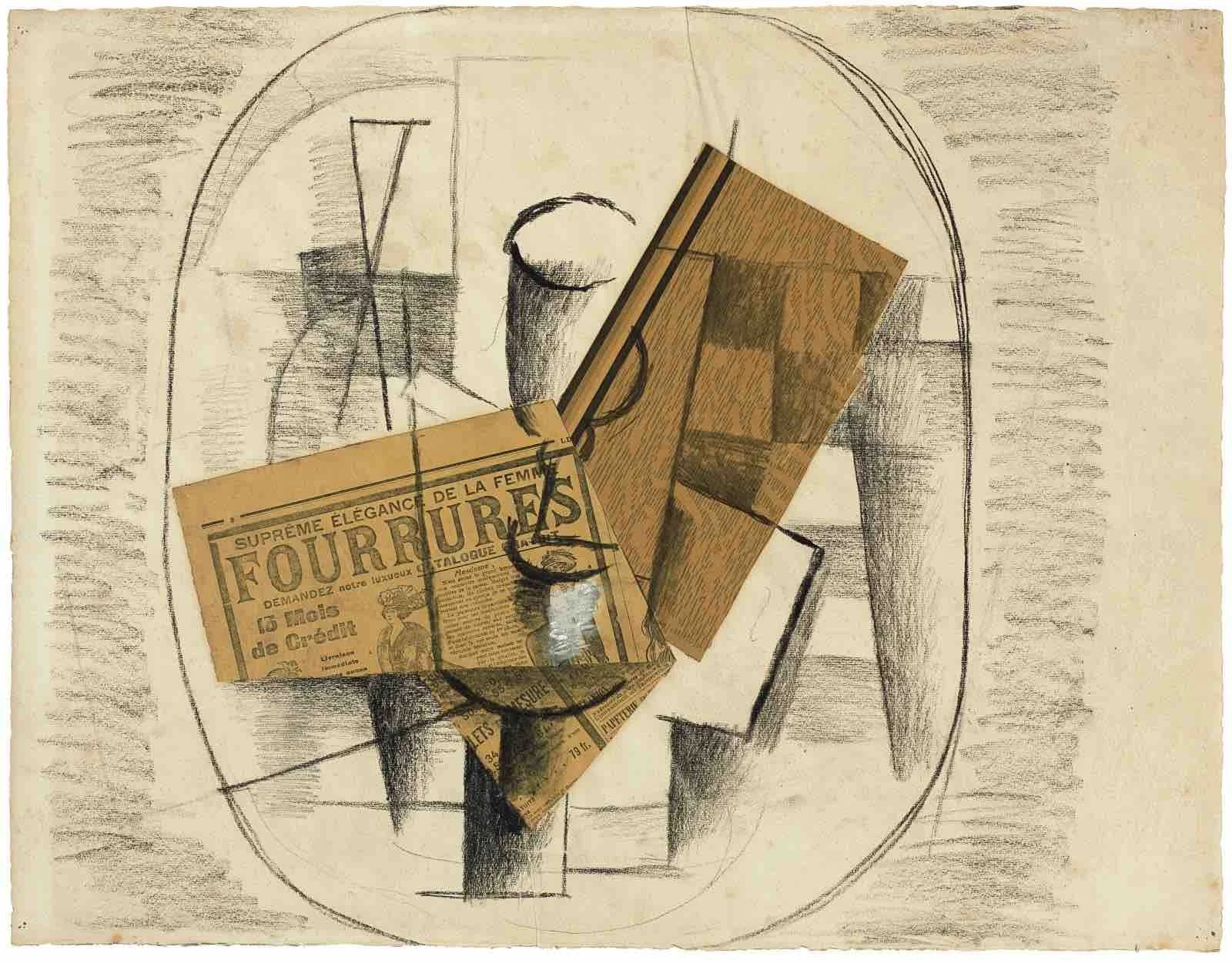
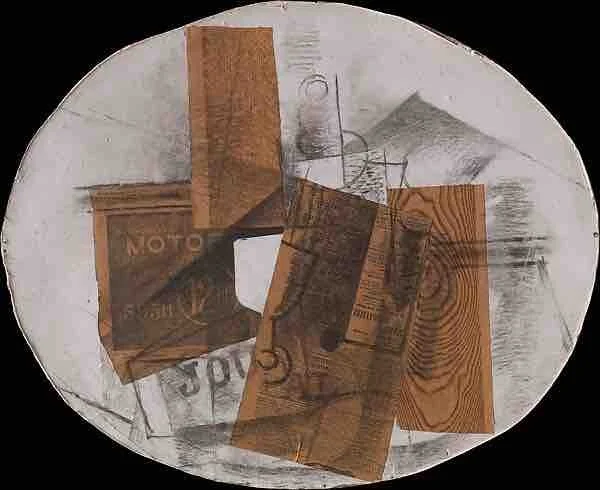
Above, clockwise from top left: Pablo Picasso “La bouteille de Suze” (1912); “Siphon, Glass, Newspaper, and Violin (1912); Georges Braque, “Verres et bouteilles (Fourrures)” (1914); “Bottle, Glass, Newspaper” (1914).
And while Picasso and Braque’s works often picture a bottle of wine or beer near their newspapers, the Wake prefers tea, choosing to put it on the very letter itself — quite literally, the only punctuation mark in The Letter is at the end, where, in lieu of a conventional period, we find a big tea stain, or in the language of the Wake, a “largelooking tache of tch. The stain, and that a teastain…”
For all my comparisons of The Letter to cubism, the Wake itself, in the next paragraph, likens it to viewing a photograph of a horse whose negative melted while under development. Blurry, in other words, and hard to make out, likely because of the time The Letter spent buried under sod.
We’re then treated to a brief cameo by the recurring character, Kate, who, as HCE and ALP’s charwoman, is well accustomed to dealing with muck. Kate made her first of many appearances back in Chapter 1 as the mock tour guide of the Museyroom (Ep003), and you’ll quickly recognize her in today’s excerpt when you hear her single-syllable signature, “Tip” (112:2), a word that also resonates with the pile of trash in which The Letter turned up.

Barack Obama (right) endorsing Kamala Harris for President in 2024
The following paragraph opens with a short, rousing sentence: “Lead, kindly fowl!” and goes on to champion womankind, reminding us that women have always led the way for men. Coincidentally, 10 days before we filmed and recorded this reading of Chapter 5 back in October of 2024, former American President Barack Obama, during the fierce presidential election between Donald Trump (a man) and Kamala Harris (a woman), urged black American males to vote for Harris in a way that meshed perfectly with this paragraph in the Wake. As Obama put it, “Women in our lives have been getting our backs this entire time. When we get in trouble and the system isn’t working for us, they’re the ones out there marching and protesting.” Sounds a lot like ALP coming to HCE’s defence.
The next paragraph focuses on ALP’s writing of her letter, telling us repeatedly about what “schwrites” (113), or ‘what she writes’. And this epistolary paragraph includes the fifth of the Wake’s 10 thunderwords — those extraordinary 100-letter words comprised of multilingual phonemes. But this thunderword differs from the others in two significant ways.
(1) Unlike the previous four thunderwords, this one occurs not at the end of the paragraph as an emphatic and dramatic exclamation, but in the middle as part of the paragraph’s ongoing flow. You almost wouldn’t notice it’s a thunderword, so little attention does it call to itself. In this sense, it draws more on ALP’s work behind-the-scenes than on HCE’s all too publicized activities. And by not ending the paragraph, as the previous thunderwords did, this very different thunderword draws on ALP’s continuously flowing nature, her riverrunning character.
(2) The previous thunderwords centred on one word or concept and mashed together various polylingual phonemes that related to it. Thunderwords 1 & 2 are comprised of words and phonemes meaning “thunder”. Thunderwords 3 & 4 mostly centre on words and phonemes for “shit” and “whore”, respectively. Today’s thunderword, on the other hand, Thunderword #5, seems more narrative than conceptual, more open to interpretation than singularly focused, more out-for-a-walk than rooted-in-place, more rolling, gentle, spread out thunder (if you will) than sharp, shocking crack.
Let’s take a look at it — but first, since my tongue gets too twisted, here’s a preview of Richard Harte reading it from today’s excerpt:
Thingcrooklyexineverypasturesixdixlikencehimaroundhersthemaggerbykinkinkankanwithdownmindlookingated. (113:9-11)
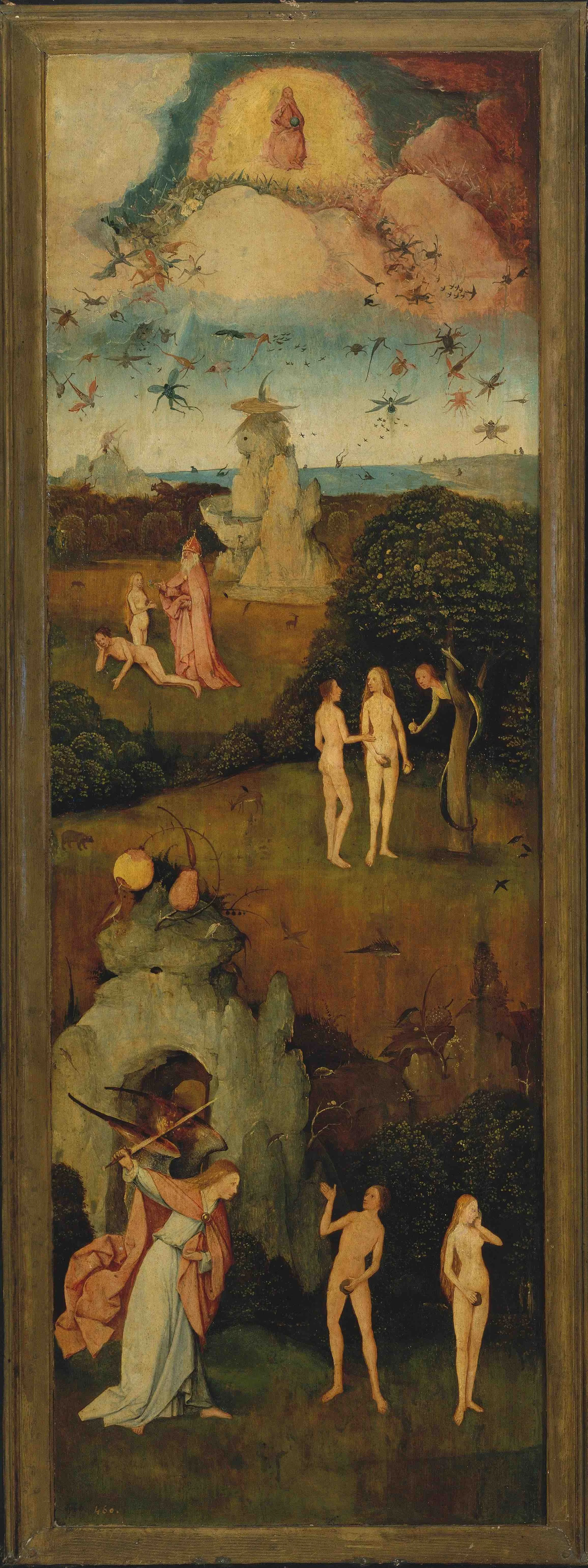
“…downmindlookingated” — Hieronymus Bosch, left panel of “Haywain Triptych” (1515)
As with everything in Finnegans Wake, there are many ways to interpret this thunderword. For example, Women and Literature are two themes that emerge here, especially in light of this paragraph’s recurring motif, she writes, or “schwrites”, i.e. She, for Women; and Writes, for Literature.
For women, we can tease out phonemes and words like “hin” for hen; “eve” for womankind’s Biblical forebear; “hers”; “magger” for Maggie; “kankan” for the energetic female dance.
For literature, we can tease out “ingcr” for ink; “crookly” for the Norwegian trykke, meaning print; “exi” for essay; “past” for post, i.e. mailing letters; “sthem” for Shem the Penman, ALP’s writer son, whom we’ll see more of as the Wake continues; “magger” for magazine; “inkink” for, well, ink and more ink; “loo” for lu, which is French for reading; “ated” for edit. (And I want to give a shoutout for these literary interpretations to The Role of Thunder in Finnegans Wake by son of Marshall McLuhan, Eric McLuhan, whose own son, incidentally, attended the reading you’re about to hear.)
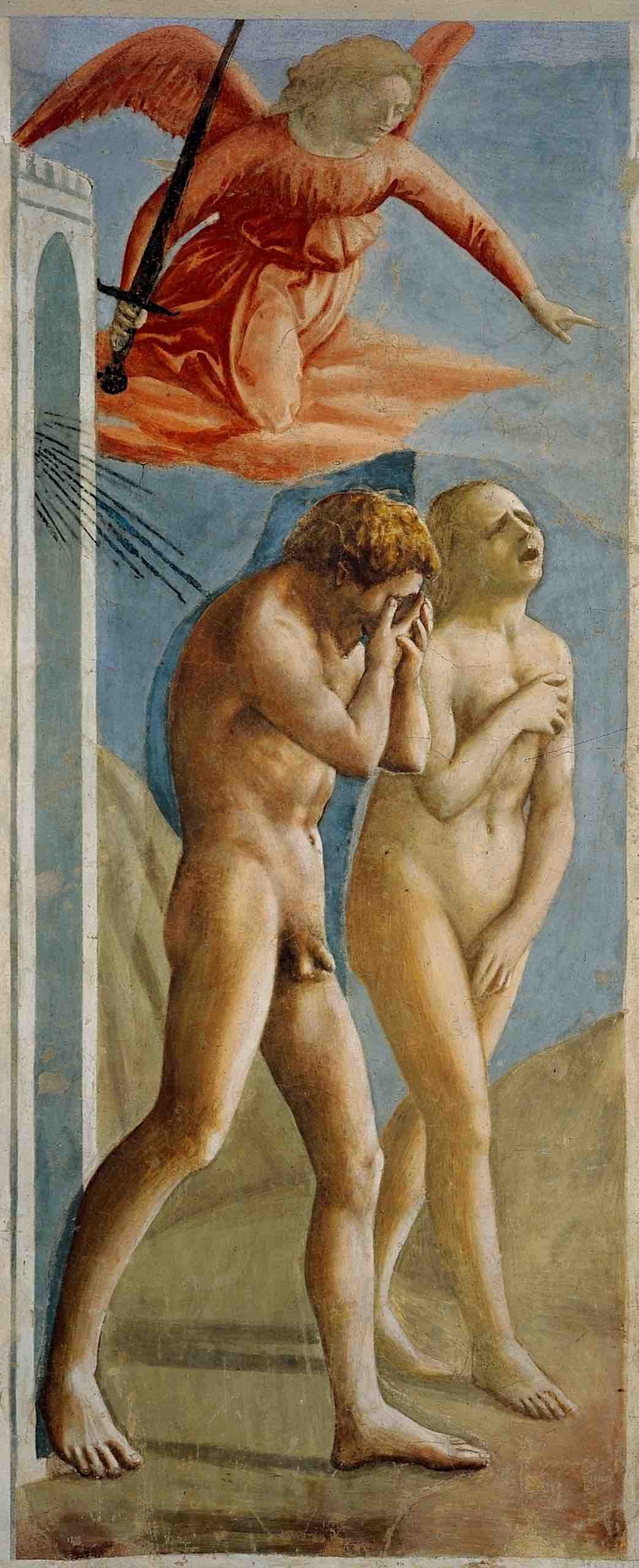
“…downmindlookingated” — Masaccio, from “The Expulsion from the Garden of Eden” fresco (1425)
In this female epistolary thunderword I also see elements of Eve and Adam, whom we met in the opening line of Finnegans Wake, and the sneaky serpent, to whom we owe humanity’s loss of paradise, our fall, our original sin of sex. Through this lens of ALP and HCE as our imperfect Biblical ancestors Eve and Adam, we can tease out “Thingcrooklyex” for the crooked, sexual snake; “eve” for Eve, naturally; “rypast” for Eve’s first repast, i.e. the forbidden fruit commonly depicted as an apple; “pasture” for the Garden of Eden; and “downmindlookingated” for Eve and Adam, having fallen, now locked out of Paradise, looking down — perhaps as painted by Renaissance artists Masaccio or Hieronymus Bosch (whose images I’ll include in the transcript). This suggestion of humanity’s sexual fall also helps account for the “dix” in this 100-letter word. So Chapter 5 of Finnegans Wake isn’t all hen, it’s also cock.
Now it’s time for Richard’s performance of James Joyce’s Finnegans Wake, page 109 line 1 to page 114 line 20 of Chapter 5. The performance was filmed and recorded at the Thomas Fisher Rare Book Library, University of Toronto on October 21st, 2024 with a live audience. And since today’s excerpt could easily be titled “The Letter,” the brief opening music you’ll hear, which I wrote for piano trio with Tyler Emond on bass and Jinu Isac on drums, loosely quotes Joe Cocker’s 1970 hit “The Letter”.
[Music: “Boston, Tea, Letter (Ch05),” instrumental with Tyler Emond on bass, Jinu Isac on drums, Adam Seelig on piano, from the Finnegans Wake film series.] [Richard Harte reads Finnegans Wake 109:1-114:20]
[109] Luckily there is another cant to the questy. Has any fellow, of
the dime a dozen type, it might with some profit some dull even-
ing quietly be hinted — has any usual sort of ornery josser, flat-
chested fortyish, faintly flatulent and given to ratiocination by
syncopation in the elucidation of complications, of his greatest
Fung Yang dynasdescendanced, only another the son of, in fact,
ever looked sufficiently longly at a quite everydaylooking stamped
addressed envelope? Admittedly it is an outer husk: its face, in
all its featureful perfection of imperfection, is its fortune: it ex-
hibits only the civil or military clothing of whatever passion-
pallid nudity or plaguepurple nakedness may happen to tuck it-
self under its flap. Yet to concentrate solely on the literal sense or
even the psychological content of any document to the sore
neglect of the enveloping facts themselves circumstantiating it is
just as hurtful to sound sense (and let it be added to the truest
taste) as were some fellow in the act of perhaps getting an intro
from another fellow turning out to be a friend in need of his, say,
to a lady of the latter's acquaintance, engaged in performing the
elaborative antecistral ceremony of upstheres, straightaway to run
off and vision her plump and plain in her natural altogether, pre-
ferring to close his blinkhard's eyes to the ethiquethical fact that
she was, after all, wearing for the space of the time being some
definite articles of evolutionary clothing, inharmonious creations,
a captious critic might describe them as, or not strictly necessary
or a trifle irritating here and there, but for all that suddenly full
of local colour and personal perfume and suggestive, too, of so
very much more and capable of being stretched, filled out, if need
or wish were, of having their surprisingly like coincidental parts
separated don't they now, for better survey by the deft hand of
an expert, don't you know? Who in his heart doubts either that
the facts of feminine clothiering are there all the time or that the
feminine fiction, stranger than the facts, is there also at the same
time, only a little to the rere? Or that one may be separated from
the other? Or that both may then be contemplated simultaneously?
Or that each may be taken up and considered in turn apart from
the other?
[110] Here let a few artifacts fend in their own favour. The river felt
she wanted salt. That was just where Brien came in. The country
asked for bearspaw for dindin! And boundin aboundin it got it
surly. We who live under heaven, we of the clovery kingdom,
we middlesins people have often watched the sky overreaching
the land. We suddenly have. Our isle is Sainge. The place. That
stern chuckler Mayhappy Mayhapnot, once said to repeation
in that lutran conservatory way of his that Isitachapel-Asitalukin
was the one place, ult aut nult, in this madh vaal of tares (whose
verdhure's yellowed therever Phaiton parks his car while its
tamelised tay is the drame of Drainophilias) where the possible
was the improbable and the improbable the inevitable. If the pro-
verbial bishop of our holy and undivided with this me ken or no
me ken Zot is the Quiztune havvermashed had his twoe nails
on the head we are in for a sequentiality of improbable possibles
though possibly nobody after having grubbed up a lock of cwold
cworn aboove his subject probably in Harrystotalies or the vivle
will go out of his way to applaud him on the onboiassed back of
his remark for utterly impossible as are all these events they are
probably as like those which may have taken place as any others
which never took person at all are ever likely to be. Ahahn!
About that original hen. Midwinter (fruur or kuur?) was in the
offing and Premver a promise of a pril when, as kischabrigies sang
life's old sahatsong, an iceclad shiverer, merest of bantlings ob-
served a cold fowl behaviourising strangely on that fatal midden
or chip factory or comicalbottomed copsjute (dump for short)
afterwards changed into the orangery when in the course of
deeper demolition unexpectedly one bushman's holiday its limon
threw up a few spontaneous fragments of orangepeel, the last
remains of an outdoor meal by some unknown sunseeker or place-
hider illico way back in his mistridden past. What child of a strand-
looper but keepy little Kevin in the despondful surrounding of
such sneezing cold would ever have trouved up on a strate that
was called strete a motive for future saintity by euchring the
finding of the Ardagh chalice by another heily innocent and
beachwalker whilst trying with pious clamour to wheedle Tip-
[111] peraw raw raw reeraw puteters out of Now Sealand in spignt
of the patchpurple of the massacre, a dual a duel to die to
day, goddam and biggod, sticks and stanks, of most of the
Jacobiters.
The bird in the case was Belinda of the Dorans, a more than
quinquegintarian (Terziis prize with Serni medal, Cheepalizzy's
Hane Exposition) and what she was scratching at the hour of
klokking twelve looked for all this zogzag world like a goodish-
sized sheet of letterpaper originating by transhipt from Boston
(Mass.) of the last of the first to Dear whom it proceded to
mention Maggy well & allathome's health well only the hate
turned the mild on the van Houtens and the general's elections
with a lovely face of some born gentleman with a beautiful present
of wedding cakes for dear thankyou Chriesty and with grand
funferall of poor Father Michael don't forget unto life's & Muggy
well how are you Maggy & hopes soon to hear well & must now
close it with fondest to the twoinns with four crosskisses for holy
paul holey comer holipoli whollyisland pee ess from (locust may
eat all but this sign shall they never) affectionate largelooking
tache of tch. The stain, and that a teastain (the overcautelousness
of the masterbilker here, as usual, signing the page away), marked
it off on the spout of the moment as a genuine relique of ancient
Irish pleasant pottery of that lydialike languishing class known as
a hurry-me-o'er-the-hazy.
Why then how?
Well, almost any photoist worth his chemicots will tip anyone
asking him the teaser that if a negative of a horse happens to melt
enough while drying, well, what you do get is, well, a positively
grotesquely distorted macromass of all sorts of horsehappy values
and masses of meltwhile horse. Tip. Well, this freely is what
must have occurred to our missive (there's a sod of a turb for
you! please wisp off the grass!) unfilthed from the boucher by
the sagacity of a lookmelittle likemelong hen. Heated residence
in the heart of the orangeflavoured mudmound had partly ob-
literated the negative to start with, causing some features pal-
pably nearer your pecker to be swollen up most grossly while
[112] the farther back we manage to wiggle the more we need the loan
of a lens to see as much as the hen saw. Tip.
You is feeling like you was lost in the bush, boy? You says:
It is a puling sample jungle of woods. You most shouts out:
Bethicket me for a stump of a beech if I have the poultriest no-
tions what the farest he all means. Gee up, girly! The quad gos-
pellers may own the targum but any of the Zingari shoolerim
may pick a peck of kindlings yet from the sack of auld hensyne.
Lead, kindly fowl! They always did: ask the ages. What bird
has done yesterday man may do next year, be it fly, be it moult,
be it hatch, be it agreement in the nest. For her socioscientific
sense is sound as a bell, sir, her volucrine automutativeness right
on normalcy: she knows, she just feels she was kind of born to
lay and love eggs (trust her to propagate the species and hoosh
her fluffballs safe through din and danger!); lastly but mostly, in
her genesic field it is all game and no gammon; she is ladylike in
everything she does and plays the gentleman's part every time.
Let us auspice it! Yes, before all this has time to end the golden
age must return with its vengeance. Man will become dirigible,
Ague will be rejuvenated, woman with her ridiculous white bur-
den will reach by one step sublime incubation, the manewanting
human lioness with her dishorned discipular manram will lie
down together publicly flank upon fleece. No, assuredly, they are
not justified, those gloompourers who grouse that letters have
never been quite their old selves again since that weird weekday
in bleak Janiveer (yet how palmy date in a waste's oasis!) when
to the shock of both, Biddy Doran looked at literature.
And. She may be a mere marcella, this midget madgetcy,
Misthress of Arths. But. It is not a hear or say of some anomo-
rous letter, signed Toga Girilis, (teasy dear). We have a cop of
her fist right against our nosibos. We note the paper with her
jotty young watermark: Notre Dame du Bon Marché. And she
has a heart of Arin! What lumililts as she fols with her falli-
mineers and her nadianods. As a strow will shaw she does the
wind blague, recting to show the rudess of a robur curling and
shewing the fansaties of a frizette. But how many of her readers
[113] realise that she is not out to dizzledazzle with a graith uncouthre-
ment of postmantuam glasseries from the lapins and the grigs.
Nuttings on her wilelife! Grabar gooden grandy for old almea-
nium adamologists like Dariaumaurius and Zovotrimaserov-
meravmerouvian; (dmzn!); she feel plain plate one flat fact thing
and if, lastways firdstwise, a man alones sine anyon anyons
utharas has no rates to done a kik at with anyon anakars about
tutus milking fores and the rereres on the outerrand asikin the
tutus to be forrarder. Thingcrooklyexineverypasturesixdix-
likencehimaroundhersthemaggerbykinkinkankanwithdownmind-
lookingated. Mesdaims, Marmouselles, Mescerfs! Silvapais! All
schwants (schwrites) ischt tell the cock's trootabout him. Ka-
pak kapuk. No minzies matter. He had to see life foully the
plak and the smut, (schwrites). There were three men in him
(schwrites). Dancings (schwrites) was his only ttoo feebles.
With apple harlottes. And a little mollvogels. Spissially (schwrites)
when they peaches. Honeys wore camelia paints. Yours very
truthful. Add dapple inn. Yet is it but an old story, the tale of
a Treestone with one Ysold, of a Mons held by tentpegs and his
pal whatholoosed on the run, what Cadman could but Badman
wouldn't, any Genoaman against any Venis, and why Kate takes
charge of the waxworks.
Let us now, weather, health, dangers, public orders and other
circumstances permitting, of perfectly convenient, if you police,
after you, policepolice, pardoning mein, ich beam so fresch, bey?
drop this jiggerypokery and talk straight turkey meet to mate, for
while the ear, be we mikealls or nicholists, may sometimes be in-
clined to believe others the eye, whether browned or nolensed,
find it devilish hard now and again even to believe itself. Habes
aures et num videbis? Habes oculos ac mannepalpabuat? Tip! Draw-
ing nearer to take our slant at it (since after all it has met with
misfortune while all underground), let us see all there may remain
to be seen.
I am a worker, a tombstone mason, anxious to pleace avery-
buries and jully glad when Christmas comes his once ayear. You
are a poorjoist, unctuous to polise nopebobbies and tunnibelly
[114] soully when 'tis thime took o'er home, gin. We cannot say aye
to aye. We cannot smile noes from noes. Still. One cannot help
noticing that rather more than half of the lines run north-south
in the Nemzes and Bukarahast directions while the others go
west-east in search from Maliziies with Bulgarad for, tiny tot
though it looks when schtschupnistling alongside other incuna-
bula, it has its cardinal points for all that. These ruled barriers
along which the traced words, run, march, halt, walk, stumble
at doubtful points, stumble up again in comparative safety seem
to have been drawn first of all in a pretty checker with lamp-
black and blackthorn. Such crossing is antechristian of course,
but the use of the homeborn shillelagh as an aid to calligraphy
shows a distinct advance from savagery to barbarism. It is
seriously believed by some that the intention may have been
geodetic, or, in the view of the cannier, domestic economical.
But by writing thithaways end to end and turning, turning and
end to end hithaways writing and with lines of litters slittering
up and louds of latters slettering down, the old semetomyplace
and jupetbackagain from tham Let Rise till Hum Lit. Sleep,
where in the waste is the wisdom?
[End of excerpt]
Adam Seelig: That was Richard Harte reading pages 109 to 114 from Chapter 5 of Finnegans Wake, recorded live at the Fisher Rare Book Library in Toronto on October 21st, 2024. Join us for Episode 26 in a fortnight for Richard Harte’s continuation of Chapter 5. In the meantime, to be sure you don’t miss the episode, why not follow or subscribe to this podcast?
[Music: “Closing Credits (Ch05),” instrumental with Tyler Emond on bass, Jinu Isac on drums, Adam Seelig on piano, from the Finnegans Wake film series.]
For more on One Little Goat’s Finnegans Wake project, including transcripts of this podcast and the complete films of Chapters 1, 2 and 3 visit our website at OneLittleGoat.org. And to hear about upcoming performances and screenings, join our mailing list, also on our website. One Little Goat Theatre Company is a nonprofit, artist-driven, registered charity in the United States and Canada that depends on donations from individuals to make our productions, including this one, possible. If you’re able, please make a tax-deductible donation through our website, www.OneLittleGoat.org
Finnegans Wake is made possible by Friends of One Little Goat Theatre Company and the Emigrant Support Programme of the government of Ireland. Thank you for your support! And thank you to the artists for this episode: Richard Harte; Sound by William Bembridge; Stage Management by Sandi Becker; Directed by yours truly, Adam Seelig; Music arranged and performed on the piano by me, with Tyler Emond on bass and Jinu Isac on drums, recorded at Ghost Town Studio in Toronto. A big thanks to John Shoesmith, Special Collections Librarian, to David Fernández, Head of Rare Books and Special Collections, and to their colleagues at the Fisher Rare Book Library at the University of Toronto, as well as to our wonderful live audience. Thank you to the team at the Irish Consulate in Toronto. And thank you to Production Consultants Cathy Murphy and Andrew Moodie. Thank you for listening! [Music fades out]
[End of Ep025]
Mentioned: Boston, Massachusetts, ALP, The Letter, suggestive envelope, Belinda the Hen, The Letter and treasure found in muck, Ardagh Chalice, Book of Kells, punctuationless letter, epistolary tropes, Picasso and Braque’s cubism, tea stain, blurry photography, Kate, “Lead, kindly fowl!”, championing womankind, Obama cheers on Harris, she writes, thunderword #5, Women and Literature, Eve and Adam and snake, synopsis.
Resources: Transcript for this episode, including the text of Finnegans Wake.
Finnegans Wake (1939) by James Joyce: there are many free copies of FW to read online or download, e.g. finwake.com
James Joyce Digital Archive, “Chicken Guide” to Finnegans Wake provides a ‘plain English’ paraphrase of each chapter by Danis Rose.
Richard Ellmann’s biography of James Joyce. Oxford University Press, 1982.
Edmund Epstein, A Guide through Finnegans Wake. University Press of Florida, 2009.
Adaline Glasheen, Third Census of Finnegans Wake: An Index of the Characters and Their Roles, University of California Press, 1977.
John Gordon’s annotations on his Finnegans Wake blog.
Roland McHugh, Annotations to Finnegans Wake (4th edition). Johns Hopkins University Press, 2016.
Raphael Slepon, fweet.org
William York Tindall, A Reader’s Guide to Finnegans Wake. Syracuse University Press, 1996.
Cited: “Obama, in blunt terms, tells Black men to get over their reluctance to support Harris,” NPR, 2024-10-10.
Eric McLuhan. The Role of Thunder in Finnegans Wake. . University of Toronto Press, 1997.